Best AI Mode SEO Tool for 2026: A Smart, Honest Guide to Getting Cited

Table of Contents
It’s been noticed that something weird has been going on in Google search lately. The rankings are all good. You continue to get visitors. Traffic doesn’t stop. However, when you ask Google’s AI Mode a question in your niche, you don’t come up with the answer.
That’s not a bug. It’s a completely different layer of visibility – and figuring out the best AI Mode SEO tool for your situation starts with understanding that layer, not just buying software for it. It’s a whole other level of visibility, and most of the AI SEO-generated content available is not accurate; that’s because a lot of it is created by tool companies selling tools. This guide is not going to do that.
That’s the simple promise I’m willing to make to you with everything that comes below: I want to help you expand your visibility, trust, and income with tools which really work — even if it implies recommending something cheaper or telling you that you may well not require a tool yet. Let’s discover the top AI Mode SEO option for the place where you are, not the place where the sales page would want you to be.
What Is AI Mode, Really? (No Hype, No Fluff)
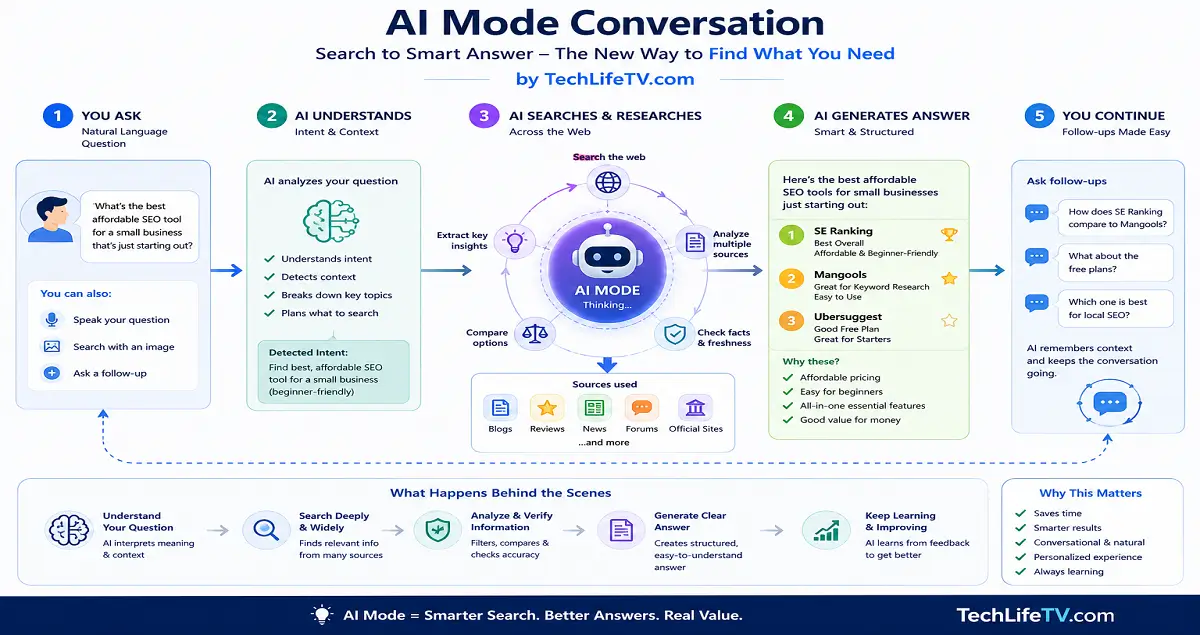
AI Mode is Google’s conversational search experience. Instead of ten blue links, you get a synthesized answer pulled from multiple sources, with follow-up questions built right in.
Here’s the part most tool marketing skips: Google’s own documentation says there’s no separate ranking system and no special file or markup required to show up there. The same fundamentals that earn you a spot in classic search are what AI Mode pulls from too. So no, “AI Mode SEO” isn’t some brand-new discipline you need to relearn from scratch. It’s the same game, with a different scoreboard.
That scoreboard is what makes tools worth talking about. You can’t see your own AI Mode visibility just by checking Search Console the way you’d check a keyword ranking. That’s the real gap tools fill — measurement, not magic.
How AI Mode Actually Changes the Game
If the fundamentals haven’t changed, what has? The mechanics behind how your content gets found and used. Four shifts matter most.
Ranking Becomes Retrieval + Citation
In classic search, you’re competing for a position. In AI Mode, you’re competing to be retrieved as a trustworthy source and then cited inside a generated answer. Position 3 doesn’t exist here — you either got pulled into the answer, or you didn’t.
One Query Becomes a Query Fan-Out
When someone asks AI Mode a question, it often breaks that single question into several smaller searches behind the scenes to build a fuller answer. This means your content isn’t just competing for one keyword anymore. It’s competing to be the best answer to a whole cluster of related sub-questions your reader didn’t even type.
Content Needs to Be “Answer-Ready”
AI Mode favors content structured so a machine can lift out a clean answer fast. That looks like this: state the question, give a direct answer immediately, explain the reasoning, back it up with evidence, add context, then point to related information. Burying your actual answer under three paragraphs of throat-clearing hurts you here more than it ever did in classic SEO.
Entities and Context Matter More Than Exact-Match Keywords
AI Mode understands your content in terms of entities — people, places, tools, concepts — and how they relate to each other, not just the exact words on the page. Writing naturally about the full topic, with the right names, tools, and concepts mentioned in context, does more for you here than keyword-stuffing ever could.
Notice what’s still true underneath all four of these: search intent, crawlability and indexability, helpful and accurate content, topical authority, clear information architecture, internal linking, entity and context understanding, E-E-A-T and trust signals, original first-hand information, strong on-page structure, relevant external references, and solid technical SEO. AI Mode didn’t replace these fundamentals. It just changed how they get rewarded.
Think about it this way. Search intent still decides whether your content matches what someone actually wants, but now it also decides which sub-questions in a query fan-out you have a shot at answering. Topical authority still matters, but now it’s what convinces the retrieval layer your site is a safe, trustworthy source to pull from across a whole cluster of related questions, not just one. Internal linking still helps Google understand your site, but it also helps establish the entity relationships AI Mode leans on to decide what your content is really about. None of this is new work. It’s the same fundamentals, pointed at a slightly different target.
Do You Even Need a Paid AI Mode SEO Tool?
Most roundups jump straight to recommending a $99 to $999 a month subscription. That’s not always honest advice, especially if you’re just getting started or running a lean affiliate site.
Here’s a simpler way to think about it, based on budget rather than hype:
| Tier | Cost | Good example | Right for | Core features | Available models |
| DIY / manual | Free | Google Search Console + a spreadsheet | Testing if this even matters for you | Manual query logging, basic AI Mode impression data | Google AI Mode only |
| Budget entry | Under $30/mo | Otterly.AI Lite, Rankscale | Solo creators, first paid step | Daily/weekly visibility tracking, basic prompt sets | AI Overviews, ChatGPT, Perplexity, Copilot (AI Mode as add-on) |
| Mid-tier | $90–$200/mo | SE Ranking AI add-on, Peec AI | Small teams needing gap analysis | Citation-gap analysis, sentiment tracking, competitor comparison | Google AI Mode, ChatGPT, Gemini, Perplexity, Claude (varies by tool) |
| Enterprise | $400+/mo | Ahrefs Brand Radar, Conductor | Bigger brands, dedicated AEO budget | Full-suite reporting, historical trends, dedicated support | All major AI engines plus custom integrations |
Search Generative AI performance reports inside Search Console will be shown in UK site Owners only
If you’re not sure this even matters for your niche yet, spend a week manually running your top 15 to 20 queries through AI Mode and logging what you find in a spreadsheet. It won’t scale, and it won’t catch daily shifts, but it will tell you honestly whether a subscription is worth it before you commit a single dollar.
How We Scored These Tools
Most “best AI SEO tools” lists rank whichever tool pays the highest affiliate commission at number one. That’s not how we’re doing this. Every tool below got scored against the same seven-part rubric, each weighted by how much it actually matters for someone choosing a tool, not by gut feeling.
| Criteria | Weight | What it measures |
| Data accuracy & refresh rate | 20% | How precise the data is, and how often it updates |
| Feature depth & model coverage | 18% | Citation-gap analysis, sentiment tracking, number of AI engines covered |
| Cost-effectiveness / ROI | 15% | Value delivered relative to the price tag |
| Ease of use | 12% | Setup time and learning curve for a non-technical user |
| Overall quality & reliability | 12% | Uptime, dashboard stability, day-to-day consistency |
| Brand trust & customer retention | 10% | Review volume, ratings, and how long customers stick around |
| Customer service | 8% | Support speed and available channels |
Each tool gets a 1-to-10 score per criterion. We multiply every score by its weight and add them up for a final number out of 100. Here’s how that plays out.
| Tool | Weighted score | Why it lands here |
| Ahrefs Brand Radar | 75/100 | Highest overall quality and data depth, but the steepest price tag pulls its cost-effectiveness score down |
| SE Ranking | 72/100 | Strong all-around balance of features, trust, and price for a mid-size budget |
| Peec AI | 71/100 | Excellent feature depth for citation-gap work, held back by pricing that climbs fast |
| Semrush AI Toolkit | 70/100 | High brand trust and accuracy, but you’re locked into an existing Semrush plan |
| Otterly.AI | 69/100 | Best cost-effectiveness score in the group, with real trade-offs in feature depth |
| Rankscale | 64/100 | Wins on price, loses points on brand trust and data maturity as a newer platform |
| Nightwatch | 62/100 | Convenient if you already track rankings there, but AI-specific depth trails dedicated tools |
A couple of things worth noticing in that table. Ahrefs Brand Radar tops the list on raw quality, but it’s not automatically the “best” pick for you — if you’re working with a small budget, its low cost-effectiveness score means a lower-ranked tool like Otterly.AI or Rankscale might genuinely serve you better. The score tells you how the tool performs; your budget tier from the section above tells you which score actually matters to your situation.
Want the Free Version First?
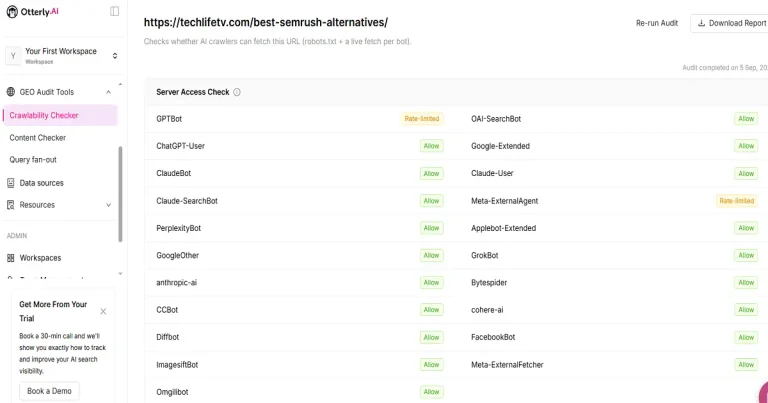
Every tool on this list does some version of what we’re about to show you. Before you spend money, try our free scanner. It checks the same basics — crawler access, structured data, content clarity — and shows you exactly what to fix first.
Best AI Mode SEO Tools in 2026 (By Budget)
These are the tools that actually fit different stages, not just the biggest names with the biggest marketing budgets.
Otterly.AI — Best Budget Entry Point
What it does: A monitoring tool that tracks your visibility daily across AI Overviews, ChatGPT, Perplexity, and Copilot, with AI Mode available as an add-on.
Best for: Solo marketers and small site owners who want the cheapest real subscription before going all-in.
Why you’d pick it: It’s the lowest-cost way to get daily data instead of guessing. Unlimited team seats even on the entry plan means you’re not paying extra just to loop in a partner or VA.
Pros
- Cheapest real daily-tracking option in the category
- Unlimited seats on every tier
- Simple, clean dashboard that doesn’t overwhelm beginners
Cons
- Full AI Mode coverage costs extra on top of the base plan
- Prompt limits are tight on the cheapest tier
Pricing: Lite plan starts around $29/month for 15 prompts; AI Mode add-on runs roughly $9 to $149/month depending on tier.
Rankscale — Best for Broad Coverage on a Budget
What it does: A lower-cost AI visibility tool covering a wide spread of AI engines without enterprise-level pricing.
Best for: Budget-conscious marketers who still want to see beyond just Google’s AI Mode.
Why you’d pick it: You get multi-engine visibility (not just AI Mode) at one of the lowest entry prices in the whole category, which matters if your audience also searches through ChatGPT or Perplexity.
Pros
- One of the lowest starting prices in the category
- Covers multiple AI engines, not just Google
- Unlimited seats on its plans
Cons
- Newer platform, so historical trend data is thinner
- Less brand-name recognition than bigger players
Pricing: Entry Essential plans start at $20/month ($17/month if billed yearly), Pro plan starts at $99($84/month if billed yearly), scaling with prompt volume.
Try Rankscale Pro Free For 7 Days
SE Ranking — Best Mid-Tier All-in-One
What it does: A full SEO suite with an AI Search add-on covering brand mentions, citations, and position trends inside AI Mode alongside classic rank tracking.
Best for: Teams who already want traditional SEO tools and don’t want a second subscription just for AI Mode data.
Why you’d pick it: One login covers both your classic SEO work and your AI Mode tracking, which saves you from juggling two dashboards and two bills every month.
Pros
- Combines classic SEO and AI Mode tracking in one place
- Solid free trial to test before committing
- Cached AI answers let you see exactly how you’re being cited
Cons
- AI refresh cadence lags behind AI-only specialist tools
- Content marketing features need a separate add-on
Promoting this tool to your audience? Our seranking affiliate program guide breaks down the commission structure.
Pricing: API plans start free, then wallet $ 50/month; Core plan starts at $129/month, with the AI Search add-on roughly $89/month on top; a 14-day free trial available.
Peec AI — Best for Understanding Why You’re Not Cited
What it does: A dedicated AI visibility platform that tracks position and sentiment across AI answers and prioritizes what to fix first.
Best for: Teams that already know they’re underperforming and need to know exactly why.
Why you’d pick it: It doesn’t just tell you that you’re missing from an answer. It shows you the citation gap and points you toward what’s actually driving your competitors’ mentions instead of yours.
Pros
- Sentiment analysis alongside standard visibility tracking
- Covers six engines and over 115 languages
- Clear prioritization of what to fix first
Cons
- Pricing rises fast once you add more engines
- Steeper onboarding than a simple tracker
Pricing: For brands, starter plans begin at $99/month or 80/mo(yearly), and for Agencies, Essentila plans start at $245/month or $205/mo(yearly). 14-day free trial. No Credit Card required
Nightwatch — Best If You Want SEO and AI Tracking on One Bill
What it does: A rank tracking platform that added AI visibility tracking, so you can monitor classic rankings and AI Mode presence side by side.
Best for: Teams that don’t want to stack a separate AI-visibility subscription on top of a rank tracker they already pay for.
Why you’d pick it: Seeing your classic ranking dip and your AI Mode visibility drop on the same dashboard makes it much easier to tell whether a change hurt one, both, or neither.
Pros
- One dashboard for both classic SEO and AI Mode data
- Useful for spotting correlation between the two
- Familiar rank-tracker interface, easy learning curve
Cons
- AI Mode-specific depth is lighter than dedicated AEO tools
- Combined plans cost more than a standalone tracker
Pricing: Starter plans begin at €99/month or €79/mo(yearly). 14-day free trial. No Credit Card required
Semrush AI Toolkit — Best If You’re Already Paying for Semrush
What it does: An AI Visibility Toolkit layered onto Semrush’s existing SEO platform, tracking brand mentions and citations across ChatGPT, AI Mode, AI Overviews, Gemini, and Perplexity.
Best for: Existing Semrush subscribers who’d rather extend a tool they already know than learn a new platform from scratch.
Why you’d pick it: You skip a second login and a second learning curve entirely, and the prompt database behind it is genuinely large, which matters for accuracy.
Pros
- No new tool to learn if you already use Semrush
- Large underlying prompt database improves data reliability
- Daily prompt tracking keeps data current
Cons
- Requires an existing Semrush subscription to access
- Interface has a real learning curve for brand-new users
Pricing: AI Visibility Toolkit at $99/month as an add-on; full Semrush One plans start near $165/month.
Ahrefs Brand Radar — Best for Enterprise Data Depth
What it does: An AI visibility tool from Ahrefs that tracks brand mentions and citations across major AI engines, backed by Ahrefs’ own crawl and backlink data for extra context.
Best for: Larger brands with a dedicated AEO budget who want enterprise-grade accuracy and don’t mind paying for it.
Why you’d pick it: It plugs into the same data infrastructure that makes Ahrefs’ link index so trusted, which means the accuracy here tends to hold up better than newer, smaller competitors.
Pros
- Highest data accuracy and reliability in this list
- Backed by Ahrefs’ established crawl infrastructure
- Strong historical trend reporting
Cons
- Priciest option here by a wide margin
- Overkill for solo marketers or small affiliate sites
Pricing: Enterprise pricing, typically $398/month depending on scope.
Common Mistakes People Make With AI Mode SEO (And How to Fix Them)
Most of the wasted time and money in this space comes down to a handful of repeatable mistakes. Here’s what to watch for.
Mistake: Chasing AI Mode visibility while ignoring the SEO fundamentals that actually earn it, like topical authority and clean site structure.
Fix: Treat AI Mode as a lens on your existing SEO, not a separate checklist. Fix crawlability, internal linking, and content depth first — visibility usually follows.
Mistake: Buying an expensive tracking tool before confirming AI Mode visibility even matters for your specific niche or keywords.
Fix: Spend a week manually checking your top queries in AI Mode first. If you rarely see any brand cited in your space, a $200/month tool isn’t the priority yet.
Mistake: Writing content the old way — long intros, answers buried three paragraphs in — and expecting AI Mode to find and cite it anyway.
Fix: Restructure your top content into the answer-ready pattern: direct answer first, then explanation, evidence, and context. This alone often improves citation odds more than any tool.
Mistake: Assuming a tool that tracks AI Overviews also covers AI Mode, when many don’t by default.
Fix: Check the tool’s feature list specifically for “AI Mode,” not just “AI Overviews” or “AI search.” They’re different surfaces, and coverage varies by tool and by plan tier.
Mistake: Treating every AI Mode SEO tool review online as neutral, when most are written by companies with an affiliate stake in the tool they rank first.
Fix: Cross-check any “best tool” claim against what the tool’s own pricing page and independent reviews (G2, Capterra) actually say, especially before a purchase.
Mistake: Picking the most expensive tool on a list assuming higher price means better data.
Fix: Match the tool to your actual budget tier first, then compare accuracy and refresh frequency within that tier. A $20/month tool that updates daily can beat a $400/month tool that updates weekly for most small sites.
Frequently Asked Questions
What’s the actual difference between AI Mode and AI Overviews?
AI Overviews shows up inline at the top of regular Google results, next to the usual blue links, for queries where Google decides a synthesized answer helps. AI Mode is a separate, fuller conversational experience you switch into on purpose, built for multi-step research with follow-up questions. A page can appear in one, both, or neither, so check specifically which one a tool tracks before you buy it.
Do I need special schema markup for AI Mode?
No. There’s no AI Mode-specific schema requirement in Google’s own documentation. Standard structured data — Article, FAQPage, Product schema where it applies — still helps, but there’s no separate file or new markup standard you’re missing.
Can I track AI Mode visibility for free?
Yes, at a small scale. Google Search Console now shows some AI Mode impression data at no cost, and manually running your priority queries through AI Mode gives you a rough, honest read. It gets impractical once you’re tracking more than a couple dozen queries or need historical trends, which is when a paid tool starts earning its keep.
Will optimizing for AI Mode hurt my classic Google rankings?
No. Since the same fundamentals power both, improving your content structure, topical depth, and E-E-A-T signals for AI Mode tends to help your classic rankings too. There’s no trade-off to manage here.
How long does it take to see results in AI Mode after making changes?
There’s no fixed timeline, and anyone promising an exact number is guessing. In practice, expect a few weeks at minimum, since AI Mode still depends on Google’s crawling and indexing schedule for your updated content.
Is AI Mode SEO worth prioritizing for a small affiliate site right now?
It depends on your niche. If your target queries are the kind people ask conversationally, research-style questions rather than quick navigational searches, it’s worth the free manual check described earlier. If not, your time is probably better spent on core SEO fundamentals first.
Should I use more than one AI Mode SEO tool at once?
Usually not right away. Running two overlapping trackers just doubles your cost without doubling your insight. It makes more sense to start with one tool that fits your budget tier, use it for a month or two, and only add a second, more specialized tool once you have a specific gap the first one can’t explain.
Not Sure Which Tool Is Right for You?
Start with your free score. It’ll show you which category needs the most work, so you can pick a tool that actually solves your problem instead of guessing.
Get My Free Score through Mobile →
The Bottom Line
There is no best AI Mode SEO tool; it’s the one that suits you best and offers the most value to the user. The one that is appropriate to you where you are this month, whether it’s a free spreadsheet or an intermediate tracker where you know there’s a real space that’s worth occupying once you have it confirmed.
Use basic vocabulary. Don’t add a tool until you are sure what the problem is that it is solving for you. The intelligent route to visibility without hyping time and money.