
Google AI Mode SEO: What Changes and What to Do

Table of Contents
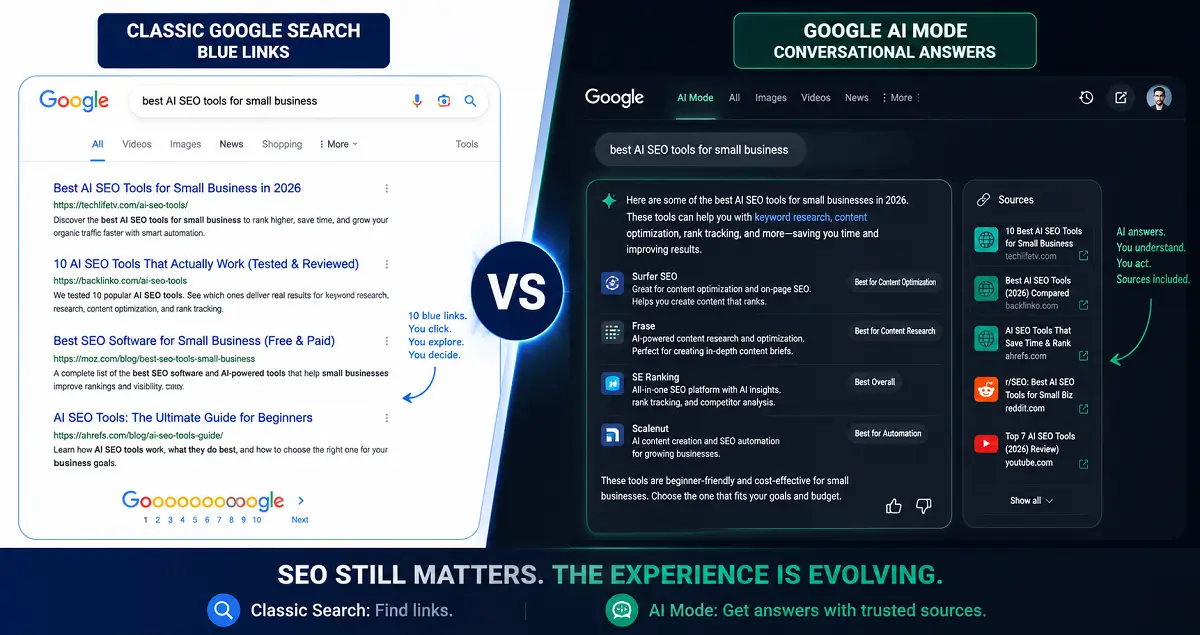
Google AI Mode SEO means improving your website so Google can find, understand, and potentially link to your content in AI Mode responses. The foundation is still SEO: accessible pages, useful information, clear navigation, and content people can trust. Google does not require special AI schema, an AI text file, or a separate writing format.
What changes is how people search—and where your content may appear.
Instead of visiting several pages to compare answers, someone can ask a detailed question, ask follow-ups, and explore supporting links inside the conversation. That creates another way to earn visibility, but it does not guarantee a visit to your website.
The practical response is not to rebuild your site for an algorithm you cannot see. Make your pages eligible, give readers something worth visiting, and measure visibility separately from business results.
What Is Google AI Mode?
Google AI Mode is a conversational search experience designed for questions that need exploration, reasoning, or complex comparisons. It can combine information from several sources and provide links to supporting websites. developer.google
For a publisher or business owner, the important question is simple:
Does your page offer information that helps someone understand the topic or make a decision?
A generic summary may answer the basics. An original test, useful comparison, detailed example, or clear explanation can give readers a reason to go further. Google’s current guidance emphasizes this kind of distinctive, useful content.
AI Mode vs. AI Overviews
The two features are related, but they are not interchangeable.
| Feature | AI Overviews | AI Mode |
| Main role | Summarizes a topic within the search experience | Supports deeper exploration and complex questions |
| User journey | Gives an initial answer and supporting links | Supports a more conversational research process |
| Website opportunity | Appear as a supporting source | Appear as a supporting source across related questions |
| SEO foundation | Standard SEO best practices | Standard SEO best practices |
Both may use query fan-out, but Google says they can use different models and techniques. Their responses and supporting links can therefore differ.
Does SEO Still Work in Google AI Mode?
Yes. Google says its generative AI search features are rooted in its core Search ranking and quality systems. They use information retrieved from the Search index to help produce grounded responses. Developers.google
That does not mean a traditional ranking guarantees an AI citation.
It means the basics still matter. If Google cannot access or index your page, a clever FAQ or a new AI tool will not solve the underlying problem.
To qualify for inclusion, your page must be indexed and eligible to appear in Search with a snippet. Google’s newer guidance also says the site must be included in Search generative AI features through Search Console. Meeting these conditions does not guarantee inclusion.
How Does Google AI Mode Find Information?
Before you adapt your SEO strategy, it helps to understand the process. Here’s a simplified way to picture it:
Your question → Related searches (query fan-out) → Relevant information → AI-generated answer with supporting links
This is a simplified overview, not a fixed sequence for every search.
Google describes two relevant techniques: retrieval-augmented generation and query fan-out.
Retrieval-augmented generation means the system uses retrieved information to help ground its response. In plain English, it can draw on relevant web pages rather than rely only on what a model learned during training.
Query fan-out means the system can issue several related searches to address different parts of a question.
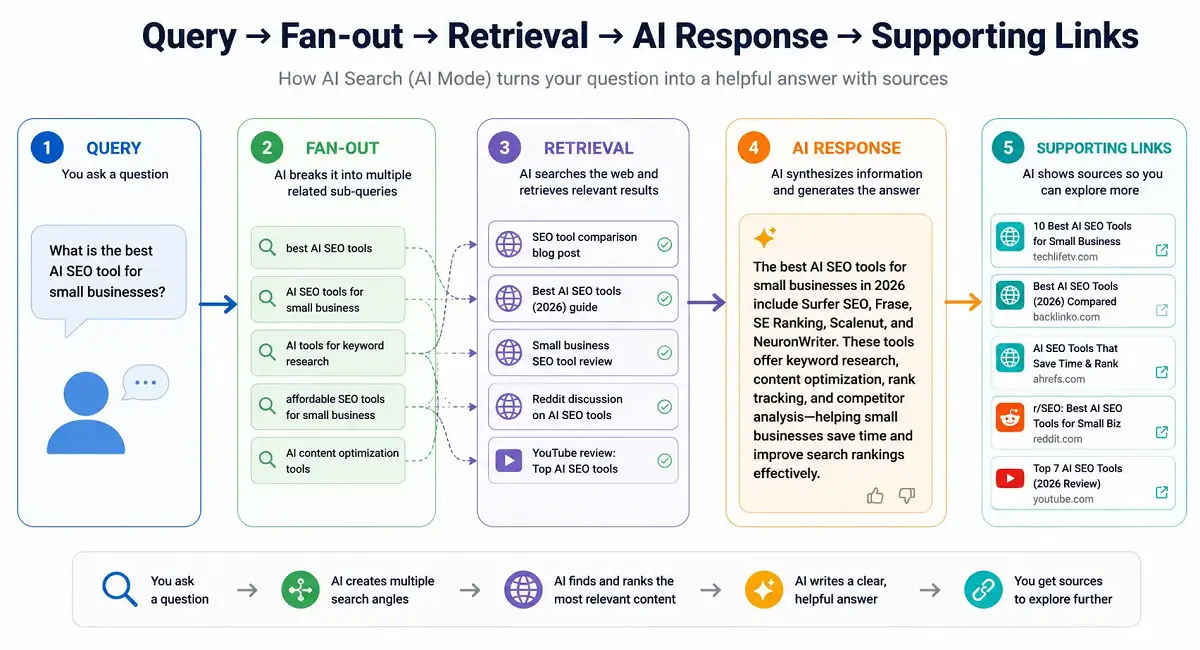
Consider this illustrative question:
“Which AI visibility tool makes sense for a small affiliate website?”
A useful answer might need information about:
- Supported search platforms.
- Pricing and usage limits.
- Whether the tool tracks linked citations, brand mentions, or both.
- Country and language coverage.
- Reporting and export options.
These are examples of possible research needs, not a record of Google’s actual hidden queries.
How Does AI Mode Change SEO?
The content lesson is straightforward: cover the questions your reader needs answered. Do not create a separate page for every possible wording variation. Google warns against creating scaled content primarily to manipulate rankings or generative AI responses.
AI Mode adds another place where your content can be discovered. It also makes it important to separate three outcomes:
- Your brand is mentioned.
- Your page is linked as a source.
- Someone visits and takes a useful action.
Those outcomes are not the same. A mention without a link is different from a citation. A citation is different from a qualified visit.
Google says AI features can surface a wider range of supporting pages through related searches. That creates opportunities beyond the original wording of a query, but it does not promise visibility for any particular website.
Will AI Mode Reduce Website Traffic?
It can answer questions without a reader visiting every source. But there is no single traffic-loss percentage you should apply to your website.
Be careful with studies about AI Overviews. Those findings should not automatically become predictions about AI Mode, a different search experience.
Instead, watch your own pages. Are impressions changing? Are visits becoming more or less valuable? Are readers signing up, clicking relevant product links, or buying?
Google recommends looking beyond clicks alone and considering engagement and conversions. Its published observation about higher-quality clicks specifically refers to search result pages with AI Overviews—not a universal promise about all AI Mode traffic.
Google AI Mode and SEO Strategy: A Practical Plan
Your Google AI Mode and SEO strategy should start with the basics: make your pages accessible, answer the reader’s main question, and offer something useful beyond a generic summary. The steps below explain what to check, what to improve, and how to measure progress
1. Check Whether Your Page Is Eligible
Start with the page itself.
- Inspect the URL in Search Console.
- Confirm that the intended page is indexed.
- Check which URL Google treats as canonical.
- Review crawl restrictions and accidental
noindexdirectives. - Check whether snippet controls limit the content available for display.
- Confirm that important information is visible to Google.
- Review your site’s inclusion setting for Search generative AI features.
Google’s technical guidance makes indexing, snippet eligibility, crawl access, and the relevant Search Console inclusion setting the starting point.
2. Match the Reader’s Actual Task
A person searching “Google AI Mode SEO” probably needs an explanation and a practical plan.
A person searching “best AI Mode SEO tools” needs a comparison.
You can address both briefly, but one page should have a clear main purpose. For an informational guide, explain the process first. Link to a separate tool comparison when readers need product-level detail.
A useful editorial check is:
“After reading this page, can someone do what they came here to do?”
3. Add Something the Reader Cannot Get From Every Other Guide
Before adding another paragraph, ask what it contributes.
Useful additions might include:
- A real audit with screenshots.
- A documented comparison of several tools.
- A repeatable reporting template.
- A first-hand example of fixing an indexing problem.
- A test that explains its method and limitations.
Google’s guidance favors content with a distinctive point of view or first-hand value over summaries that simply repeat information already available elsewhere.
If you have not run a test, do not describe an example as your own result.
4. Make the Article Easy to Read
Use headings that describe the question being answered. Put the main point early. Use a table when it makes comparison easier and a numbered list when order matters.
Do this for readers—not because there is a special AI-friendly paragraph length.
Google says there is no required “chunking” format, ideal page length, or special writing style for generative AI search.
5. Connect Related Pages With Useful Internal Links
A guide should help readers find the next relevant resource.
For example, this article could link to a detailed guide about:
- Choosing an AI visibility tool.
- Checking indexing and crawl access.
- Building an SEO reporting workflow.
- Comparing AI search measurement methods.
Use descriptive anchor text and link where the next page genuinely helps. Google includes internal discovery among its established SEO best practices.
6. Use Structured Data Where It Fits
Keep supported structured data accurate and consistent with the visible page.
Do not add markup because someone calls it “AI schema.” Google does not require special schema for AI visibility, and its newer guidance warns against overfocusing on structured data as an AI tactic.
The same applies to llms.txt: Google says Search ignores it. Maintaining one for another service does not improve your Google Search rankings or AI visibility.
How to Measure SEO Performance in Google AI Mode
Use different reports for different questions.
Check Generative AI Impressions in Search Console
Google’s Generative AI performance report includes impressions from AI Overviews and AI Mode. Google says these insights became available to websites worldwide on August 31, 2026.
The report provides breakdowns by:
- Page.
- Country.
- Device.
- Date.
It measures impressions, not a complete AI-only conversion journey. It does not provide a separate AI Mode versus AI Overviews breakdown in the documented dimensions.
If you do not see the report, Google says insufficient impressions or exclusion from Search generative AI features may explain it.
Use the Regular Performance Report for Broader Search Trends
The regular Search Console Performance report remains useful for query, page, click, and ranking trends. AI-feature traffic is included within the broader Web reporting, so do not label every change as an AI Mode result.
Track What Happens After the Visit
Use your analytics setup to monitor meaningful outcomes:
- Newsletter sign-ups.
- Relevant affiliate-link clicks.
- Contact requests.
- Purchases.
- Engagement with important resources.
Choose the actions that match your business. Google recommends combining Search Console insights with engagement and conversion measurement.
Keep a Small Manual Citation Log
For your own research, choose a consistent set of relevant questions and record:
| Field | What to record |
| Question | Exact wording used |
| Date | When you checked |
| Context | Country, device, and other relevant conditions |
| Brand mention | Whether your brand appeared |
| Linked citation | Whether your page received a link |
| Cited URL | Which page appeared |
| Follow-up | Whether the result came after another question |
Treat this as a snapshot, not a universal ranking report or proof of what all users see.
If you need more than a manual log, our guide to AI Mode SEO trackers vs. analysis tools explains the difference between monitoring visibility and evaluating what to improve.
Do You Need an AI Mode SEO Tool?
You do not need a paid tool to get started. A tool can help you schedule checks, compare competitors, and organize reports, but it cannot guarantee that Google will cite your website.
Before choosing an AI Mode SEO tool, decide what you need to measure: linked citations, brand mentions, or changes in visibility over time.
When comparing AI visibility tools, ask:
- Does it specifically support Google AI Mode, rather than only AI Overviews?
- Does it distinguish linked citations from brand mentions?
- Can you inspect the original response and its supporting links?
- Which countries and languages does it support?
- How often does it collect new data?
- Can you export the results?
For a small website, start with Search Console, analytics, and a focused manual log. Consider paid software when repeated checks take too much time or you need more detailed competitor reporting.
For a closer comparison, see our guide to AI Mode SEO tools and choose an option that fits your budget and reporting needs.
If you also want to monitor your brand across other AI platforms, explore our guide to AI search visibility management tools for broader tracking options and workflows.
Common Google AI Mode SEO Mistakes
Treating Visibility as Guaranteed Traffic
An impression shows that a link was displayed under the report’s counting rules. It does not show that the reader visited or converted.
Publishing Every Keyword Variation as a Separate Page
One useful guide is better than a collection of overlapping pages created to target imagined AI queries. Google warns against scaled content intended primarily to manipulate search or generative AI responses.
Adding Length Without Adding Value
There is no ideal word count for generative AI search. Add detail when it helps the reader complete a task or understand a decision.
Buying Guaranteed AI Rankings
No outside provider can guarantee Google citations. Be especially cautious when a service claims privileged access to Google’s internal AI metrics.
Common AI Mode SEO Mistakes
A few practical habits waste more time than anything above. Keep this list short and check it before you publish.
- Creating a separate page for every imagined fan-out variation of a query, instead of one strong page that covers the topic fully — Google’s May 2026 spam policy update explicitly extends existing rules against scaled, low-value content to cover attempts to manipulate generative AI responses
- Publishing generic AI-written content with no original data, testing, or first-hand experience behind it
- Measuring only classic rankings while ignoring AI visibility entirely
- Focusing on clicks alone instead of what those visits actually convert into
Frequently Asked Questions
How Will SEO Look in Google AI Mode?
The foundation remains familiar: accessible pages, useful information, clear navigation, and reliable content. Measurement also needs to account for visibility in generated answers, while keeping impressions separate from visits and conversions.
Is SEO Dead After Google AI Mode?
No. Google says its generative AI search features rely on core Search ranking and quality systems. SEO remains relevant, although the way people discover and use information is changing.
Can My Page Appear Without Ranking First?
Google’s guidance does not list a number-one ranking as an eligibility requirement. A page must meet the relevant indexing, snippet, and inclusion conditions, but qualification does not guarantee selection.
Are SEO, AEO, and GEO Separate Requirements?
AEO and GEO describe work focused on visibility in answer-based and generative search experiences. Google says that, from its perspective, optimizing for those experiences is still SEO—not a separate technical requirement.
Can I Track Google AI Mode Separately in Search Console?
The Generative AI performance report includes AI Mode and AI Overviews impressions, but its documented dimensions do not separate those two features. Use it alongside broader Search Console reporting, analytics, and clearly labeled manual observations.
Where to Start
Inspect the page, confirm eligibility, and identify the reader’s main question. Then improve the information—not just the wording.
Add something useful that competing pages do not provide. Connect the guide to relevant resources, establish a measurement baseline, and judge progress through both visibility and meaningful actions.
That is a practical Google AI Mode SEO strategy: sound SEO, original value, and reporting that says exactly what it can—and cannot—tell you.
Ready for the next step? Our guide to the best AI Mode SEO tool breaks down budget-friendly options for measuring your visibility, and our AI Mode SEO tracker vs analysis tool comparison helps you pick the right one for where you’re at right now.
