Best Semrush Alternatives 2026: Free & Paid, Ranked

Table of Contents
A few years back, one of our readers wrote in with a simple problem. She ran a small home-goods blog, loved the research side of SEO, and hated her monthly bill. Semrush was doing its job, but the price kept nagging at her every time she opened her bank statement. She wasn’t alone. That question, “is there something that does what I need without costing this much,” is one of the most common ones we hear.
So we set out to answer it properly. Semrush is a genuinely strong platform, and we’re not here to talk you out of it if it’s working for you. But it’s not the right fit for every budget, team size, or SEO workflow. This guide walks through the best Semrush alternative options for 2026, including free tools, budget-friendly picks, and platforms built for agencies or AI search visibility tracking.
One more thing before we start. Many articles ranking the best Semrush alternatives are written by companies trying to sell you their own product. That’s worth knowing before you trust a “winner” badge on someone else’s comparison chart. This one follows our Research Before Recommendation™ promise. We didn’t ask which tool pays the highest commission. We asked which ones would genuinely help a real person get real results.
How We Evaluated These Tools
Before ranking anything, we checked each platform against the same list of questions:
- Data accuracy — does the keyword and traffic data line up with what you’d see in Google Search Console?
- Ease of use — could a beginner figure it out without a training course?
- Pricing transparency — are there hidden add-ons or confusing upgrade traps?
- Genuine value for money — do you get real results for what you’re paying?
- Customer support — will someone actually help you when you’re stuck?
- Ongoing development — is the platform still improving, or has it gone quiet?
- Real user reputation — what are actual users saying, not just the marketing page?
- Security and privacy, where it applies
No tool earned a spot here because of affiliate payouts. Every one of them earned it through genuine value.
Quick Answer: Best Semrush Alternatives at a Glance
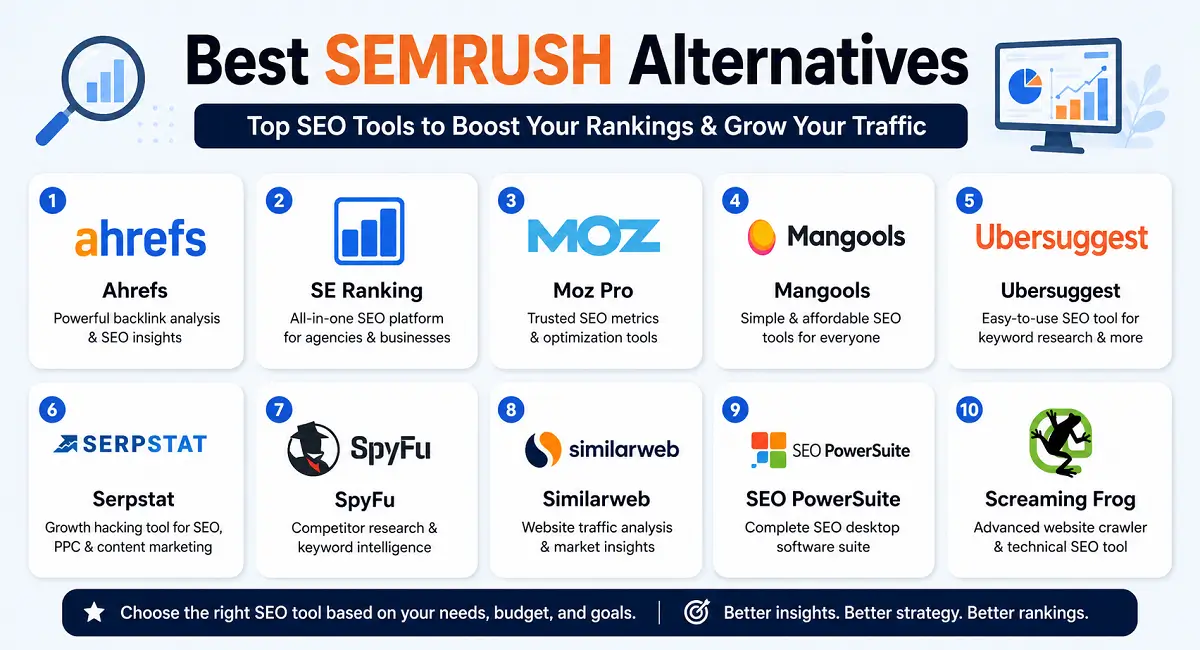
If you’re short on time, here’s the quick version. Each of these is one of the strongest alternatives to Semrush, and we’ve matched them to the situation they fit best.
| Ahrefs | Backlinks and content research | ~$129/month | No |
| SE Ranking | Balanced all-in-one, AI search tracking | ~$129/month | 14-day trial |
| Moz Pro | Beginners and client reporting | ~$99/month | 7-day trial |
| Mangools | Freelancers and solo bloggers | ~$30.50/month | Yes, limited |
| Ubersuggest | Tightest budget | ~$12/month | 5 months free ($6.67/mo, annual plan) |
| Serpstat | International, multi-market SEO | ~$69/month | 7-day trial |
| SpyFu | Competitor PPC research | ~$39/month | No |
| Similarweb | Traffic and market intelligence | ~$125/month | 7-day trial |
| SEO PowerSuite | Desktop tool, forever-free tier | Free, or ~$29.1/month | Yes, forever-free |
| Screaming Frog | Technical SEO audits | Free, or £199 /year | Yes, limited free |
*Pricing on every SEO tool changes often. Please confirm current rates on each company’s official site before subscribing. Save up to 44% with an annual plan, depending on the tool.
Our Top Semrush Alternative Pick
If you only remember one thing from this article, remember this: our top Semrush alternative pick overall is SE Ranking. It strikes the best balance of price, features, and long-term value, and it’s one of the few tools that builds AI search tracking into every plan instead of charging extra for it. If your budget is tighter, Mangools is our top pick for solo bloggers and small businesses instead.
Who Are Semrush’s Main Competitors?
So who exactly are Semrush’s competitors in 2026? Honestly, the list looks almost identical to the best Semrush alternatives we just covered, and that’s no coincidence. Searching “Semrush competitors” and “alternative to Semrush” usually means the same thing: which tools do the job without the same price tag or learning curve. Ahrefs and SE Ranking lead the pack, both covering the same core ground, keyword research, backlink tracking, rank monitoring, and both pushing hard into AI search visibility now too. Moz Pro stays in the mix thanks to Domain Authority, a metric almost every client already recognizes. Then there’s a second tier that competes in narrower lanes: Serpstat for international keyword data, SpyFu for competitor PPC intelligence, Similarweb for traffic and market research. Screaming Frog and SEO PowerSuite round things out on the budget, technical-audit side. None of these tools like Semrush copy it feature-for-feature, and that’s actually the smart part. Semrush went broad; its competitors went specialized. The real question isn’t which tool is “best overall,” it’s which one solves your specific problem. Curious which one that is for you? Keep scrolling, we break down exactly where each competitor pulls ahead, and where it falls short.
The Best Semrush Alternatives, Reviewed
Ahrefs — Best for Backlink and Content Research
If your strategy relies on backlink analysis and understanding what’s already ranking, Ahrefs is genuinely hard to beat. It has one of the largest, most frequently updated backlink databases around, and its Content Explorer tool makes competitor research fast, showing you what’s working in any niche before you write a single word.
Pros:
- Massive, fast-updating backlink index that catches links other tools miss
- Content Explorer speeds up competitor and content-gap research
- Clean, intuitive interface despite the sheer amount of data
Cons:
- No free trial, and pricing climbs quickly past the entry tier
- Steeper learning curve for people newer to SEO
Best for: Agencies and content marketers who need deep backlink data and don’t mind investing time to learn the platform.
SE Ranking: Best Balanced All-in-One
SE Ranking covers the core SEO basics well, including rank tracking, keyword research, site audits, and backlink checking. What sets it apart lately is its AI Search Toolkit, which tracks how your brand appears in AI-generated answers from ChatGPT, Gemini, and Google’s AI Overviews, alongside your normal search rankings.
Pros:
- AI search visibility tracking is built into every plan, not sold as an add-on
- White-label reporting and API access included from the entry-level tier
- 14-day free trial with no credit card required
Cons:
- Backlink database is smaller than Ahrefs or Moz
- Can feel like more platform than a total beginner needs at first
Best for: Small to mid-sized agencies and teams who want traditional SEO and AI search tracking in one dashboard.
Looking for a Better Semrush Alternative?
Try SE Ranking — All-in-One SEO at a Lower Cost
Start Your Free Trial →
14-day free trial • No credit card required
Curious about the seranking affiliate program if you want to promote it yourself? We break down the 30% recurring commission and payout terms in our full guide.
Moz Pro: Best for Beginners and Client Reporting
Moz Pro has been around since 2004, and it’s stayed relevant by keeping things simple. Its Domain Authority score is something almost everyone in SEO recognizes, and its white-label reports look professional straight out of the box, which matters a lot when you’re presenting to non-technical clients.
Pros:
- Domain Authority is a widely trusted, easy-to-explain metric for clients
- Genuinely beginner-friendly dashboard and reporting
- Strong local SEO features, including zip-code-level rank tracking
Cons:
- Backlink data refreshes more slowly than premium competitors
- Site crawl limits are tight on lower-tier plans
Best for: Agencies that need clean, client-friendly reports, and beginners who want a gentle learning curve.
Mangools: Best for Freelancers and Solo Bloggers
Mangools bundles five simple tools into one: keyword research, SERP analysis, rank tracking, backlink checking, and a site overview tool. It’s genuinely easy to use, even if you’ve never touched an SEO platform before, and its interface still gets described by users as one of the friendliest in the industry.
Pros:
- Clean, uncluttered interface that’s easy to learn in under 30 minutes
- Affordable pricing with all core tools included, no confusing add-ons
- Limited free plan lets you test it with no credit card
Cons:
- Smaller backlink database than premium tools
- No built-in technical site audit crawler
Best for: Solo bloggers, freelancers, and small business owners who want the essentials done well without extra complexity.
Ubersuggest: Best for the Tightest Budget
Created by Neil Patel, Ubersuggest is built for beginners and small website owners who need real SEO data without a big monthly bill. It covers keyword research, basic site audits, and rank tracking, plus AI writing tools that help speed up content planning.
Pros:
One of the most affordable full-featured SEO tools on the market
Simple, beginner-friendly dashboard with almost no learning curve
Built-in content idea generator based on your niche
Cons:
Keyword and traffic data can be less accurate at scale than premium tools
No free trial before you commit
Best for: New bloggers and very small businesses just getting started with SEO.
Serpstat: Best for International SEO
Serpstat stands out with one of the most comprehensive keyword databases for markets outside the US, especially Eastern Europe and parts of Asia. It also includes a full suite of standard tools, covering rank tracking, site audits, backlink analysis, and PPC research.
Pros:
- Strong international keyword coverage where Western-focused tools fall short
- Keyword clustering feature simplifies content planning
- API access included even on lower-tier plans
Cons:
- Interface feels dated compared to newer platforms
- US-specific keyword data isn’t as strong as Ahrefs or Semrush
Best for: Agencies and businesses managing SEO across multiple countries and languages.
SpyFu: Best for Competitor PPC Research
SpyFu’s specialty is showing you exactly what your competitors are doing in Google Ads, with historical data going back more than a decade. If paid search competitive intelligence matters to your strategy, few tools match its ad history depth.
Pros:
- Unmatched depth of competitor ad history and keyword bidding data
- Kombat feature makes side-by-side competitor comparisons genuinely useful
- Affordable entry price compared to full SEO suites
Cons:
- Organic SEO features are secondary to its PPC focus
- Backlink database is smaller than dedicated SEO platforms
Best for: PPC managers and agencies that need to reverse-engineer competitor ad strategies.
Similarweb: Best for Traffic and Market Intelligence
Similarweb answers a different kind of question than most SEO tools. Instead of tracking your rankings, it estimates traffic, audience demographics, and market share for any website, which makes it useful for bigger strategic decisions like entering a new market.
Pros:
- Reliable traffic estimates, especially for mid-to-large sites
- Rich audience demographic and market-share data
- Useful for high-level competitive benchmarking beyond SEO
Cons:
- Traffic estimates get shaky for smaller, lower-traffic sites
- Not built for hands-on, day-to-day SEO tasks like on-page optimization
Best for: Larger businesses and teams doing competitive market research, not daily SEO execution.
Screaming Frog: Best for Technical SEO Audits
Screaming Frog is a desktop tool, not a cloud dashboard, and it does one thing extremely well: crawling your website the way Google does, then showing you every technical issue it finds.
Pros:
- Deep, accurate technical audits that catch issues web-based tools miss
- Genuinely useful free version for smaller sites
- Handles large sites quickly without crashing
Cons:
- No guided recommendations, so you need some technical SEO knowledge
- Desktop-only, which limits access for distributed teams
Best for: Developers and technical SEOs who need deep site audits, paired with a separate tool for keyword research and rankings.
Best FREE Alternatives to Semrush
If your budget is zero right now, you still have real options. The most useful completely free choices are SEO PowerSuite (a forever-free desktop tier), Screaming Frog (a free crawler limited to 500 URLs), and Mangools (a limited free plan).
Here’s the honest catch with each one. SEO PowerSuite’s free tier covers up to 500 URLs to crawl and around 1,100 backlinks to track, but you lose scheduled reports and data exporting until you upgrade. Screaming Frog’s free version is genuinely powerful for small sites, but it caps out at 500 URLs per crawl, which won’t cut it for a larger website. Mangools’ free plan lets you try the interface and get a feel for its keyword research tools, but the daily lookup limits are tight.
A free tool is a great starting point if you’re just learning SEO or managing a very small site. But if you’re actively growing organic traffic and need to track dozens of keywords consistently, you’ll likely outgrow the free tier within a few months. That’s not a flaw in the tools. It’s just how free plans are built, and it’s worth planning for from the start.
Cheaper Alternatives to Semrush (If Budget Is Your Main Concern)
Free and cheap aren’t the same thing, so let’s separate them. If you don’t need a free plan but just want real value for less money, look at Mangools ($30.5/month), Ubersuggest ($12/month), or Serpstat ($69/month). Compare that to Semrush’s higher-tier plans, which can run well over $100 a month, and the savings add up fast without giving up the core tools you actually use day to day.
Best Semrush Alternative for Agencies
If you’re running an agency, the short answer is this: SE Ranking and Ahrefs are the strongest picks, depending on what matters more to your team.
SE Ranking includes white-label reporting, a lead generation tool, and an Agency Pack with client management features built in, all from a lower starting price than most competitors. Ahrefs doesn’t offer as many agency-specific extras, but its backlink data and Content Explorer make it easier to prove ROI to clients who care about link building and content strategy. Moz Pro is also worth a look here, since its branded, scheduled reports are some of the cleanest in the industry, which matters when you’re presenting directly to non-technical clients.
The right pick usually comes down to how many clients you manage and what those clients actually care about seeing in their monthly reports.
If you’re an affiliate marketer covering agency tools, the Seranking affiliate program is worth adding to your content lineup.
Best Semrush Alternative for AI Search Visibility (GEO & AEO)
Search isn’t only happening on Google anymore. People are asking ChatGPT, Gemini, and Perplexity questions that used to go straight into a search bar, and businesses want to know if they’re showing up in those answers. This is often called GEO, short for Generative Engine Optimization, or AEO, short for Answer Engine Optimization. Either way, it’s quickly becoming a real part of modern SEO strategy, not just a buzzword.
A few tools on this list are ahead of the curve here. SE Ranking’s AI Search Toolkit tracks brand mentions and citations across ChatGPT, Gemini, Perplexity, and AI Overviews. Ahrefs’ Brand Radar does something similar, though it’s a paid add-on rather than something built into the core plan. Mangools’ AI Search Watcher covers an even wider range of AI models, including Claude and DeepSeek. Ubersuggest and Similarweb have each rolled out their own AI visibility tools as well.
If tracking your brand’s presence in AI-generated answers matters to your strategy, look closely at SE Ranking or Mangools first, since both build this into their core plans instead of charging extra for it. Promoting this feature to your audience? See our seranking affiliate program guide for commission details.
Which Semrush Alternative Should Solo Bloggers and Small Businesses Choose?
If you’re managing your own blog or small business website, here’s our honest, no-fluff recommendation.
Start with Mangools. It covers the essentials well, it’s genuinely easy to learn, and the price won’t eat into a tight budget. If even that feels like too much right now, Ubersuggest is a reasonable starting point, as long as you understand its data won’t be as precise as the bigger platforms. Once you outgrow the basics, Serpstat is a natural next step before you’d ever need to consider premium, enterprise-focused tools like Ahrefs or Similarweb.
We covered this exact topic in more depth in our guide to Best SE Ranking Alternatives for Solo Bloggers & Small Businesses, if you want a closer look at budget-friendly picks specifically.
Is Semrush Still Worth Keeping?
Here’s the truth: switching tools isn’t automatically the right move for everyone.
Semrush remains one of the most complete platforms available, especially if your work spans SEO, content marketing, competitor research, and paid advertising all in one place. If you’re already comfortable in it and it’s meeting your needs, no rule says you have to change just because something newer exists. The best move is usually the one that fits how you actually work, not the one with the most hype behind it.
Frequently Asked Questions
What is the best Semrush alternative?
There’s no single “best” tool for everyone. SE Ranking and Ahrefs are the strongest overall alternatives for agencies and serious SEO work, while Mangools is the best pick for solo bloggers and small businesses on a tighter budget.
Is there a free alternative to Semrush?
Yes. SEO PowerSuite offers a forever-free desktop tier, Screaming Frog has a free crawler for smaller sites, and Mangools offers a limited free plan. Each comes with real limits, so they work best for beginners or very small sites.
What are the best alternatives to Semrush for agencies?
SE Ranking and Ahrefs are the top choices for agencies, thanks to white-label reporting, client management features, and strong data depth. Moz Pro is also worth considering for its clean, presentation-ready reports.
Which is better, Ahrefs or Semrush?
It depends on your priorities. Ahrefs generally offers stronger backlink data and can be more affordable at the entry level, while Semrush tends to perform better for content marketing and local SEO features.
Which is cheaper, Semrush or SE Ranking?
SE Ranking is typically the more affordable option, with plans starting around $129 a month compared to Semrush’s higher entry-level pricing for plans that include AI search features.
Can I switch from Semrush without losing my data?
Most alternatives, including SE Ranking, support importing your existing keyword lists and connecting your Google Search Console and Analytics accounts, so your historical tracking data isn’t lost in the switch. Migration details vary by platform, so check the specific import options before you commit.
The Bottom Line
None of the tools in this article earned a spot because of commission size. They earned it through genuine, everyday value for real users. Pricing and features on every SEO tool change often, so before you subscribe to anything, take a minute to confirm current details on the official pricing page.
If this helped, you might also like our guides on Best SE Ranking Alternatives for Solo Bloggers & Small Businesses and How to Check Domain Authority (And What It Actually Means).
This article follows the TechLifeTV Editorial Promise. We were not paid to feature any product mentioned here. Pricing was accurate to the best of our research as of the Last Verified date above, and since SEO tool pricing changes frequently, we recommend confirming current rates directly on each vendor’s website.