AI Mode SEO Tracker vs Analysis Tool: Which One Do You Actually Need?

Table of Contents
If you’ve spent any time researching how to show up in Google’s AI Mode, you’ve probably run into two terms that sound almost interchangeable: AI Mode SEO tracker and AI Mode SEO analysis tool. A lot of tool marketing treats them as the same thing. They’re not, and picking the wrong one wastes both your budget and your time.
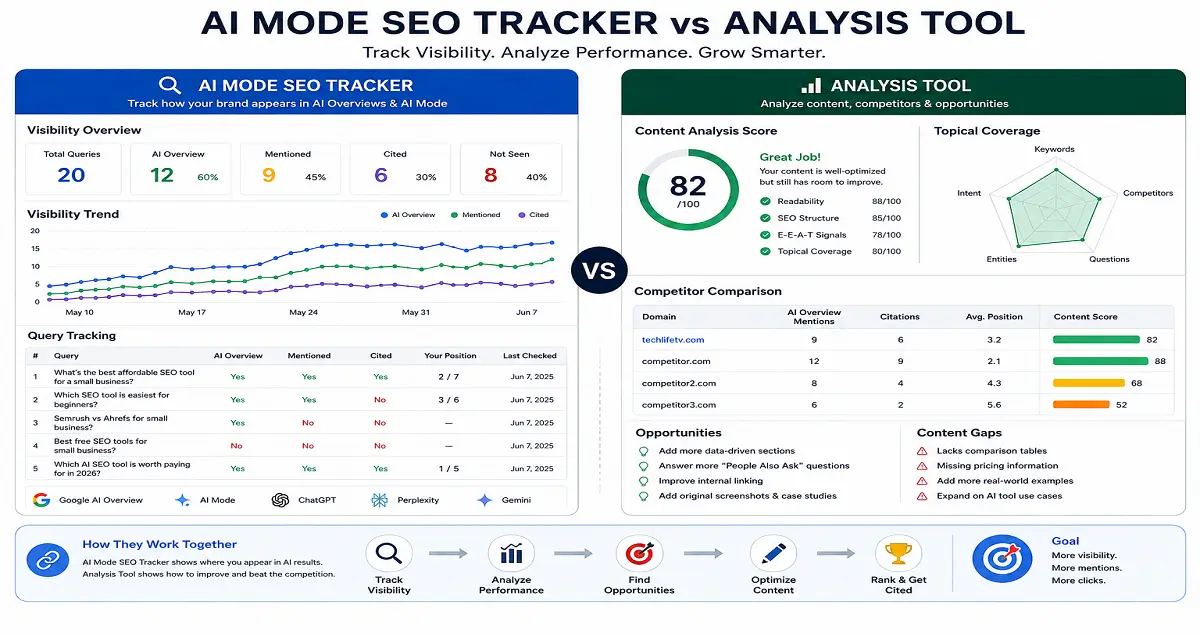
Here’s the short version before we dig in: a tracker tells you where you stand. An analysis tool tells you why, and what to do about it. Most sites eventually need both, but almost nobody needs both on day one.
Quick Answer: Tracker vs. Analysis Tool
| AI Mode SEO Tracker | AI Mode SEO Analysis Tool | |
| What it tracks | Presence, position, and citation order inside AI Mode responses | Brand mentions, URL citations, and the gaps behind them |
| Main output | A monitoring dashboard | Actionable insight and recommendations |
| Best for | Reactive monitoring, knowing where you stand | Proactive optimization, knowing what to fix |
What Is an AI Mode SEO Tracker?
An AI Mode SEO tracker is built for one job: monitoring. It runs your target queries through AI Mode on a schedule, then logs whether your brand shows up, where it lands in the response, and in what order it’s cited relative to other sources. Some trackers also record the exact page URL that got pulled, which matters when several of your own pages compete for the same topic.
Think of it as the AI Mode equivalent of a rank tracker. You’re not getting deep reasoning about why a competitor got the citation instead of you; you’re getting a consistent, repeatable snapshot over time so you can spot trends. Is your visibility improving after your last content update, or did it quietly drop last week? A tracker answers that.
A tracker is the right starting point if you’re new to AI Mode SEO, working with a lean team, or you just need to prove to a client or a boss that AI Mode visibility deserves a budget line.
What Is an AI Mode SEO Analysis Tool?
An AI Mode SEO analysis tool goes a step further. Instead of just logging where you appear, it digs into brand mentions and URL-level citations to explain the pattern behind them: which competitors get cited consistently and why, what kind of content structure AI Mode seems to favor, and where the gap sits between what you publish and what actually gets referenced.
This is the layer that turns raw data into a to-do list. A good analysis tool flags things like: your competitor’s comparison page gets cited because it answers a follow-up question you haven’t covered, or your product page reads too thin to be a trustworthy citation source.
You’ll want this layer once tracking alone stops being useful, once you already know you’re underperforming and need to know what’s actually driving it.
AI Mode SEO Tracking Tools: Is This a Third Category?
Not really. “AI Mode SEO tracking tools” is just the plural, more generic phrasing of “AI Mode SEO tracker.” People search it the way they’d search “rank tracking tools” instead of “rank tracker,” same intent, different phrasing habit. If a piece of content promises a distinct third category here, take it with a grain of salt. The underlying function is the monitoring job described above.
A Few Tool Examples, for Context
To make the tracker-versus-analysis distinction less abstract, here’s how a few well-known names line up against the categories above:
| Tool type | Example | Purpose |
| AI Mode tracker | SE Ranking | Monitor AI Mode visibility |
| AI visibility/rank tracking | Rankability | Track mentions, citations, and visibility |
| Broader AI visibility platform | seoClarity | Tracking plus deeper analysis |
These are examples, not a ranking. For a full comparison of AI Mode SEO tools, including pricing tiers and pros and cons, see our dedicated guide on the best AI Mode SEO tool. SE Ranking offers dedicated AI Mode tracking as part of its platform — see pricing and features → SE Ranking's AI Mode tracking features.
Want to earn from recommending it? See our seranking affiliate program guide.
Want a quick, free version of this kind of check before you commit to a paid tool? Try our AI Visibility Score scanner — same idea, zero cost, results in under a minute.
What Should You Actually Measure in Google AI Mode?
Before you pick a tool, it helps to know what “visibility” even means inside AI Mode. Most trackers and analysis tools report on some mix of the following:
- Appearance rate: how often your brand shows up at all across your tracked query set
- Position and citation order: where you land relative to other cited sources in the response
- Source URL: which exact page of yours got pulled, useful when several pages compete for one topic
- Context and sentiment: whether the mention is neutral, favorable, or comparative against a competitor
- Share of voice: how your citation frequency compares to your top two or three competitors on the same queries
- Fan-out coverage: how many of the related sub-questions AI Mode generates from one query you actually get cited for
A basic tracker usually covers the first three. Real analysis depth starts showing up in the last three, which is the clearest practical line between the two tool types.
AI Mode vs. AI Overviews: Why Tracking Both Matters
These two surfaces get confused constantly, and it affects which tool you should buy. AI Overviews shows up inline at the top of regular Google search results, next to the usual blue links, for queries where Google judges a synthesized answer is helpful. AI Mode is a separate, fuller conversational experience you actively switch into, built for multi-step research with follow-up questions.
A page can appear in one, both, or neither. Some tools track AI Overviews only and quietly skip AI Mode, or bundle AI Mode in as a paid add-on rather than the core plan. If your audience uses both surfaces, and most audiences do, checking exactly what a tool covers before you buy saves you from a nasty surprise three months in when your “AI visibility” dashboard turns out to have missed half the picture.
Are AI Mode Trackers and Analysis Tools Becoming the Same Thing?
Kind of, and it’s worth being honest about that. A growing number of platforms now bundle basic citation-gap reporting into what used to be pure tracking tools, which blurs the line we drew earlier. But bundled analysis is rarely as deep as what a dedicated analysis tool delivers. If citation-gap insight is genuinely your priority, check what the analysis layer actually reports on before assuming an all-in-one tool has you covered; a headline feature list and real depth aren’t always the same thing.
How Do You Decide: Tracker, Analysis Tool, or Both?
- Solo marketer or small site: start with a tracker. You need to know if AI Mode visibility is even a factor for your niche before investing in deeper analysis.
- Small agency managing a few client sites: a tracker with basic citation-order data usually covers reporting needs, with analysis reserved for underperforming accounts.
- Growing brand with real AI Mode traffic at stake: run both. Use the tracker for ongoing monitoring and bring in an analysis tool when a trend line needs explaining.
How to Track AI Mode for Free
You don’t need to spend anything to get your first honest read. Here’s a simple way to do it manually:
- Check Google Search Console. It now surfaces some AI Mode impression data at no cost, which works fine for a rough directional read (currently UK only)
- Build a list of 15 to 20 real queries your audience would actually type into AI Mode
- Run each query manually once a week and log whether your brand appears, and which page got cited, in a simple spreadsheet
- Keep this up for two to three weeks minimum before drawing any conclusion from the pattern
This won’t catch daily fluctuations, and it won’t scale past a couple dozen queries, but it answers the only question that matters before you spend money: does this even show up as a problem for your niche?
Try This Instead
Since you’re already looking for a free way to track this, here’s one: our AI Visibility Score checker. Enter your URL, and it scores your site on the exact factors that matter for AI search — no spreadsheet required.
When Do You Need a Paid AI Mode Tracker?
The free method above has a ceiling, and you’ll feel it hit in a few specific situations.
- You’re tracking more than 20 to 30 queries and manual logging is eating real hours every week
- You need historical trend data to prove visibility is improving or slipping over months, not weeks
- You’re reporting results to a client or a boss who expects a dashboard, not a spreadsheet screenshot
- Your manual check already turned up a consistent gap, and you need daily or near-daily refresh to catch changes
If none of those apply yet, stick with the free method. Paying for a tracker before you have one of these signals is paying to solve a problem you haven’t confirmed you have.
How to Turn AI Mode Tracking Data Into SEO Actions
A tracker or dashboard full of numbers is worthless if it doesn’t change what you publish next. Here’s the bridge from data to action:
- If a competitor gets cited and you don’t for the same query, pull up their page and compare structure: do they answer the question in the first two sentences while you bury it in paragraph three?
- If your fan-out coverage is low, look at the sub-questions AI Mode is generating and build supporting content or FAQ sections that answer them directly
- If your citation order consistently lands behind the same one or two competitors, audit their content for entity and context signals: are they naming the right tools, people, and concepts your page leaves vague?
- If your appearance rate is dropping over time with no content changes on your end, check whether a technical issue like crawlability or a recent site change is the real culprit before touching your content at all
Treat every tracking report as a prompt for one specific content or technical fix, not just a number to screenshot for a monthly report.
Does AI Mode Tracking Replace Traditional SEO?
No, and anyone telling you otherwise is selling something. AI Mode tracking measures a layer of visibility that classic rank tracking can’t see into, but it doesn’t replace the fundamentals underneath both: crawlability, helpful content, topical authority, and solid technical SEO. Track AI Mode as an addition to your existing SEO work, not a replacement for it.
Who Needs an AI Mode SEO Tracker?
Not every site needs one right now, and that’s an honest thing to say out loud. You’re a good candidate if:
- Your audience tends to ask research-style, conversational questions rather than short navigational searches
- You’re already investing in content marketing and want to know if that investment shows up in AI-generated answers
- You manage client sites and need a defensible way to report on a visibility layer clients are starting to ask about
If your niche is mostly transactional, quick-answer searches, AI Mode tracking is worth a free manual check but probably isn’t your top priority yet.
Frequently Asked Questions
Can one tool do both tracking and analysis?
Some platforms bundle both functions, but the depth of analysis usually trails behind dedicated analysis tools. If citation-gap insight is your priority, check what the analysis layer actually reports before assuming an all-in-one tool covers it.
Does an AI Mode tracker also cover ChatGPT or Perplexity?
It depends on the tool. Some are AI Mode-specific, while others track visibility across multiple AI platforms at once. If multi-engine coverage matters to you, confirm it before committing, since not every tracker on the market covers Google’s AI Mode specifically.
How often should I refresh my AI Mode tracking data?
Weekly is usually enough while you’re establishing a baseline. Move to daily only once you’re actively testing changes and need to see results faster.
Is a low-cost tracker accurate enough to trust?
Often, yes. Price correlates more with feature depth and engine coverage than with raw accuracy on the core presence/position data. Check reviews for accuracy complaints specifically, not just feature lists.
What’s the biggest mistake people make when choosing between these tools?
Buying analysis-tool pricing to solve a tracking-tool problem. If you haven’t confirmed you have a visibility issue yet, you don’t need citation-gap analysis; you need a baseline first.
Final Verdict
Start with the free manual method. If it shows a real gap and you’re spending real hours on it, move to a budget tracker. Only bring in a full analysis tool once you know exactly what question you’re trying to answer: why a specific competitor keeps beating you to the citation. That’s the smart way to build this into your workflow without wasting time or money chasing a dashboard you don’t need yet.