The Modern SEO Workflow: A Step-by-Step Guide to Ranking in 2026

Table of Contents
Why Your Content Isn’t Ranking?
You had spent hours on that posting.
Researched. Outlined. Drafted. Edited. Hit publish.
Then… silence.
No impressions. No clicks. No rankings. A single page, sitting in the dark, gathering digital dust, and your competitors are climbing up the Google front page like it’s nothing.
Not only is it frustrating, but it is demoralizing. And when it has occurred more than once, you have likely cast the same inquiry into everything. Wrong niche? Bad writing? Not enough backlinks?
Stop. It is not the issue.
The problem isn’t your content. It’s that there’s no system behind it.
The vast majority of creators never calculate that out – until they have wasted months of their lives putting words into an empty box.
This is what makes the difference between all the pages that are ranked on page one: somebody did not simply write good content. They had a rigorous, repeatable workflow – whereby the choice of keywords, search purpose, content form, and on-page layout were all predetermined before a pen could be laid on a sheet of paper.
Effort is not graded at Google. It ranks alignment.
When a keyword matches its intent, intent match format, format match structure, and structure is an indicator of authority – that is, when the algorithm takes notice. This is where impressions become clicks, clicks become traffic, and traffic multiplies without you always being in search of the publish button.
This is the system that this guide gives you – the system that will be built in 2026. An actual, stepwise workflow to:
• Discover keywords that your site can truly rank.
• encode search intent, such that you produce what Google and the searcher desire.
• Form content that is not only pleasing to humans but also to algorithms.
• Streamline signals on the page without over-engineering.
• Create consistency that transforms posts into a compounding traffic engine.
No guesswork. No random publishing.
Simply, a simple process that continues to work even after you have hit publish and walked away.
What Is an SEO Workflow?
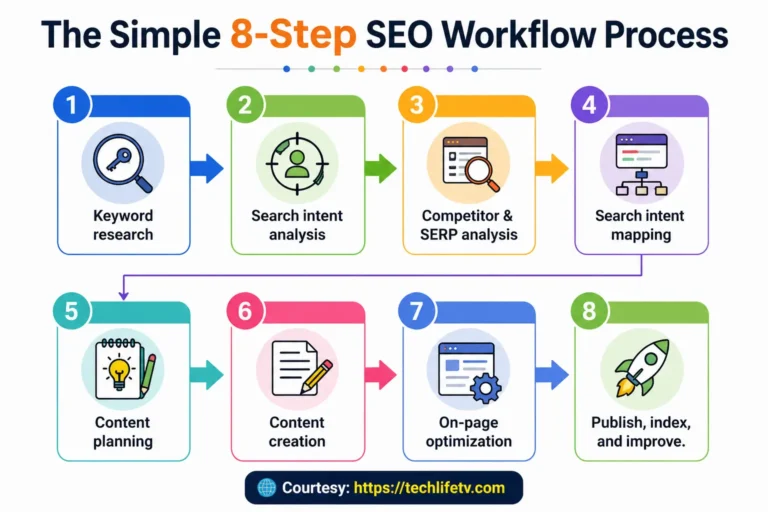
An SEO workflow is a step-by-step system for planning, creating, optimizing, and improving content so it ranks in search engines. Understanding the full SEO workflow process helps you move from guessing to a clear, repeatable system. Instead of guessing what to write, you follow a clear process — from keyword selection to publishing to continuous improvement. That’s what turns content into consistent, compounding traffic.
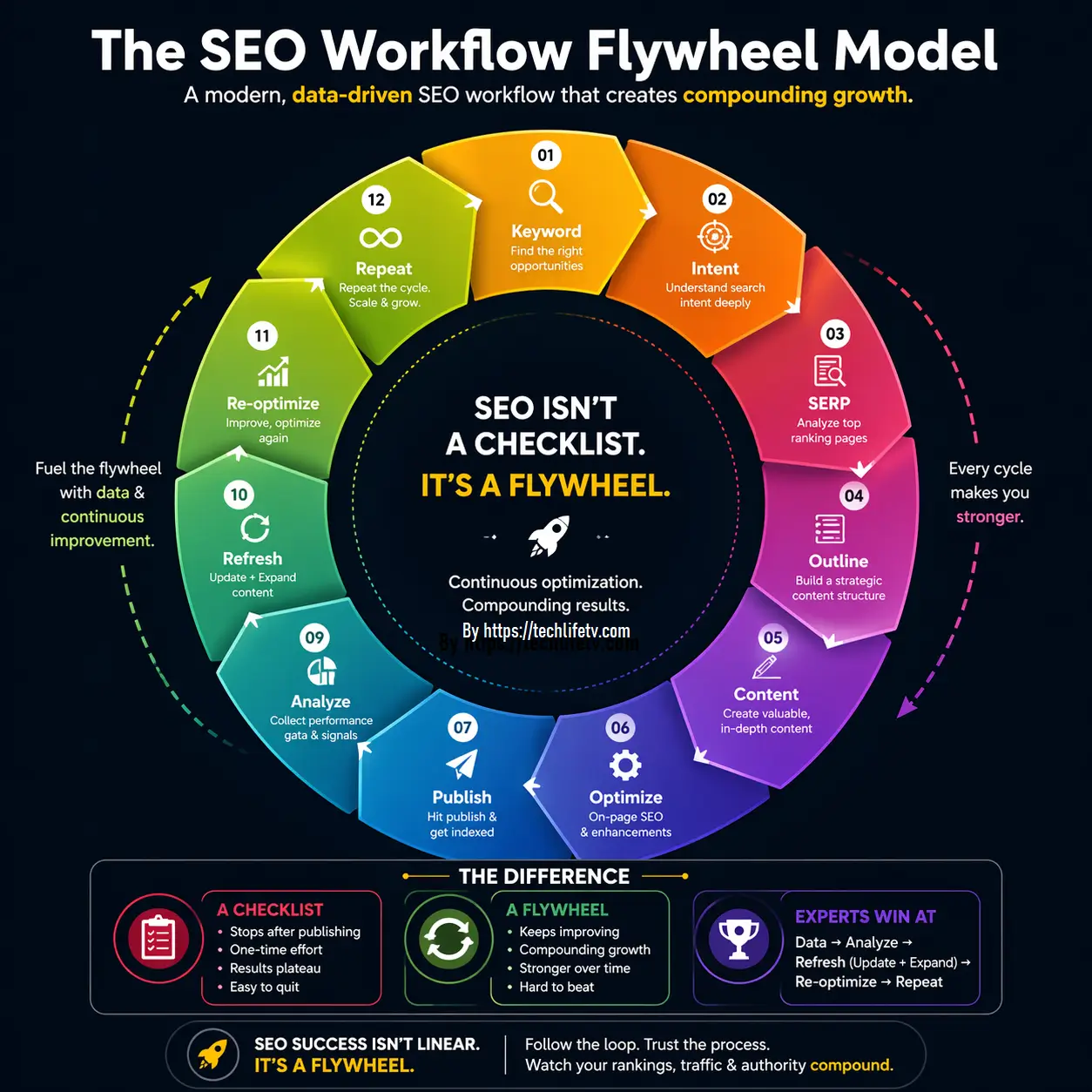
It is also called the SEO Flywheel Model
The SEO Workflow Flywheel Model
What Is Modern SEO?
Modern SEO is the process of building search-aligned content systems that improve continuously based on real performance data.
Key Differences: Old vs Modern SEO
| Old SEO | Modern SEO |
|---|---|
| Keyword stuffing | Intent matching |
| Single articles | Content systems |
| Publish and forget(ends at “publish.) | Continuous updates(never ends) |
| Focus on backlinks only | Focus on topical authority |
| Guessing strategy | SERP-driven strategy |
| Static content | Living content (updated) |
Most people treat SEO like a checklist.
But rankings don’t come from isolated actions — they come from systems.
Checklist vs Flywheel (Key Difference)
A checklist stops after publishing. A flywheel keeps improving.
Beginners stop at “Publish.” Experts win at “Data → Analyze → Refresh (Update + Expand) → Re-optimize → Repeat.”
That single contrast is the authority signal most people never build.
Modern SEO Workflow (Data-Driven Growth Loop):
Modern SEO Workflow looks like:
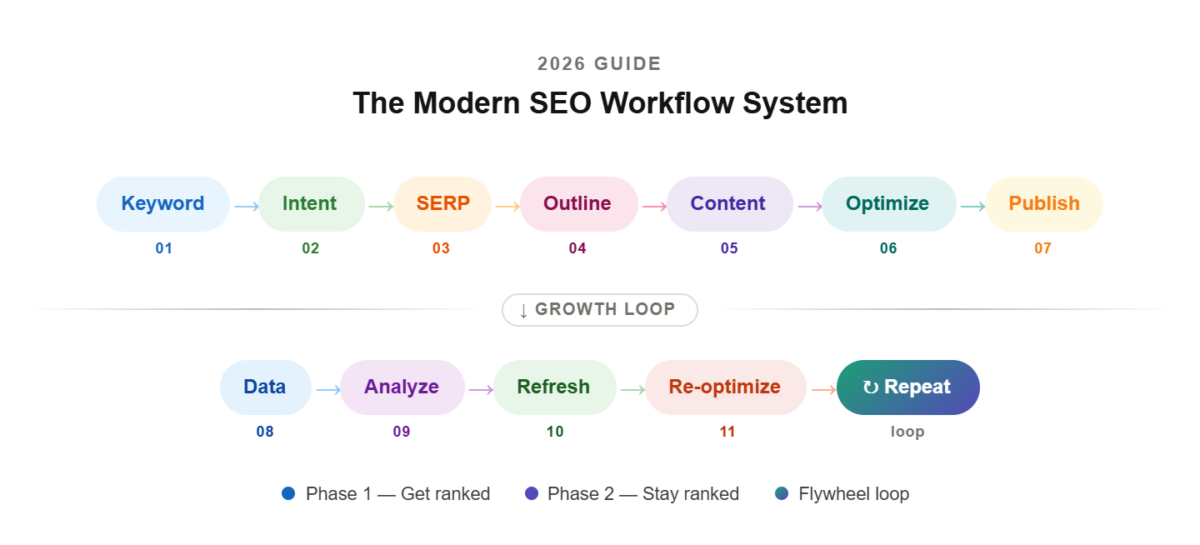
A modern SEO workflow is a continuous optimization loop powered by data, not a linear publishing process.
Why Most Websites Fail Without an SEO Workflow
Most people don’t fail at SEO because it’s too hard.
They fail because they’re working without direction.
Most publish randomly, pick topics without real research, ignore what the searcher actually wants, write without structure, and never go back to track or improve what they’ve already published. It feels like you’re doing everything right — but nothing moves.
A relatable scenario
You spend hours writing a blog post. You hit publish, maybe share it once… and wait.
Days go by. Then weeks.
Still nothing. No impressions. No clicks.
At that point, it’s easy to think: “Maybe SEO just doesn’t work anymore.”
But the real issue isn’t SEO. It’s that there was no system behind the content — no validated keyword, no intent matching, no SERP alignment, no optimization process. Without those pieces, even good content gets buried.
The Reality: SEO Is a System
SEO isn’t about writing more. It’s about following a process that compounds.
When you have a workflow:
• Every piece of content has a purpose.
• Every step builds on the last.
• Every post increases your chances of ranking. That’s when SEO starts to feel predictable — not random
The 2-Phase SEO Model (Modern SEO Explained)
Most people treat SEO like a checklist. Add a keyword, write a post, hit publish… and hope something happens.
But real SEO doesn’t work like that. It works like a system — with two layers:
• One gets you seen.
• The other keeps you winning.
If you only focus on the first, you might rank briefly. If you master both, you build traffic that compounds.
Phase 1: Basic SEO (Get Ranked)
This is your entry system. It decides whether your content shows up at all.
Keyword Research
Start with a clear, focused keyword. Not ten ideas. Not a vague topic. One specific search query your audience is actually typing.
Think:
• “seo workflow.”
• “seo workflow checklist.”
The goal here is simple: target something real and searchable.
Search Intent
Every keyword has a purpose. Ask: What does the searcher actually want?
• Learn something? → informational
• Compare options? → commercial
• Buy or take action? → transactional
Now check Google. If the top results are “best tools”… and you write a long theory-based guide… you’re already out of alignment.
SERP Match
This is where most people fail — and don’t even realize it. Google already shows you what works. So instead of guessing, look at the top results and ask:
• Are they listicles or guides?
• Beginner-friendly or advanced?
• Short or in-depth?
Your job is not to reinvent the format. Your job is to match what’s working — then improve it.
Content Quality
Now comes execution. But “quality” doesn’t mean fancy words or longer content. It means:
• Clear structure (easy to scan)
• Direct answers (no fluff)
• Useful examples (real, not generic)
Ask yourself: can someone solve their problem quickly with this? If yes, you’re on the right track.
What Phase 1 really does:
It gives you a chance to rank. Miss any one of these — wrong keyword, wrong intent, wrong format — and your content struggles before it even starts.
Once your content can rank, the next step is making it dominate.
Phase 2: Modern SEO (Rank Higher & Stay There)
This is your growth engine. It’s what separates page 2 from page 1, and page 1 from the top 3.
Topical Authority
Google doesn’t just rank pages. It ranks trusted sources. If you only write one article on a topic, you’re just another voice. But if you cover related topics, supporting questions, and connected content, you become a resource, not just a page. That’s how authority builds.
Semantic Depth (NLP / Entities)
SEO is no longer about repeating one keyword. It’s about covering the topic completely. Instead of saying “SEO workflow” 20 times, include related concepts, tools, and processes, and real use cases. This helps search engines understand your content on a deeper level — and makes it more useful for readers, too.
Information Gain (Your Edge)
Here’s the real question Google asks: “Why should I rank YOU over everything else?”
If your content says the same thing as everyone else, it has no reason to win. So you add:
• Real examples
• Personal insights
• Better explanations
• Clear comparisons
This is what pushes you into the top results.
UX Signals (User Experience)
Even if you rank, you won’t stay there without a good experience. Google watches how users interact:
• Do they click your result? (CTR)
• Do they stay and read? (dwell time)
• Do they leave immediately? (bounce)
So your content needs to feel easy — clean layout, short paragraphs, helpful formatting like lists and tables. Good UX isn’t design — it’s clarity.
Simple Takeaway: Entry vs Growth System
Phase 1 gets you in the game. Phase 2 helps you win the game.
The Model to Remember
Ranking = Entry System × Growth System
Where:
• Entry = Keyword + Intent + SERP Match
• Growth = Quality + Authority + UX + Uniqueness
If you’re just starting, focus on Phase 1 first. Get your content ranking. Then layer in Phase 2 — that’s when traffic starts to grow and stick.
The Complete SEO Workflow (Step-by-Step)
This is your real-world system — the one that turns ideas into rankings. Follow it in order. Don’t skip steps. Each one builds on the next.
1. Keyword Research Workflow (Find Low-Competition Keywords)
This is where everything starts — and where most people go wrong. Instead of guessing, you focus on clear demand + low competition.
What to focus on
• Choose one primary keyword (your main target)
• Add long-tail variations (more specific, easier to rank)
• Target low-competition keywords with real search demand
Simple rule
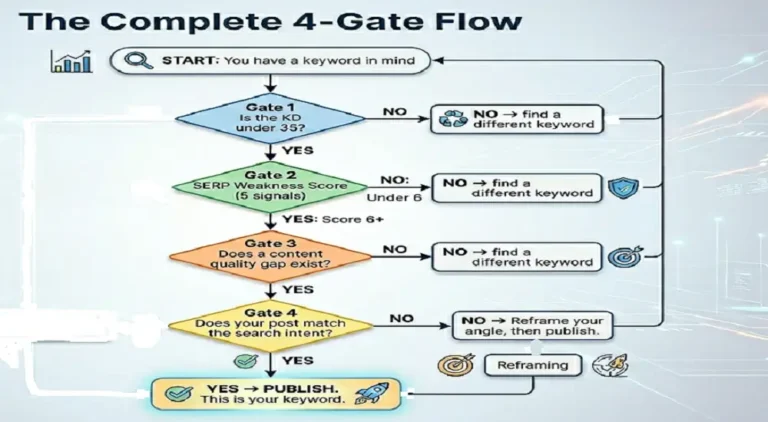
If big authority sites dominate the top results, it’s not your keyword (yet).
What works better
• Specific problems
• Beginner-focused queries
• “Best”, “how to”, or “for [audience]” keywords
Rankable first, scalable later.
What Works Better
Before using tools, understand the strategy:
• Keyword research for beginners
• How to find low competition keywords
These help you learn how to identify keywords you can actually win.
Recommended Tools for Keyword Research
Once you understand the basics, tools help you execute faster and more accurately:
• LowFruits → Find low-competition keywords you can actually rank for
• Keysearch → Beginner-friendly keyword research + difficulty analysis
These tools help you validate opportunities instead of guessing what might work.
Best Tool for SERP Weakness Analysis for Beginners
The best beginner-friendly SEO tool for SERP weakness analysis is LowFruits — it specifically highlights weak spots in search results (like low-authority sites and forums), making it easy to find keywords you can realistically rank for.
Why it stands out:
• Detects weak competitors (low DA sites) in SERPs
• Shows easy-to-rank keyword opportunities instantly
• Built specifically for beginners and niche site owners
In short, if your goal is SERP weakness analysis without complexity, LowFruits is the most beginner-friendly option.
Beginner-Friendly Alternatives
• Keysearch (Easier UI + shows competitor strength)
• Ubersuggest (Good for beginners + basic SERP overview)
2. Search Intent Analysis (Critical Step)
Before you write anything, answer this: What does the searcher actually want?
Every keyword has intent behind it:
Types of Search Intent
• Informational → learning something
• Commercial → comparing options
• Transactional → ready to take action
Your job: match your content to that intent — exactly.
Quick validation method
Search your keyword on Google. Look at the top 5 results. Ask:
• Are they guides?
• Lists?
• Product pages?
That’s your answer. Follow it.
Reality check:
If intent doesn’t match, your content won’t rank, no matter how good it is.
3. Reverse-Engineering the SERP (Blueprint for Ranking)
This is where strategy replaces guesswork. You’re not starting from scratch — you’re studying what already works.
Identify Content Type
Look at the top results: blog posts, listicles (“Top 10 tools”), and landing pages. Match the dominant type.
Analyze Content Format
Go deeper into how content is presented: how-to guide, best tools list, comparison, review. Format = how the information is delivered.
Evaluate Content Depth
Open 3–5 top pages and scan: length (short vs long), number of sections, topic coverage. You don’t need more content — you need complete content.
Extract Structure
Pay attention to patterns: headings (H2, H3), section flow, repeated elements (FAQs, tables, pros/cons). This becomes your content blueprint.
Find Gaps & Opportunities
Now the most important question: what are they missing?
Look for:
• Outdated information
• Weak or generic explanations
• Poor readability or UX
• No real examples
This is where you win.
How to Find Weak SERPs (Beginner-Friendly Method)
• Scan top 5–10 results
• Look for low-authority sites
• Identify outdated content
• Spot thin or shallow articles
• Check intent mismatch
• Analyze weak titles and poor UX
Rule: Match, then improve.
Don’t try to be creative first. Be strategic first. Match what works — then make it better.
4. Content Planning (Build Before You Write)
This step saves you hours — and prevents messy content.
Before writing, define:
• Target keyword
• Search intent
• Main sections (H2–H3)
• Key questions to answer
This becomes your content brief.
Why it matters:
• Keeps your content focused
• Prevents rambling
• Improves structure instantly
5. Content Creation (Human + AI Workflow)
Now you start writing — but not blindly.
Using AI the Right Way
• Generate outlines
• Speed up first drafts
• Improve clarity
Then do what AI can’t:
• Add real insights
• Share practical examples
• Simplify complex ideas
This is where ranking happens.
Apply E-E-A-T naturally
• Show experience
• Be clear and honest
• Solve real problems
People trust content that feels real.
6. On-Page Optimization (Make It Rank)
Now refine your content for search engines — without overdoing it.
Focus on Core On-Page Elements
• Title (clear + click-worthy)
• Meta description (boost CTR)
• Clean heading structure (H1–H3)
• Natural keyword placement
Optimize Faster with AI Tools
Instead of manually guessing what to optimize, these tools show you exactly what’s missing:
• Frase → Builds data-driven content briefs based on top results
• Scalenut → Improves structure, NLP coverage, and topical relevance
These tools help you match what’s already ranking — and improve it faster.
Follow this: on-page SEO checklist.
Featured Snippet Optimization Tip
If you want to rank in featured snippets, structure your content like this:
• Use short, direct answers
• Add bullet points where possible
• Keep sections scannable and clean
Make it easy for Google to extract and display your content.
7. Internal Linking (Build Authority)
This is one of the easiest wins — and most ignored. Internal linking is what turns pages into a system, not isolated content.
Essential Technical Checks
• Link to related content
• Use descriptive anchor text
• Connect articles into clusters
This helps users navigate, helps Google understand your site, and pushes authority across pages.
8. Technical SEO Basics (Quick Wins)
You don’t need to be technical — just cover the essentials.
Check these:
• Page loads fast
• Mobile-friendly layout
• No broken links
• Basic schema (if possible)
Small fixes = big impact.
On-Page SEO Made Simple (Tool Layer)
Instead of manually handling everything, you can streamline this process:
• Rank Math → Helps optimize titles, meta descriptions, schema, and technical SEO in one place
This is especially useful if you want a clean SEO setup without dealing with technical complexity.
9. Publishing & Indexing
Don’t just hit publish and hope. Do this immediately:
• Submit URL in Google Search Console
• Update your sitemap
• Request indexing
This speeds up visibility.
10. Tracking & Optimization (Growth Loop)
This is where most people stop — but where real SEO growth begins.
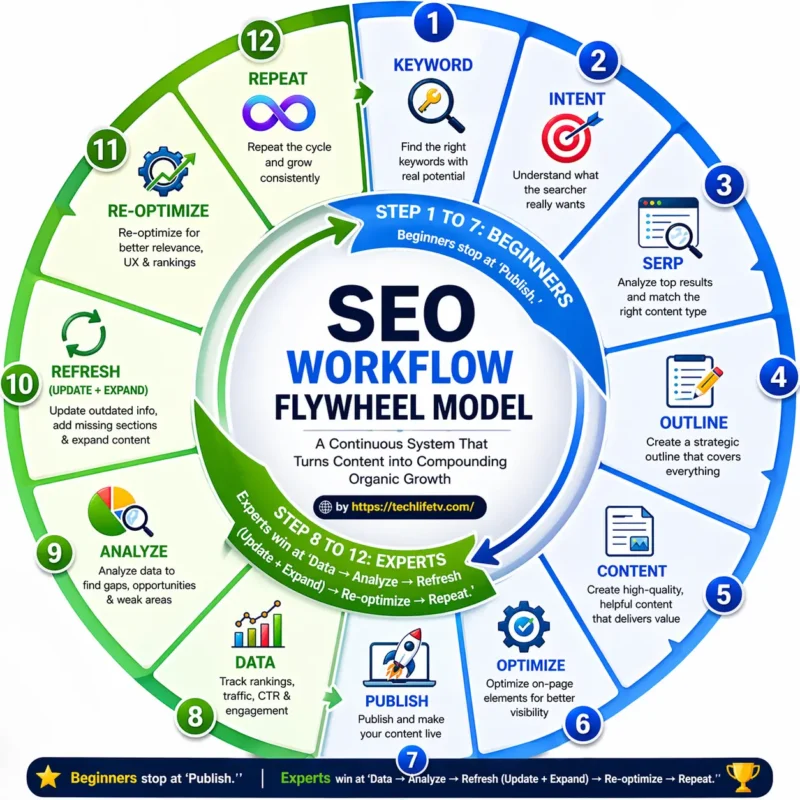
The SEO Workflow Flywheel: growth happens when you continuously turn data into improvements.
Beginners publish and move on. Experts update and win.
What to Track
• Rankings
• Traffic
• Click-through rate (CTR)
How to Improve
• Update weak sections
• Improve titles for higher CTR
• Add missing information
• Build more internal links
This is the loop: Data → Improve → Repeat.
11. Content Refresh Strategy (2026 Ranking Boost Loop)
Content doesn’t stop working after you publish it — it either grows or slowly loses visibility. That’s why in 2026, updating and improving your existing articles is just as important as creating new ones.
A Content Refresh Strategy means regularly revisiting your posts to update outdated information, add missing sections, improve SEO alignment, and strengthen internal links. This signals to Google that your content is still relevant, accurate, and worth ranking higher. In many cases, refreshing an existing page can deliver faster ranking gains than publishing a brand-new article.
AI SEO Workflow (Simplified)
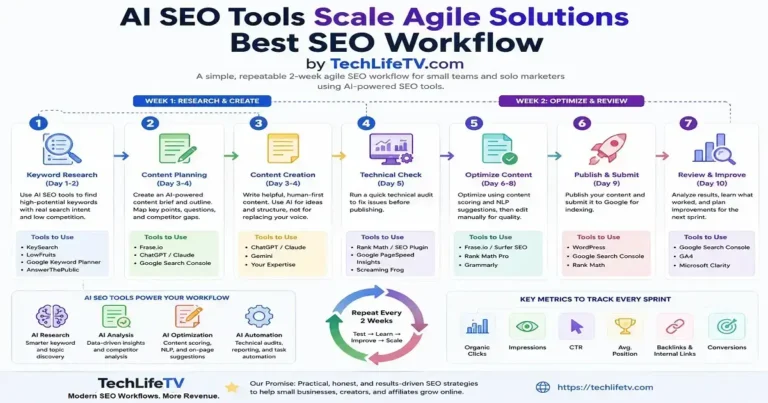
AI doesn’t replace your SEO process — it removes friction from it. Used right, it turns a slow, manual workflow into something fast, repeatable, and scalable. Here’s how it fits into each stage:
AI in Keyword Research
Instead of guessing what to write about, AI helps you surface ideas in minutes:
• Discover long-tail keywords you’d normally miss
• Spot patterns in what people are actually searching
• Expand one idea into multiple content angles
The win: you spend less time searching — and more time choosing the right opportunities.
AI in Content Creation
This is where AI saves the most time — but only if you use it correctly:
• Generate structured outlines based on your topic
• Create first drafts to overcome blank-page syndrome
• Organize messy ideas into clear sections
But here’s the rule: don’t publish AI content as-is. Add your experience, real examples, and clear explanations.
The win: faster writing without sacrificing quality.
AI in Optimization
AI helps you align your content with what’s already ranking — without overthinking it:
• Suggest related terms and topics (semantic coverage)
• Improve structure (headings, flow, readability)
• Highlight missing sections compared to competitors
The win: your content becomes more complete and easier to understand — for both users and search engines.
AI in Automation
This is where your workflow becomes scalable:
• Suggest internal links as you publish
• Identify outdated content that needs updates
• Track performance patterns faster
The win: you stop doing repetitive tasks manually — and focus on strategy instead.
Key Idea
AI creates content. You create trust.
SEO Tool Stacks (By Budget & Audience)
You don’t need dozens of tools. You need the right tools for your stage. Here’s a clean, practical stack based on real-world use:
Beginner (Free) Best for: New bloggers
Start simple. Focus on learning the workflow — not collecting tools.
• Google Search Console
• Google Keyword Planner
• ChatGPT/Cluade
Manual, but powerful. You’ll learn how keywords work, how content ranks, and how to improve based on real data.
Affordable (Best ROI) Best for: Affiliates, niche sites
This is where things start to click.
• LowFruits (find easy wins). Try LowFruits — find keywords you can actually rank for in minutes.
• Keysearch (easier UI + shows competitor strength). Try Keysearch free — beginner-friendly research at a price that makes sense
• Ubersuggest (good for beginners + basic SERP overview)
• Frase (SERP briefs + structure + outline). Try Frase — build your content brief and outline before you write a single word.
• ChatGPT/Cluade. Use ChatGPT/Claude to draft faster — then add your expertise on top.
• Rank Math for on-page optimization. Try Rank Math for Free
• (Optional) Scalenut
Fast growth with low cost. You’ll find low-competition keywords, build structured content faster, and start seeing real traffic.
You don’t need all of these at once. Start with LowFruits to find your keyword, Frase to build your brief, and ChatGPT/Claude to speed up your draft. That stack alone is enough to start ranking.
Mid-Level (Growth Stage) Best for: Small businesses
Now you’re optimizing — not just publishing.
• Frase (SERP briefs + structure + outline)
• Scalenut or Surfer SEO
• SE Ranking or Moz
Better optimization + insights. You’ll refine content based on data, improve rankings consistently, and understand competitors better.
Explore: best SEO tools for small businesses.
Pro (Scale & Dominate) Best for: Agencies, advanced users
This is full control mode.
• Semrush
• Ahrefs
• Surfer SEO / Clearscope
You’ll analyze competitors deeply, scale content production, and build a complete SEO system.
Common SEO Workflow Mistakes
Most people don’t fail because SEO is hard. They fail because they skip the steps that actually matter. Here’s what to avoid:
Ignoring Search Intent
You write what you want — not what users are searching for—result: no rankings, no traffic.
Skipping SERP Analysis
You don’t check what’s already ranking. Result: your content doesn’t match what Google expects.
Overusing AI (Generic Content)
You publish AI-generated content that adds no value. Result: it feels flat, forgettable, and replaceable.
No Internal Linking
Your content exists in isolation. Result: weak authority, slow ranking growth.
No Tracking System
You publish — and move on. Result: you never improve what’s already working.
Simple Reality
SEO isn’t about doing more. It’s about doing the right steps in the right order. Fix these mistakes — and you’re already ahead of most beginners.
SEO Workflow Checklist (2026 Edition)
Before you publish anything, run through this checklist. This is the difference between content that gets ignored and content that ranks.
• Keyword selected (clear primary target)
• Search intent matched (what the user actually wants)
• SERP & content type analyzed (blog, listicle, guide, or landing page)
• Content optimized (clear structure + NLP keywords + readability)
• Internal links added (build topical authority across your site)
• Technical basics checked (speed, mobile, broken links, schema)
• Indexed in Google (via Search Console submission)
• Performance tracked (rankings, CTR, traffic updates)
This simple checklist alone eliminates most beginner SEO mistakes — because it forces you to think in systems, not guesses.
TL;DR (Quick Summary)
• Master Workflow: Keyword → Intent → SERP → Outline → Content → Optimize → Publish → Improve
• Two Phases:
o Phase 1 (Entry): Keyword + Intent + SERP Match + Quality
o Phase 2 (Growth): Authority + Semantic Depth + Information Gain + UX
• Core Formula: Ranking = Entry System × Growth System
• Principle: Start with alignment (intent + SERP), then execute. AI speeds you up; human expertise wins.
Final Conclusion: SEO Workflow Is What Separates “Publishers” From “Rankers”
Let’s be honest for a moment.
Most people in SEO are working hard — but not moving forward. They write blog after blog, follow trends, try new tools every month — and still, nothing really changes. No steady traffic. No predictable rankings. No real growth.
At some point, it starts feeling like SEO is just luck.
But it’s not.
The Real Turning Point
The shift happens when you stop treating SEO like individual tasks — and start treating it like a system.
When you follow a clear SEO workflow:
• Every keyword has a purpose.
• Every article is built on intent.
• Every section matches what Google already rewards.
• Every page supports another page.
• Every update improves your entire system.
Nothing is random anymore. You’re no longer “trying to rank.” You’re building something that is designed to rank.
A Simple Reality Most People Miss
Two people can write the same article. One follows guesswork. The other follows a structured SEO workflow.
After a few months, the first one is stuck refreshing analytics. The second one is getting consistent daily traffic.
Same topic. Different system. That’s the real gap in SEO today — not knowledge, not tools, but structure.
Why This Matters More in 2026
Search is no longer just about keywords. It’s about intent accuracy, content depth, topical authority, user experience, and information value. And AI has made this even more competitive — which means random content dies faster, and structured systems grow faster.
The Modern SEO Formula in Full
Remember the two-phase model from earlier? Here’s how it all connects:
SEO = (Keyword + Intent + SERP Match) × (Quality + Authority + UX + Uniqueness)
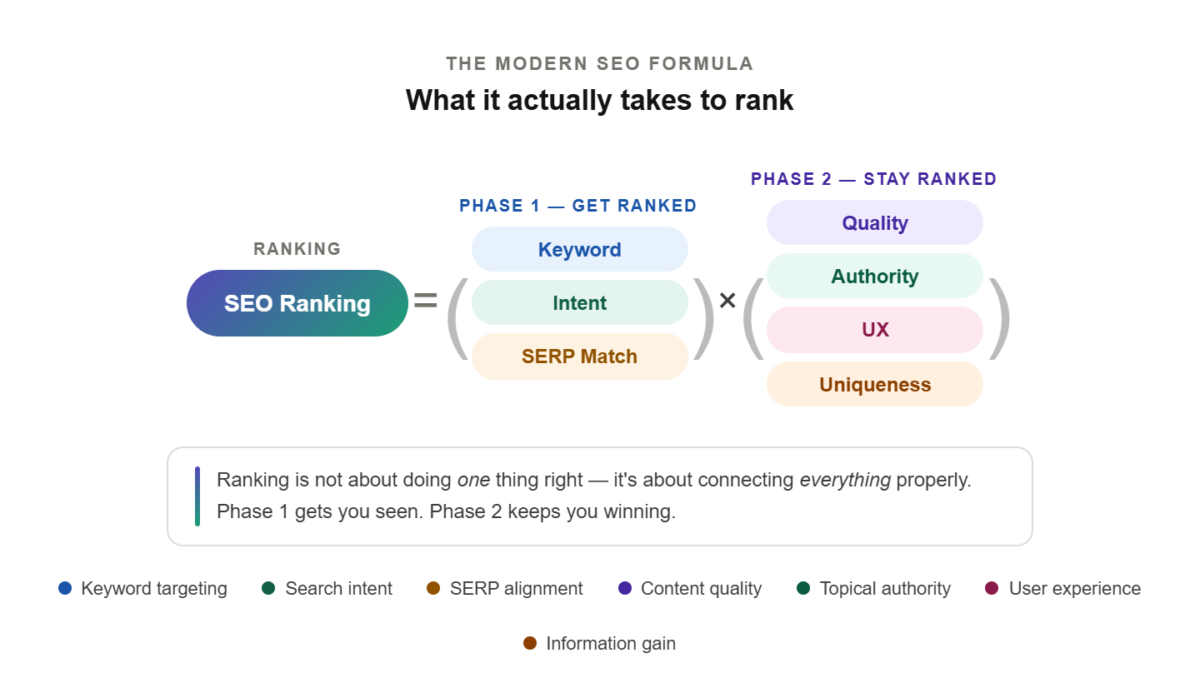
Ranking is not about doing one thing right — it’s about connecting everything properly. When your workflow is aligned, content stops being random and starts becoming predictable.
And that’s the real point: SEO is not a one-time process — it’s a repeatable system that compounds over time.
Your Next Step (Keep It Simple)
You don’t need to do everything at once. Start here:
• Pick one keyword
• Follow the workflow step-by-step
• Publish with structure, not speed
• Improve one article at a time
Then repeat because SEO doesn’t reward intensity. It rewards consistency built on systems.
One day, you’ll look back and realize: it wasn’t the “best article” that changed your traffic. It was the moment you stopped guessing — and started following a workflow that actually works.
That’s when SEO stops feeling like work. It starts becoming a system that compounds in your favor.
If you want real SEO results, keep it simple:
• Pick one keyword
• Follow one clear SEO workflow
• Use one reliable tool (don’t overcomplicate it)
Then focus on consistency — not complexity. Because in modern SEO, systems rank. Random content doesn’t.
FAQ (SEO Workflow)
What is an SEO workflow?
An SEO workflow is a step-by-step system for planning, creating, optimizing, and improving content so it can rank in search engines and attract organic traffic.
What are the main steps in SEO?
The core steps include keyword research, search intent analysis, SERP research, content creation, on-page optimization, internal linking, indexing, and performance tracking.
Is SEO still relevant in 2026?
Yes — SEO is more important than ever. It has evolved into a system-driven process where content quality, structure, and user experience matter more than keyword stuffing.
How does AI improve SEO workflow?
AI helps speed up keyword research, content structuring, optimization suggestions, and workflow automation — but human insight is still essential for ranking.
What tools are best for beginners?
Beginners can start with free tools like Google Search Console, Google Keyword Planner, and ChatGPT. As they grow, tools like LowFruits and Frase help scale results faster.