AI Search Visibility Management Tools: Best Picks for 2026 (Even on a Small Budget)

Table of Contents
Here’s a question worth sitting with for a second: the last time someone asked ChatGPT or Google AI Mode “what’s the best tool for X,” was your brand even in the room?
If you don’t know the answer, you’re not alone. Most small business owners, bloggers, and affiliate marketers are still checking their Google rankings while a whole new front door to the internet has quietly opened next to it. People are asking AI systems for recommendations instead of scrolling through ten blue links. And if AI doesn’t mention you, it’s like your storefront disappeared from a busy street corner overnight.
That’s exactly the gap AI search visibility management tools are built to close. They show you whether ChatGPT, Perplexity, Google AI Overviews, and AI Mode actually know you exist — and more importantly, what to do about it if they don’t.
The tricky part? Most guides on this topic are written for agencies with five-figure marketing budgets. If you’re running a one-person blog, a small affiliate site, or a scrappy agency juggling a handful of clients, you need something simpler, cheaper, and faster to act on. That’s what this guide is for.
Quick Pick: If You Want an Answer
Short on time? Here’s the fast version.
- Best budget pick: Otterly.ai — Lite at $29 a month or $25/month when billed annually (For solo marketers and small teams, it’s one of the most affordable dedicated AI visibility tools out there. It covers the engines that matter most: ChatGPT, Perplexity, Google AI Overviews, and Copilot.
- Best for content + tracking together: Frase — Its free checker shows you where you stand today, and the paid plan (around $39 a month) pairs tracking with real content help, so you’re not juggling two separate tools.
Both fit under $50 a month, and both are covered in detail below. Managing several client sites? Jump to the agency section — SE Ranking’s SE Visible product handles that well, just at a higher price point than these two.
What Is an AI Search Visibility Management Tool, Really?
Think of it this way. A classic SEO tool tells you where you rank on a Google results page. An AI search visibility management tool tells you something newer and, honestly, scarier: whether AI even mentions you at all when someone asks a question in your niche.
These tools work by sending real (or simulated) questions to ChatGPT, Perplexity, Gemini, and Google’s AI Overviews, then checking:
- Does your brand show up in the answer?
- How often, and for which questions?
- What does the AI actually say about you — good, bad, or wrong?
- Which competitors show up instead of you?
- Which of your pages are the ones getting cited?
That last point matters more than people realize. AI systems don’t reward the prettiest homepage. They reward the page that answers a question clearly, fast, and without fluff. Visibility tools help you find out which of your pages are already doing that — and which ones AI is quietly skipping.
AI Search Visibility vs. Traditional SEO: What’s Actually Different?
It helps to see the two side by side, because they’re not measuring the same thing.
| Traditional SEO | AI Search Visibility |
| Keyword rankings | Brand mentions and citations |
| Exact-match keywords | Entities and concepts |
| Search results pages | AI-generated answers |
| Position tracking | Citation frequency and share of voice |
| Backlinks | Broader trust and authority signals |
| Click-through rate | Being recommended, click or no click |
Here’s the part worth remembering: a page can rank #1 on Google and still never get mentioned by ChatGPT. AI systems pull from a mix of sources when they build an answer, not just whatever sits at the top of a results page. So think of AI visibility as running alongside your SEO work, not replacing it.
Why This Matters More If You’re Budget-Conscious
Here’s the part most comparison articles skip: they’re written by tools that cost hundreds of dollars a month, aimed at enterprise teams who can absorb that cost without blinking. If you’re a solo affiliate, a blogger, or a small agency in a T1 or T2 market, that pricing isn’t just inconvenient — it’s a non-starter.
But here’s the smart way to think about it: you don’t need the biggest tool. You need the right-sized one. A tool that tracks 50 prompts a day for $20 a month is genuinely more useful to you right now than a $300/month platform with features you’ll never touch. Getting cited by AI isn’t about spending more — it’s about spending smart. If you specifically want to track Google’s AI Mode, see our full guide.
What Actually Matters When You’re Choosing a Tool (Not What the Vendors Tell You)
Before you open your wallet, run any tool through this checklist. It’ll save you from paying for features that sound impressive but don’t move the needle for a small operation.
1. Does it track the engines your audience actually uses? You don’t need all ten AI platforms tracked. ChatGPT, Google AI Overviews, and Perplexity cover most of what your readers are doing. If a tool charges extra for Gemini or Copilot tracking and your audience barely touches those, skip the upsell.
2. Is the data real, or guessed? Some tools turn your old SEO keywords into “prompts” and call it AI tracking. That’s not the same as watching what people actually type into ChatGPT. It’s not a dealbreaker for a starter tool, but know what you’re paying for.
3. Can you act on what it shows you, or does it just sit there? A dashboard that says “you’re not cited for this topic” is only half the job. The best budget tools pair that alert with a clear next step — a content brief, a suggested fix, or at least plain-English guidance on what to write.
4. Does pricing scale with you, not against you? Look for tools with a real entry tier, not just a “contact sales” button. If a plan starts under $50 and grows as your site grows, that’s the smart way to start.
5. If you manage more than one site or client, is multi-brand support built in — or an expensive add-on? This one catches a lot of small agencies off guard. Check before you commit.
How I Evaluated These Tools
Here’s what this list is actually based on, so you know where the picks come from. I compared each tool against the checklist above – engine coverage, whether the data comes from real prompts or an estimate, how clearly it connects a finding to a fix, pricing transparency, and multi-brand support. I checked each vendor’s own pricing page, then cross-referenced third-party review sites for real user feedback, and left out any tool that only offers “contact sales” pricing with nothing published, since that’s not usable information on a small budget. See our broader SEO tool evaluation criteria
One honest caveat: pricing in this space changes often, sometimes every few months. Treat the numbers below as a starting point, not a guarantee, and confirm the current rate on each vendor’s site before you subscribe. See our broader SEO tool evaluation criteria
The Best AI Search Visibility Management Tools for Small Budgets (2026)
Here’s the honest breakdown, sorted by what you’ll actually spend — not by whichever vendor wrote the “best of” list.
Free and Near-Free Starting Points
You can get a real first look at your AI visibility without spending anything.
- Free AI visibility checkers (offered by several platforms, including Frase and a handful of newer GEO tools) let you plug in your domain and see, in one shot, whether AI engines currently cite you. It’s a single snapshot, not ongoing tracking, but it’s the fastest way to find out where you stand today – right now, for free.
- Sedestral’s free plan is worth a look if you’re an e-commerce seller, freelancer, or small blog owner. It bundles a handful of tracked pages and basic SEO audits into a no-cost tier, which makes it a genuinely low-risk way to dip a toe in before upgrading.
Use these to answer one question first: “Am I already showing up anywhere?” That answer shapes everything else you do next.
Under $50 a Month: The Sweet Spot for Solo Marketers
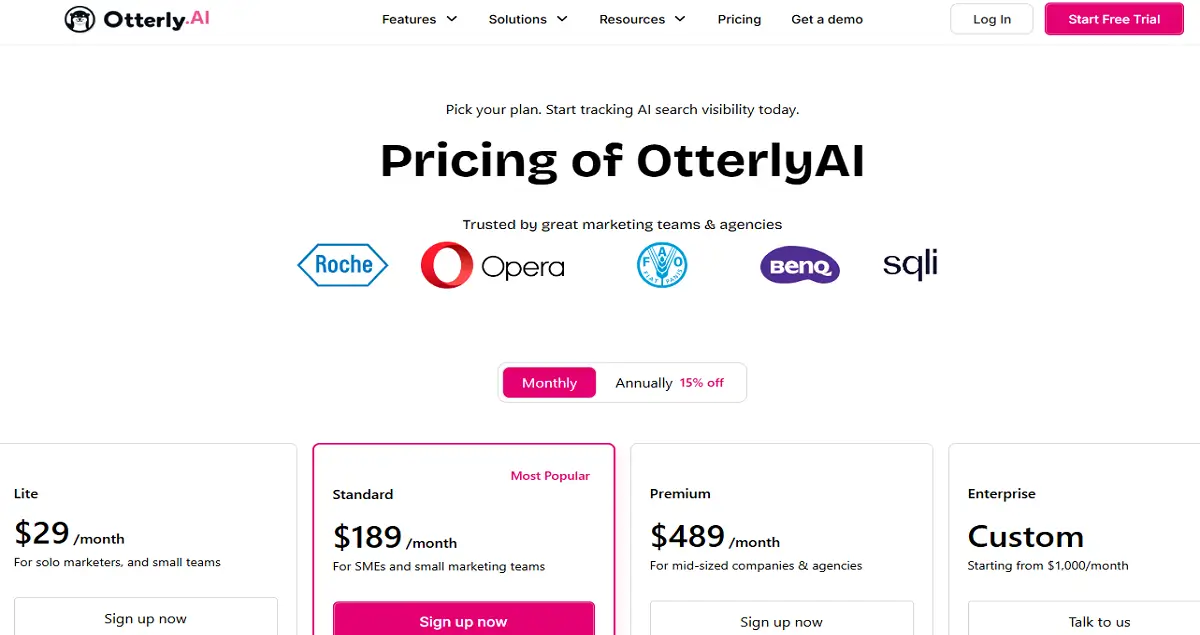
Otterly.ai: Lite plan(entry) starts at $29 a month and is built with solo marketers and small teams in mind. Setup takes minutes, not days, and it tracks the core engines – ChatGPT, Perplexity, Google AI Overviews, and Copilot – while pairing monitoring with plain-language recommendations. It won’t give you the deepest data on the market, but for a blogger or single-site affiliate, “clear and fast” beats “deep and complicated” every time.
Frase, at $39 a month, or at $39 a month when billed annually, folds AI visibility tracking into the same platform as its content research and writing tools. If you’re already producing your own content, this covers two jobs with one subscription instead of two. Here is Frase Official Pricing Page
Mid-Range: Worth the Upgrade Once You’re Earning From It
- SE Visible, SE Ranking’s standalone AI visibility product, starts at roughly $99 a month and supports multiple brands from one workspace- a nice detail if you run more than one niche site. It costs more than the entry-level picks above, and its published pricing has shifted more than once this year, so double-check the current tier before you buy. Curious about SE Ranking’s own affiliate program?
- Peec AI brings daily tracking, sentiment scoring, and screenshot-based audit trails, starting around $89 to $95 a month. If your site is already making affiliate income and you want sharper data to protect it, this is a natural next step up.
- Semrush’s AI Visibility toolkit starts around $165 a month and makes the most sense if you’re already paying for Semrush for keyword research. You’re not adding a brand-new subscription – you’re getting more out of one you already have. If Semrush doesn’t fit your budget, see our alternatives guide.
Quick Comparison Table
| Tool | Best for | Engines tracked | Multi-brand support | Starting price* |
| Otterly.ai | Solo bloggers, tight budgets | ChatGPT, Perplexity, AI Overviews, Copilot | Partner/workspace plan | Lite: $29/mo; Standard:$189/mo, Premium: $489/mo; Enterprise: $1,000/mo |
| Frase | Content + tracking in one place | ChatGPT, Perplexity, Claude, Gemini, Google AI | Not the main focus | Free checker; ~$39/mo paid |
| Sedestral | E-commerce sellers, freelancers | Core AI/SEO tracking | Multi-site tiers | Free plan; paid from ~$119/mo |
| SE Visible | Small agencies, multiple brands | ChatGPT, Gemini, AI Mode, Perplexity | Yes, from the entry plan | Core: $129-Growth: 279/mo; SE Ranking API: $223.75/mo( Annual only) |
| Peec AI | Sites already earning steady income | ChatGPT, Perplexity, AI Overviews (add-ons for more) | Agency plans available | ~$89–95/mo |
| Semrush AI Toolkit | Teams already on Semrush | Major engines plus AI Overviews | Depends on plan | ~$99/mo |
*Prices shift often in this space — confirm the current rate on each vendor’s pricing page before you subscribe.
When You’re Managing More Than One Client’s AI Visibility
If you’re a small agency juggling several client sites, paying for five separate visibility subscriptions fast turns your margin into a rounding error. A few tools solve this without the enterprise price tag:
- Otterly.ai’s partner setup includes workspace management, so you can keep client accounts organized without buying five logins.
- SE Visible supports multiple brands on every plan tier, including the entry one – genuinely rare in this space, though you’ll pay more for it than for Otterly or Frase.
- Sedestral’s agency-style tiers track dozens to hundreds of pages across multiple sites or languages under one subscription, which works well if your clients are smaller local or e-commerce businesses.
The tools built for giant agencies (the ones with “book a demo” instead of a price tag) are usually overkill here. You’re not running enterprise pitch decks — you’re keeping five to fifteen client sites visible without burning your whole budget on software.
The Metrics and KPIs That Actually Tell You Something
This is where most guides throw jargon at you and move on. Let’s keep it simple. When you open any AI visibility dashboard, these are the numbers worth your attention:
- Citation frequency — how often AI mentions you at all, for questions in your niche. This is your baseline number. Watch the trend, not the single snapshot.
- Share of voice — how often you show up compared to your top three competitors for the same questions. A citation frequency of “sometimes” means nothing without this comparison.
- Sentiment — is AI describing you accurately and positively, or getting details wrong? A wrong price, an outdated feature, or a mixed-up comparison can quietly cost you trust before a reader even clicks through.
- Source attribution — which of your pages AI is actually pulling from. This tells you which content is working, so you can build more like it instead of guessing.
- Trend direction — is your visibility climbing, flat, or slipping? A single good week means less than three months of steady movement.
You don’t need to track all five daily. Check citation frequency and share of voice weekly, and review sentiment and source pages monthly. That’s enough to catch problems early without turning this into a full-time job. For a deeper tracker-vs-analysis breakdown
How to Optimize Your Website So ChatGPT and Perplexity Actually Cite You
Tracking tells you where you stand. This is how you actually move the needle — and it’s simpler than most technical SEO guides make it sound.
Write answer-first, every time. AI engines pull the paragraph that answers a question most directly, not the one buried under three paragraphs of introduction. Put your clearest answer in the first two or three sentences of any section, then explain further below it.
Make your entities crystal clear. AI systems care less about exact-match keywords and more about what you actually are — your brand name, your niche, your product category, stated plainly and consistently across your site. If you sell budget laptops for students, say exactly that, in those words, more than once.
Structure content the way AI reads it, not just the way Google ranks it. Clear headings, short paragraphs, and FAQ sections aren’t just nice for humans — they’re what AI engines fan out across when they break a big question into smaller ones (what’s often called query fan-out). A page structured in clean, answerable chunks gets picked up more often than one long unbroken wall of text.
Get mentioned somewhere other than your own site. AI engines lean heavily on what other trusted sources say about you — comparison articles, review sites, and genuine conversations in your niche. Show up in those spaces by adding real, useful answers, not by dropping a link and moving on. One honest mention on a trusted community page can do more for your AI visibility than another blog post on your own domain.
Keep your facts current and consistent. Outdated pricing, old feature lists, or contradicting details across pages confuse retrieval systems and hurt the accuracy of what AI says about you. A quick quarterly fact-check saves you from being cited incorrectly.
Add schema markup where it’s relevant. FAQ schema and product schema give search engines and AI crawlers a clean, structured version of your content to work with. It won’t guarantee a citation, but it helps these systems understand what’s actually on the page, and it costs you almost nothing to add. None of this requires a developer or a big budget. It requires about an hour a week, done consistently, which is genuinely more valuable than one big optimization push you never repeat
A Simple Weekly Routine (No Team Required)
If you’re doing this alone, here’s a routine that takes under two hours a week and actually works:
- Monday: Check your visibility tool’s citation frequency and share-of-voice numbers. Note anything that dropped.
- Tuesday: Pick one page that lost visibility or never had it, and rewrite the opening two sentences to answer the core question more directly.
- Wednesday: Spend 20 minutes finding one relevant discussion or comparison post where you can add a genuinely useful answer. Don’t post just to drop a link — contribute first, and let any mention happen naturally.
- Thursday: Add or fix FAQ schema on one page.
- Friday: Review sentiment on any new citations. Fix anything factually wrong immediately — don’t let it sit.
That’s the whole system. Small, repeatable, and it compounds. Faster results come from consistency here, not from one massive content overhaul.
Common Mistakes to Avoid When Picking a Tool
A few traps catch beginners over and over. Watch for these:
Trusting a “best tool” list written by the tool itself. Look closely at most AI visibility comparison articles online, and you’ll notice something funny: the company that wrote the article usually ranks itself first. That’s not necessarily dishonest, but it’s not an unbiased pick either. Cross-check any recommendation, including this one, against a couple of independent reviews before you pay for a year upfront.
Paying for engine coverage you don’t need. If your readers are mostly asking ChatGPT and Google AI Overviews, don’t upgrade to a plan just to unlock Grok or DeepSeek tracking. Match the tool to where your actual audience spends time, not to the longest features list.
Treating the dashboard as the finish line. A visibility tool tells you what’s broken. It doesn’t fix your content for you. Budget real time each week to act on what it shows you, or the subscription becomes another bill you forget to use.
Ignoring sentiment because the citation count looks fine. Showing up isn’t automatically good news. If AI is citing you with outdated pricing or the wrong feature set, that’s arguably worse than not being mentioned at all, because readers act on wrong information believing it’s current.
Switching tools every month chasing a slightly better dashboard. Data takes a few weeks to show a real trend. Give a tool at least a month before deciding it’s not working, otherwise you’re comparing noise, not signal.
Frequently Asked Questions
What are the best AI tools to manage search visibility across channels?
The strongest picks depend on your budget and how many channels you’re tracking. For a solo blogger or single site, Otterly.ai or Frase cover the core channels — ChatGPT, Perplexity, and Google AI Overviews — for under $50 a month. If you’re managing visibility across multiple brands or client sites, SE Visible or Sedestral handle that multi-channel, multi-brand tracking in one place.
What is the future of AI search visibility management?
AI is shifting search visibility from something you check occasionally to something you monitor continuously, similar to analytics. Expect more engines covered, sharper sentiment analysis, and tighter links between tracking data and content fixes. The core skill won’t change, though — clear, accurate, consistently structured content still wins citations.
What are the key features to look for in AI search visibility management tools?
Look for four things: real prompt tracking instead of repurposed keywords, coverage of the engines your audience actually uses, clear next-step guidance tied to each alert, and pricing that scales instead of jumping straight to enterprise tiers. Multi-brand support matters too if you manage more than one site.
What are common pitfalls when implementing AI search visibility tools?
The biggest ones: trusting a vendor’s own “best tool” list, paying for engine coverage you don’t need, treating the dashboard as the finish line instead of acting on it, and switching tools too fast before a trend has time to show. Give any tool a full month before judging it.
Which industries benefit the most from AI search visibility tools?
E-commerce brands, SaaS companies, local service businesses, and content publishers tend to see the clearest value, since buyers in these spaces often ask AI for recommendations before visiting a site. Agencies managing clients across these industries benefit even more from multi-brand tracking.
How do I integrate AI search visibility tools with my existing marketing strategy?
Treat it as an added layer, not a replacement. Keep your existing SEO and content workflow, then add a weekly check of citation frequency and share of voice alongside your usual analytics review. The two data sets inform each other — a page losing AI visibility is often worth revisiting from an SEO angle too.
The Bottom Line
AI search visibility management tools aren’t a luxury reserved for agencies with big budgets anymore — they’re becoming as basic as checking your Google Analytics. Getting started doesn’t require the most expensive platform on the market. It requires picking a tool sized to where you actually are, checking the right two or three numbers consistently, and fixing your content one page at a time.
I test these tools and compare what they actually deliver before recommending anything — because I help you grow visibility, trust, and revenue using AI tools that actually work, even if I earn less commission. Building an affiliate income around SEO tools? See our full list. Start with a free checker this week, pick one tool from the budget tiers above, and give the weekly routine a month before you judge whether it’s working. That’s what actually moves brands from invisible to cited, without wasting time or money getting there.