
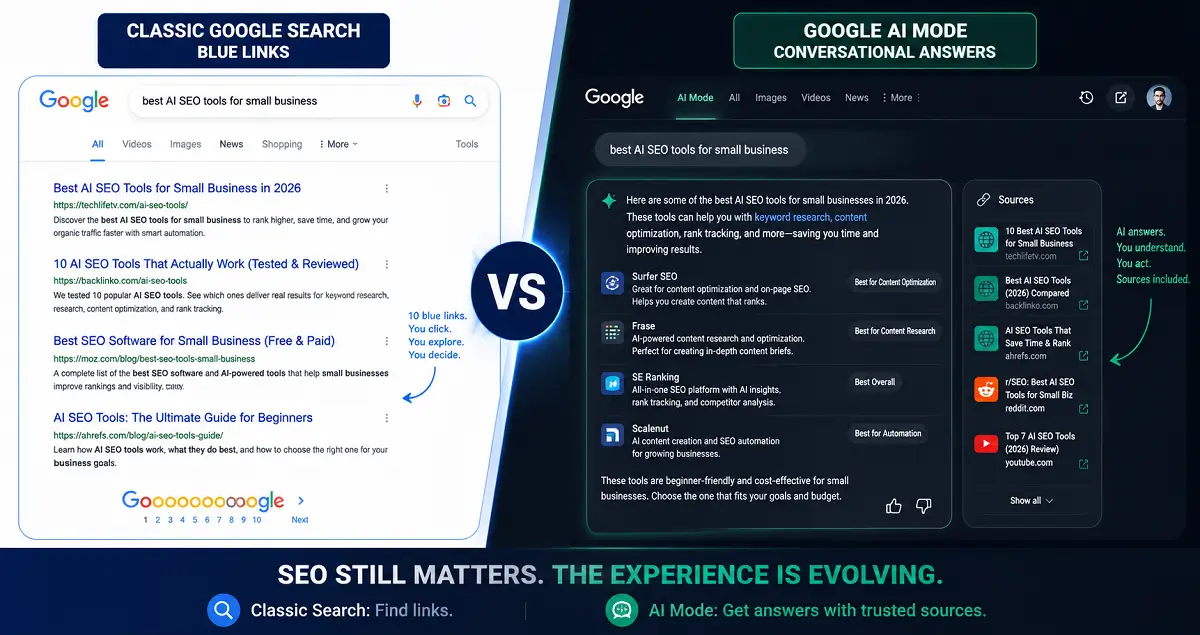
Google AI Mode SEO: What Changes, What Doesn’t, and How to Adapt

Table of Contents
Search ‘Google AI Mode SEO’ today, and you’ll find yourself in the middle of 2 parties. One says that SEO is dead. The other wants to sell you a brand new toolkit to survive it. Neither is being honest with you, and it’s taking up time you don’t want to waste.
In fact, according to Google’s own advice, the basic principles of SEO still hold when using AI Mode. It shows up there without any special optimizations and technical requirements. Weirdly, the changes are smaller and more specific than one thinks, and a lot easier to do. This guide will help you understand all the changes, what remains the same, and how to adapt in a smart way without spending one minute on a trend that doesn’t exist.
Does SEO Work in Google AI Mode?
Yes. Full stop. Google says the same foundational SEO practices that get you into classic search results are what get you considered for AI Overviews and AI Mode too. There’s no separate ranking system, no new file to create, and no special markup you’re missing.
What actually matters is whether your page already covers the basics people forget to check: search intent match, crawlability and indexability, and content that’s genuinely helpful and accurate. If your site struggles in classic search, AI Mode won’t rescue it. If your fundamentals are solid, you’re already in the race.
How Google AI Mode Works
Before you can adapt your strategy, it helps to see the mechanism in plain terms. Here’s the simple version:
Query → Fan-out → Retrieval → AI Response → Supporting Links
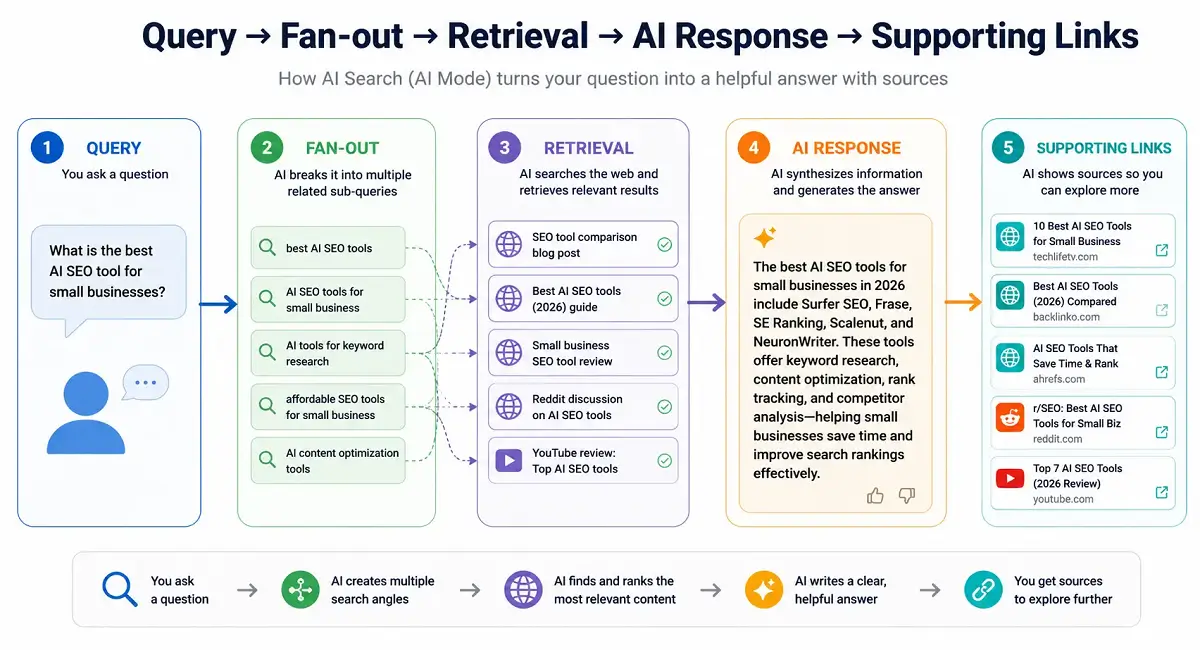
A person asks a question. Google breaks it into several related searches behind the scenes — that’s the fan-out. It retrieves relevant passages from its index, synthesizes them into one answer, and shows supporting links alongside it. Google describes this fan-out and retrieval process directly in its own documentation, so this isn’t a guess — it’s how the system is actually built.
How Google AI mode changes Google SEO Eecosystem
Google says AI Mode is particularly useful for exploration, reasoning, and complex comparisons — the kind of question that used to take three or four separate searches. It can pull from multiple sources at once, which means a wider and more diverse set of links can get surfaced than a classic top-10 list would ever show. For sites with strong topical authority in a niche, that’s a real opportunity, not just a threat.
Does AI Mode Reduce Clicks?
Here’s where you need to separate what Google says from what independent researchers say, because they’re not quite the same story.
Third-party SEO research this year has found real click-through rate declines on queries where AI Overviews or AI Mode responses appear, especially for simple, single-answer questions. More complex, multi-part queries see a smaller drop, since people often still want to dig deeper.
Google’s own data tells a slightly different part of the story: when people do click through from an AI-powered results page, those visits tend to be higher quality, meaning users spend more time on the site once they arrive. Fewer total clicks, but the ones you get may work harder for you. Both things are true at once, and a smart strategy for new AI Mode content plans around both.
Who Does AI Mode Matter Most For?
The impact isn’t even across content types. Knowing where you sit helps you prioritize instead of panicking.
- Informational content (quick definitions, basic how-tos): highest exposure, since AI Mode can often answer the question directly
- Commercial investigation (best-of lists, “should I buy X”): moderate exposure — people still want detail before deciding
- Product and affiliate content: lower exposure if it’s genuinely helpful and specific, since AI Mode tends to cite original comparisons rather than replace them
- Comparison content: often gains visibility, since fan-out queries frequently generate exactly this kind of question
- Local content: shifts toward accurate business details, reviews, and profile data mattering more than ever
- Complex research content: holds up well, since AI Mode still needs to cite a real, trustworthy source for nuanced answers
How SEO Changes in AI Mode
Google’s latest guidance is clear that optimizing for generative AI search is still SEO, not a separate discipline. Think of the shifts below as adaptations of what you already know, not new rules to memorize.
Ranking becomes retrieval and citation.
In classic search, you compete for a position. In AI Mode, you compete to be retrieved as a trustworthy source and cited inside the generated answer. There’s no position 7 here — you’re either part of the answer, or you’re not.
One query becomes a fan-out.
A single search can spin off into several related queries behind the scenes. Your content is now competing to answer a cluster of real sub-questions, not just the one your reader typed.
Content needs to be answer-ready.
The pattern that works best follows a simple flow: question, direct answer, explanation, evidence, context, related information. State your answer early. Don’t bury it under three paragraphs of throat-clearing.
Entity and context understanding matters more.
These systems read your content in terms of the people, tools, and concepts you’re discussing, and how they connect, not just the exact words on the page. Writing naturally about your full topic does more here than keyword-stuffing ever could
What Changes vs. What Doesn’t
| Traditional SEO | AI Search / AI Mode |
| Search query | Conversational, complex query |
| Ranking visibility | Answer and citation visibility |
| Single SERP path | Multiple retrieval paths (fan-out) |
| Page relevance | Passage relevance + entity context |
| Clicks | Clicks + engagement + citations |
| SEO fundamentals | Still SEO fundamentals |
That last row is the real message of this entire guide. SEO fundamentals — search intent, technical SEO, helpful content, strong on-page structure — are still doing the heavy lifting. Everything else is a shift in where that work pays off.
Google’s AI Search SEO Checklist
This isn’t our own list of “7 secret rules.” It’s Google’s own guidance, boiled down into something you can actually act on this week:
- Confirm crawling is allowed in your robots.txt and by any CDN or hosting layer in front of it
- Strengthen internal linking so your best pages are easy to find from other pages on your site
- Deliver solid technical SEO and page experience — fast load times, clean layout, no intrusive pop-ups
- Make sure your core content exists as real, readable text, not locked inside images or scripts
- Back up your writing with relevant images and video, and cite external references where they add credibility
- Keep structured data accurate and matching exactly what’s visible on the page
- Build topical authority with original, first-hand information — data, testing, or experience competitors can’t just copy
- Strengthen E-E-A-T signals with real author bios, sources, and credentials on your content
And here’s what you genuinely don’t need, no matter what a sales page tells you:
- No special AI schema markup
- No AI-specific structured data type
- No “AI text file” or new machine-readable format
- No separate AI-only technical SEO track
Google says this directly. None of it is required to appear in AI Overviews or AI Mode.
How to Measure Success in AI Mode
This section matters more than it did even a few months ago. On June 3, 2026, Google launched dedicated Search Generative AI performance reports inside Search Console, giving site owners their first real window into AI visibility. The reports break out impressions, pages, countries, devices, and dates for AI Overviews, AI Mode, and generative AI features in Discover — separate from your regular performance data, though click data isn’t included yet. Right now, the rollout covers a subset of UK site owners, with a global expansion expected but no confirmed date.
Until it reaches your account, or even after it does, here’s what a complete measurement approach looks like:
- Check Search Console’s new AI performance report if you have access, or the Performance report’s “Web” search type if you don’t yet
- Track brand mentions and citations manually or with a dedicated AI visibility tool
- Watch organic traffic and engagement trends in Analytics alongside impressions, not in isolation
- Tie any AI visibility gains back to actual conversions, not just impression counts
If you want a deeper answer to “how do I actually track AI Mode visibility,” our guide to the best AI Mode SEO tool and our AI Mode SEO tracker vs analysis tool comparison walk through the options by budget.
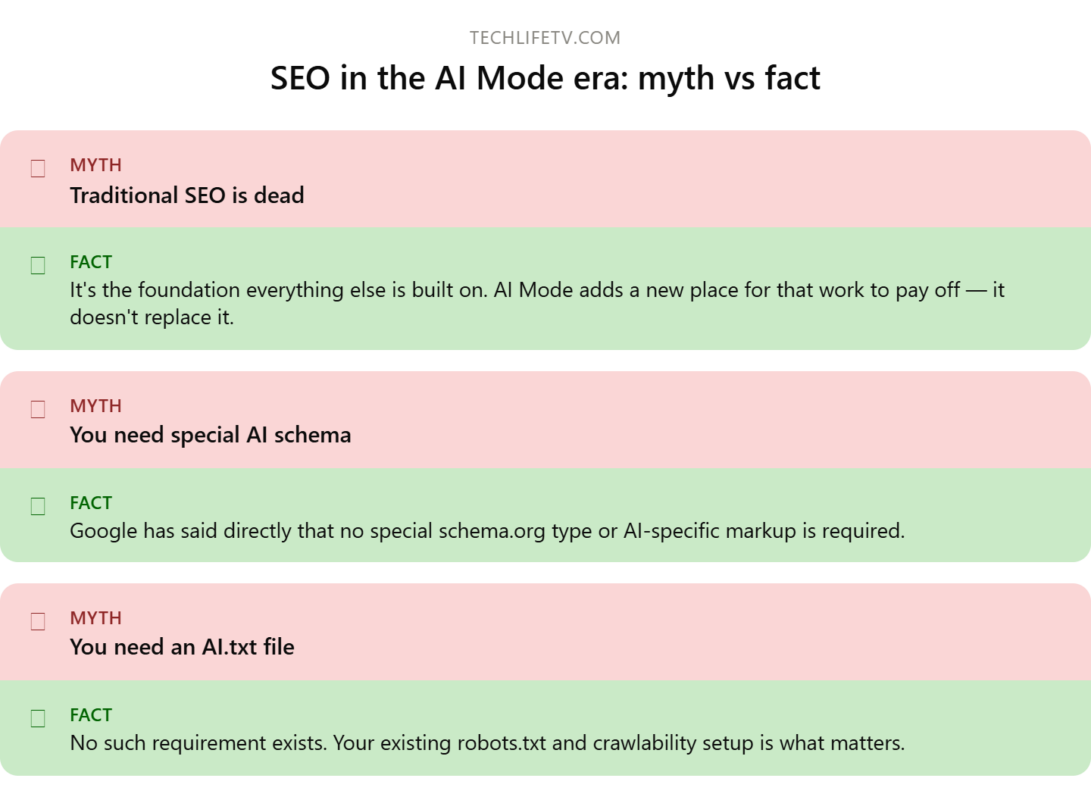
Common AI Mode SEO Myths
Myth: Traditional SEO is dead.
It’s the foundation on which everything else is built. AI Mode adds a new place for that work to pay off — it doesn’t replace it.
Myth: You need special AI schema.
Google has said directly that no special schema.org type or AI-specific markup is required.
Myth: You need an AI.txt file.
No such requirement exists. Your existing robots.txt and crawlability setup is what matters.
Myth: AI-generated content automatically wins.
Original, first-hand information and genuine expertise are what earn citations. Generic AI-written filler is easy for these systems to skip over.
Myth: Ranking number one guarantees an AI citation.
Retrieval and citation work on a different logic than ranking position. A well-structured page further down the list can still get cited if it answers the question more directly.
Common AI Mode SEO Mistakes
A few practical habits waste more time than anything above. Keep this list short and check it before you publish.
- Creating a separate page for every imagined fan-out variation of a query, instead of one strong page that covers the topic fully — Google’s May 2026 spam policy update explicitly extends existing rules against scaled, low-value content to cover attempts to manipulate generative AI responses
- Publishing generic AI-written content with no original data, testing, or first-hand experience behind it
- Measuring only classic rankings while ignoring AI visibility entirely
- Focusing on clicks alone instead of what those visits actually convert into
Frequently Asked Questions
How will SEO look in Google AI Mode?
Broadly familiar, with a shift in emphasis. Crawlability, helpful content, and clear information architecture remain the foundation. What’s new is that visibility now includes being cited inside a generated answer, which rewards well-structured, answer-ready content a bit more than before.
How does Google AI Mode change the Google SEO ecosystem?
It shifts some click volume away from simple, single-answer queries while keeping traffic steadier for complex or comparison-style searches. It also widens the pool of sites that can get surfaced, since fan-out pulls from a broader set of sources than a classic top-10 list ever did.
What’s a good SEO strategy for Google’s new AI Mode?
Stick to the fundamentals: crawlable pages, real textual content, strong internal linking, accurate structured data, and genuinely helpful writing backed by original insight. Then format your best content to be answer-ready, with a direct answer up front followed by explanation and evidence.
Does SEO work in Google AI mode, or is it a separate skill now?
It works, and it’s not separate. Google has said directly that the same SEO fundamentals apply here as everywhere else in Search. Treat AI Mode as a new surface for the work you’re already doing, not a new discipline to learn from scratch.
Is Google AI Mode SEO different from AI Overviews SEO?
The underlying fundamentals are identical. AI Mode is a fuller, more conversational experience built for multi-step research, while AI Overviews appears inline in classic results. Both draw from the same retrieval and fan-out systems, so the same content approach serves both.
Can I track how my site performs in Google AI Mode?
Increasingly, yes. Search Console’s new Generative AI performance report is rolling out to give site owners impression-level data (Only UK site owners). Until it reaches your account, a dedicated AI visibility tool or a manual tracking method can fill the gap.
What Should You Do Next?
The first one is simple: learn the way AI Mode works, rather than trying to build a new one, because you should first figure out what you can start tracking as those tools become available and then determine whether you need a dedicated tracker or analysis tool.
That’s the clever strategy on how to build your Google AI Mode SEO visibility without squandering time chasing shady tactics that never needed to be taken up in the first place. My fundamental promise on this site remains constant on any guide: By providing solutions that work — even when they aren’t the right solution — I can help you build visibility, trust, and revenue.
Ready for the next step? Our guide to the best AI Mode SEO tool breaks down budget-friendly options for measuring your visibility, and our AI Mode SEO tracker vs analysis tool comparison helps you pick the right one for where you’re at right now.
