
Best AI SEO Tools for Small Business 2026: Get Traffic & Leads

You’re doing everything right—posting content, tweaking your website, trying to figure out keywords—and Google still isn’t sending you traffic. Meanwhile, bigger competitors seem to dominate every search result without breaking a sweat. Sound familiar?
That frustration is real. Traditional SEO was built for teams with time, budget, and dedicated specialists—things most small businesses simply don’t have.
But here’s what’s changed: AI SEO tools for small business are completely shifting that equation.
Instead of relying on big budgets, full SEO teams, or constant content output, you can now use AI to handle keyword research, content creation, and technical SEO in a much simpler, more efficient way. What used to feel complex and time-consuming is becoming a clear, repeatable system.
That means less guessing, less overwhelm, and more focus on what actually grows your business.
In this guide, you’ll see which AI SEO tools actually matter, how to use them in a practical SEO workflow, and how to turn SEO into steady traffic, rankings, and long-term growth—without needing a big team or budget to make it work.
Table of Contents
Quick Takeaways: Best AI SEO Tools for Small Business Owners
- Cut SEO workload: Automate keyword research, content planning, and routine SEO tasks so you can focus on strategy and execution
- Boost search visibility: Discover low-competition keywords and untapped opportunities your competitors often overlook
- Improve content performance: Create structured, search-intent-focused content that ranks better and converts more visitors
- Make data-driven decisions: Use AI insights to replace guesswork with clear SEO direction based on real search data
- Scale without extra cost: Grow traffic and rankings without needing a full SEO team or increasing your marketing budget
Understanding AI SEO & Modern Search
Search isn’t what it used to be. Google doesn’t just match keywords anymore — it tries to understand why someone is searching. That shift changes everything for small businesses.
You’re already stretched thin. Between running operations, managing customers, and keeping the lights on, who has time to deep-dive into algorithm updates? That’s exactly where AI SEO tools earn their keep. At a practical level, they help you:
- Cut manual work by automating keyword research, content planning, and technical audits
- Target low-competition, high-intent keywords with real business value
- Create content that actually matches what users are searching for
- Move from research to published, optimized content way faster
And with AI Overviews now showing up directly in search results, your content needs to be crystal clear and easy to scan — or it simply won’t get seen.
Here’s the honest take: AI isn’t killing SEO. It’s just changing the game. Small businesses that adapt early are the ones pulling ahead.
Where AI SEO Tools Actually Move the Needle
Keyword Research — Find What’s Actually Winnable
Forget chasing head terms dominated by massive brands. AI tools like LowFruits and Semrush dig into the long-tail opportunities your competitors are sleeping on — discovering low-competition, high-intent keywords, uncovering related search terms based on how real users think, and spotting gaps where competitors aren’t fully showing up. High-intent searches with real buying signals and way less competition. That’s where small businesses win.
Content Creation — Write for People AND Search Engines
Once you know what people are searching for, you need content that actually answers it. You know your product — AI helps you communicate it in a way search engines reward. It builds outlines, drafts, and meta descriptions fast, improves readability so people actually stay and read, and aligns your content with what modern search and AI answer systems reward. Tools like Frase and NeuronWriter can turn a single keyword into a structured, search-ready article in minutes. Less guessing, more publishing.
Technical SEO – Stop Leaving Rankings on the Table
Great content still struggles if your site has hidden issues. Broken links, slow load times, crawl errors, duplicate content — these quietly kill your rankings without you even knowing. AI tools like Screaming Frog, Sitebulb, and Rank Math surface these problems fast, give you clear fix suggestions without needing a developer on call, and keep your site aligned with what Google — and AI search — actually needs. Clean site, better visibility. Simple.
Stop Losing Local Customers – The Right Local SEO Tools Put You on the Map
For most small businesses, local search is the highest-ROI channel, period. And the battle is won or lost on three things: citations, Google Maps visibility, and on-page optimization. Whitespark handles the first two better than almost anything else at its price point — and unlike BrightLocal or Moz Local, you’re not paying for a bloated platform when you only need a few things done well. Sharper beats broader when every dollar has to count. Its modular pricing means you pay for what you actually need, and its citation building, combined with Google Maps rank tracking, delivers real results without a big budget. Pair it with a fully optimized Google Business Profile (free) and Rank Math for on-page SEO, and you’ve got a complete local setup that’s genuinely enough to rank in the Maps 3-pack, drive local traffic, and turn searchers into calls — without an agency, without a big team, and without overcomplicating it.
Competitor Analysis – Learn from the Best
Don’t reinvent the wheel, just copy what works! Semrush and Ahrefs help you see exactly what keywords your competitors are ranking for, their traffic channels, and backlink profile – so you know exactly what you’re up against. Semrush’s Keyword Gap feature tells you what keywords your competitors are ranking for that you’re not. Ahrefs dives deeper into backlinks, so you can find what’s achievable to go after. And when it comes to content ideas, Frase tells you what the top-ranking pages are talking about so you can spot what they’re not and do it better than they have.
See what’s working – and do it better. The tools exist. The opportunity is real. All you need is an effective workflow.
Competitor Analysis – Compete Smarter, Not Harder
Why guess when you can just see what’s already working? AI breaks down competitor keyword strategies, content angles, and backlink profiles — so you can spot the gaps, find backlink opportunities you can realistically go after, and track what’s gaining traction so you move faster. Learn from what’s already ranking — then do it better.
The tools exist. The opportunity is real. The only thing left is building a workflow that actually gets results.
How to Choose the Right AI SEO Tool
Here’s the truth most tool roundups won’t tell you — the best AI SEO tool isn’t the most popular one. It’s the one that actually fits your budget, your skill level, and your goals. Everything else is just noise.
Budget: Spend What Makes Sense
If you’re just getting started, free and low-cost tools like Google Search Console, Rank Math, and LowFruits are more than enough to get early wins without the learning curve. Mid-range tools like Frase, NeuronWriter, and KeySearch hit the sweet spot — real SEO power without draining your budget. And if you’re ready to go all in, platforms like Semrush and Ahrefs give you deep competitor data, full-scale tracking, and everything in between.
Skill Level: Be Honest With Yourself
Beginners do best with tools that guide rather than overwhelm — Rank Math, LowFruits, and Frase are built for that. If you’ve got experience and want more control, Semrush, Ahrefs, and Surfer SEO give you the depth to work with — but they reward people who already know what they’re doing.
Goal: Traffic, Leads, or Content Volume?
Chasing traffic? Lead with keyword tools like LowFruits and Semrush to find opportunities that actually rank. Focused on lead generation? Pair Frase with Surfer SEO to build content that converts, not just content that shows up. Need to scale your content output fast? ChatGPT or Scalenut gets you there without burning through your entire week.
Match your budget, skill level, and goal — and you’ll stop wasting time on the wrong tools and start seeing results that actually matter.
Top AI SEO Tools for Small Businesses (The Ones That Actually Work)
Let’s be real — there are way too many SEO tools for small Businesses out there. Most of them you don’t need. What actually moves the needle for a small business is a lean, intentional stack that helps you find opportunities, create better content, and rank without overcomplicating everything.
Think of this as your practical discovery map — not every tool that exists, but the ones that make real sense in real SEO work.
All-in-One SEO Platforms
Semrush is what you reach for when you want the full picture in one place. Keyword research, competitor insights, content ideas, site audits — it’s all there. The real power is in finding keyword gaps your competitors rank for that you’re completely missing. Fair warning, though: it’s incredibly powerful, and that can feel like a lot when you’re new to it.
Scalenut is an all-in-one AI SEO + content marketing tool that helps you plan, create, optimize, and scale content—from keyword to ranking.
Flow:
keyword → content → optimize → publish → rank → scale → repeat
The promise of Scalenut is simple: turn a keyword into a published, ranking article, all in the same place. You can do keyword research, create clusters, draft articles with AI, and optimize your content all in the same platform. That’s important for small businesses. It eliminates the barriers that keep most people from publishing – no white page, no Post-it notes, no five browser windows. You still do the thinking, the editing, and the final call. But Scalenut keeps the whole SEO workflow moving — and at that price point, it’s a genuinely hard combination to beat.
Ahrefs goes deep rather than wide. It’s the strongest tool in the room when it comes to backlinks and understanding why a competitor outranks you. If you want to study their link profile and find real opportunities to close that gap, Ahrefs is built for exactly that. Just know it’s not beginner-friendly, and it’s not cheap.
Budget-Friendly & Entry-Level Tools
LowFruits is where smaller sites finally get a fair shot. Instead of going head-to-head with authority sites on competitive keywords, it surfaces the low-competition opportunities the big players are ignoring. Less about massive traffic volume, more about wins you can actually get early on.
KeySearch keeps everything simple. It gives you just enough keyword data to make a smart call — without drowning you in dashboards. It’s especially useful for quickly checking whether a keyword is even worth your time before you write a single word. The database is smaller than premium tools, but for most small businesses, it’s more than enough.
Content Creation & Optimization Tools
Frase is what saves you from the blank page. It pulls the top-ranking pages for your keyword and turns them into a clear content outline — so you’re not guessing at structure or topic coverage. It works best when you bring your own real-world experience to it, not just let it do all the thinking.
Surfer SEO acts like a live checklist based on what’s already winning on Google. It shows you what your content is missing — structure, coverage, keyword use — so you can close the gap. One thing to watch: leaning too hard on its scoring system can make your content feel formulaic. Use it as a guide, not a rulebook.
NeuronWriter goes a layer deeper — it’s less about keyword stuffing and more about semantic depth and topical completeness. If you’ve got thin content that needs to become a comprehensive guide, this is the tool for that job. Takes a little time to get comfortable with, but the output quality is worth it.
ChatGPT or Claude is your speed layer. Neither one replaces real SEO thinking, but both are incredibly useful for moving fast — turning outlines into full drafts, generating ideas, or expanding sections in minutes. Give it a clear direction, or the output stays too generic to be useful.
The Real Pattern – How This Actually Works
Stop thinking about these as random tools and start thinking of them as a simple flow:
- Find opportunities → LowFruits / KeySearch / Semrush
- Build structure → Frase/Scalenut
- Create content → ChatGPT / Claude
- Sharpen for rankings → Surfer SEO / NeuronWriter
- Build authority → Ahrefs / Semrush / Scalenut
That’s the whole system. No complexity beyond that.
Most small businesses don’t fail because they lack tools — they fail because everything feels disconnected. The real edge comes when you stop chasing the next shiny tool and start running a simple, repeatable process. Use fewer tools. Use them with intention. And stay consistent long enough for your content to actually compound into real traffic.
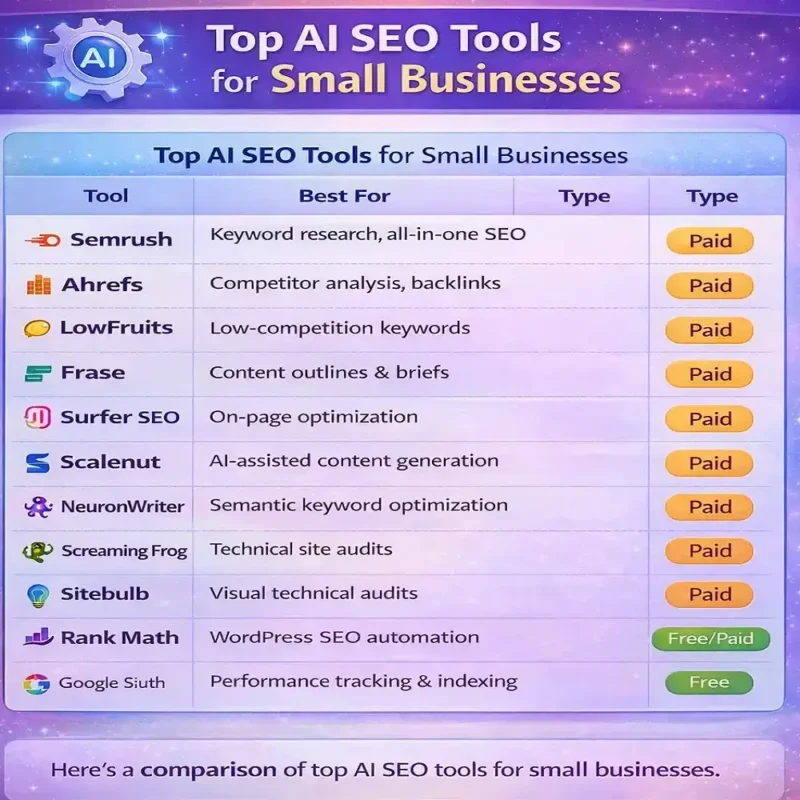
Comparison Table of Top AI SEO Tools
| Tool | Best For | Ease of Use | Pricing Tier | Key Strength | Effort Level | Limitation | Use If… |
| Semrush | All-in-one SEO, keyword research | Medium | Premium | Huge data + full SEO suite | High | Expensive, learning curve | You want a complete SEO system and can invest in growth |
| Ahrefs | Backlinks, competitor analysis | Medium | Premium | Best backlink database | High | High cost, less beginner-friendly | You want to compete in tough niches and build authority |
| LowFruits | Low-competition keywords | Easy | Budget | Finds easy-to-rank opportunities fast | Low | Limited advanced features | You want quick wins and early rankings on a small site |
| KeySearch | Budget keyword research | Easy | Budget | Simple UI + affordable | Low | Smaller keyword database | You’re starting SEO on a tight budget |
| Frase | Content briefs & outlines | Easy | Mid-range | SERP-based content planning | Medium | Needs manual editing | You want faster, search-intent-based content planning |
| Surfer SEO | On-page optimization | Medium | Mid–High | Data-driven content scoring | Medium | Can feel rigid | You want structured, predictable ranking improvements |
| Scalenut | AI content + SEO workflow | Easy | Mid-range | All-in-one content creation | Low–Medium | Output needs refinement | You want to scale content production quickly |
| NeuronWriter | Semantic optimization | Medium | Budget–Mid | Strong NLP-based suggestions | Medium | UI/performance issues | You want deeper topical SEO without high cost |
| Screaming Frog | Technical SEO audits | Hard | Mid-range | Deep technical analysis | High | Not beginner-friendly | You need full technical SEO control and audits |
| Sitebulb | Visual SEO audits | Medium | Mid-range | Easy-to-understand reports | Medium | Paid for full features | You want clear, visual technical SEO insights |
| Rank Math | WordPress SEO | Easy | Free / Paid | Beginner-friendly + powerful | Low | WordPress-only | You want simple on-page SEO inside WordPress |
| Google Search Console | Performance tracking | Medium | Free | Direct Google data | Low | Limited advanced insights | You want accurate keyword and indexing data |
| Google Analytics | User behavior & ROI | Medium | Free | Deep traffic insights | Medium | Steep learning curve | You want to understand user behavior and conversions |
Pro Tip: How to Use This Table
- Beginner? → Start with LowFruits + Frase + Rank Math
- On a budget? → KeySearch + NeuronWriter + Google Search Console
- Scaling up? → Semrush or Ahrefs + Surfer SEO + Scalenut
- Technical issues? → Screaming Frog or Sitebulb
Don’t choose tools based on popularity — choose them based on what you actually need right now. Think of your AI SEO tools as a workflow stack:
Keyword research → Intent analysis → Content planning → Content creation → On-page optimization → Performance tracking → Optimization & expansion → Repeat. That’s how small businesses turn AI SEO tools into real rankings, traffic, and growth
Best AI SEO Tools by Use Case – Quick Reference
What are the best AI SEO tools for small businesses?
The short answer: there’s no one best tool, there’s one best stack for you. But most small businesses can get by with this minimalist setup: LowFruits (to discover keywords you can rank for), Frase (to quickly build content skeletons), Rank Math (to make your WordPress site search engine friendly), and Google Search Console (to analyse what’s working). On a tighter budget, that whole setup costs less than one premium subscription — and it covers the full workflow from keyword to published, optimized content.
Here are the best AI SEO Tools for our use case
- Keyword research → LowFruits, KeySearch, Semrush — LowFruits for easy wins, KeySearch for simplicity, Semrush when you’re ready to scale.
- Beginners → LowFruits, Frase, Rank Math — find low-competition keywords, build structure, optimize without the overwhelm.
- SERP-based outlines → Frase — stops the guessing and aligns your content with real search intent from day one
- Content creation → ChatGPT / Claude — fast drafts and scalable writing, just don’t skip the human editing
- Content optimization → Surfer SEO, NeuronWriter — Surfer for structure and scoring, NeuronWriter for deeper topical coverage
- All-in-one → Ahrefs, Semrush, Scalenut — full SEO ecosystems with research, backlinks, and tracking, plus Scalenut’s built-in AI content layer
- Zero budget → Google Search Console + Rank Math — free, powerful, and genuinely enough to start ranking if you use them properly
- Affordable stack → LowFruits + Frase + Scalenut + Rank Math — covers research, content, and optimization without overspending
Each tool solves a specific problem. Put the right ones together, and you’ve got a lean, scalable SEO system that actually drives traffic — without the chaos of trying to use everything at once.
Building Your AI SEO Stack ( SEO Workflow Execution System, Not Just Tools)
A strong AI SEO stack isn’t about stacking more tools—it’s about running a repeatable execution system that moves one idea from keyword → ranking content.
Most small businesses don’t struggle because they lack tools. They struggle because the tools are disconnected. This system fixes that.
1. Keyword Research → Find Real Opportunities
Start by targeting keywords you can actually rank for—not just the ones with the highest search volume.
• Example tools: LowFruits, KeySearch, Semrush
• What you do: Identify low-competition, high-intent keywords that match your site’s strengths
Example: Instead of chasing “SEO tools,” you go after “AI SEO tools for small business.”
This step sets the direction. If you get this wrong, everything else becomes harder.
2. Intent Analysis
It is pointless to rank the right keyword and read between the lines why somebody is searching. It is intent analysis that makes you know whether a searcher wants to know something, make a comparison, or draw out his/her credit card, and the difference makes everything different in how you write the content. It can be found automatically in AI tools such as Frase and Surfer SEO without you having to guess at the structure or angle before you can even write a single word. Get the intent right, and the rest of the content strategy gets a lot easier.
3. Content Planning → Build a Clear Structure
Turn your keyword into a structured outline before you write anything.
• Example tools: Frase. Try Frase Free
• What you do: Analyze top-ranking pages and build a search-intent-driven outline
Example: Frase suggests headings based on what Google is already rewarding
A strong structure removes guesswork and makes writing feel effortless instead of overwhelming.
4. Content Creation → Draft With Speed
Now you turn structure into content—fast, but not blindly.
• Example tools: ChatGPT, Claude, Scalenut
• What you do: Expand outlines into full drafts, then refine with your own insights
Example: You generate a full section quickly, then reshape it with real experience and clarity
AI accelerates the process, but your input is what makes it valuable and trustworthy.
5. On-Page Optimization and Technical SEO -Make It Competitive and Keep It Clean.
Good content not being optimized is merely a well-written page that no one visits. This is where content starts to rank — not just exist. Surfer SEO and NeuronWriter can help you see precisely what you need to add versus pages that are already doing better in the search results, whether it’s structure, coverage of keywords, or coverage of the topic, and you are refining, not rewriting. Frase takes what the higher pages occupy and emphasises the holes in yours. Minor gains in this area result in unexpectedly large ranking disparities. But even perfectly optimized content struggles if your site is quietly working against you.
Broken links, slow load times, crawl errors, and missing metadata are the hidden barriers that kill rankings without you ever knowing why. Rank Math will grab most of them internally with WordPress without the help of a developer, and Screaming Frog will take you further with a complete technical audit when you require one. Fix the errors, clean up the metadata, improve crawlability — and this step quietly protects everything else you’ve built.
6. Tracking & Growth → Improve What Works
Publishing is not the end—it’s the feedback loop.
• Example tools: Google Search Console, Google Analytics
• What you do: Track rankings, clicks, and user behavior
Example: You find a page gaining traction and double down with updates and internal links
This is where SEO becomes predictable instead of random.
You don’t need more tools—you need a system that actually flows:
Research → Plan → Create → Optimize → Fix → Track
Each step has a purpose. Each tool has a role.
That’s how small businesses stop guessing and start building consistent rankings, traffic, and compounding growth—without overwhelm.
7. Optimization & Expansion — Publication is the New Frontier.
The majority of small business owners publish and move on, which is the reason why their content plateaus. The real gains come after. Identify pages that are picking up using Google Search Console, and revise them with more up-to-date information, internal links, and coverage of keywords. Surfer SEO or NeuronWriter can reveal precisely what is lacking in comparison to pages that rank higher than yours, minor details that make huge ranking jumps with time. Semrush allows you to discover new keyword opportunities from already-working content so that you grow off a position of strength, versus starting each time with a blank slate. The companies that compound their growth in SEO are not publishing more articles; they are just constantly refining what is already there. Update, optimize, expand, repeat. That’s where the rankings, traffic, and revenue actually stack up.
What Actually Happened: Honest Lessons from the Field
What Didn’t Work
Publishing raw AI content flopped — it felt generic and added nothing new. Chasing high-volume keywords from Semrush or Ahrefs also backfired for smaller sites. It killed momentum more than it built it.
The Learning Curve
LowFruits and Rank Math are easy to pick up. Frase takes a little getting used to. Semrush and Ahrefs? You’ll need a solid SEO foundation first — otherwise you’re paying for features you can’t fully use.
The Real ROI
Rankings improved, but the bigger win was efficiency. Better keywords, faster. More consistent publishing. Less guessing. That’s what created real, compounding growth.
Using AI SEO Responsibly
AI helps — but it doesn’t think for you. Your judgment still matters more than any tool.
When AI suggests a high-volume keyword, your experience is what tells you the intent is informational, not commercial. That distinction changes everything. Treat AI as a co-pilot, not the driver.
Google also rewards E-E-A-T — Experience, Expertise, Authority, Trust. AI can handle structure and optimization. You bring the real-world examples, case studies, and insights that actually build credibility.
And always fact-check, avoid keyword stuffing, and disclose AI assistance where it makes sense. Ethical SEO isn’t just good practice — it builds the kind of trust that converts.
Mistakes That Quietly Hold You Back
- Over-relying on AI content — It drafts fast but lacks depth. Your voice and experience can’t be automated.
- Ignoring search intent — The right keyword means nothing if the content doesn’t match what the user actually wants.
- Tool overload — More tools don’t equal better SEO. A focused stack beats a cluttered one every time.
- Trusting AI data blindly — Always cross-check keyword difficulty and SERP insights against real Google results.
AI doesn’t replace SEO thinking — it rewards it. Fewer tools, clearer strategy, consistent execution. That’s the actual edge.
Measuring Growth: How to Know Your AI SEO Is Actually Working
Implementing AI SEO tools for small businesses only moves the needle if you’re tracking the right numbers. Otherwise, you’re just guessing.
The metrics that actually matter:
- Organic traffic growth — are more people finding you through search?
- Keyword rankings — are you moving up for the terms that matter to your business?
- Click-through rate (CTR) — are people choosing your result over competitors?
- Time on page and bounce rate — are visitors staying and engaging, or leaving immediately?
- Conversion rate — is your traffic turning into leads, sales, or signups?
One practical tip: track weekly or monthly — not daily. SEO moves slowly, and daily fluctuations will just stress you out without telling you anything useful.
The Free Tools That Tell You Everything
You don’t need expensive dashboards to measure SEO performance. Two free tools cover most of what small businesses actually need:
Google Search Console shows you exactly which keywords are driving clicks, how your pages are indexed, and where your rankings stand. It’s your direct line to how Google sees your site.
Google Analytics goes deeper into behavior — how long people stay, which pages convert, and where traffic drops off. Together, these two tools give you a complete picture without spending a dollar.
As your content grows, AI dashboards inside tools like Semrush or Frase help you connect the dots across keyword research, content performance, and optimization — all in one place.
Using AI Insights to Spend Your Budget Smarter
This is where AI SEO pays for itself. Instead of guessing where to invest your time and money, you let the data decide.
- Double down on content that’s already gaining traction
- Cut spending on campaigns that aren’t converting
- Automate repetitive tasks — audits, reporting, briefs — so you can focus on strategy
Think of your AI SEO stack as an investment with compounding returns, not a monthly expense.
The Next Frontier: AI Overviews and Generative Search
Search isn’t just blue links anymore. Google’s AI Overviews now summarize answers directly in results — and your content can appear there, but only if it’s structured the right way.
What that means practically:
- Use clear headings and concise answers that Google can pull directly
- Add structured data and schema markup so AI understands your content’s context
- Format key sections as lists, tables, or direct Q&A — formats that AI systems can retrieve easily
- Keep page speed fast and mobile experience clean — AI-driven results favor technically sound pages
Think of your content like a well-labeled package. If Google’s AI can’t quickly identify what’s inside, it’ll move on to a competitor’s page that makes it easier.
SEO Is Evolving — Here’s What’s Coming Next
Traditional SEO is merging into something broader called Generative Engine Optimization (GEO) — optimizing not just for search rankings but for AI-generated answers across Google, ChatGPT, Perplexity, and beyond.
For small businesses, that means:
- Building content with strong E-E-A-T signals — real experience, genuine expertise, demonstrated authority
- Structuring every page so AI systems can retrieve and cite it accurately
- Monitoring AI answer performance through Search Console alongside traditional ranking data
GEO doesn’t replace SEO — it amplifies it. The businesses that get this right now will have a significant head start as generative search becomes the default way people find information.
Here’s How Small Businesses Can Win at SEO with low-Cost
Here’s the deal – AI SEO tools aren’t for time savings. They’re about playing big with a small team or agency budget.
The companies leading in search aren’t creating more content. They’re publishing better – with a strong structure, real intent match, and a low-friction workflow that they actually follow.
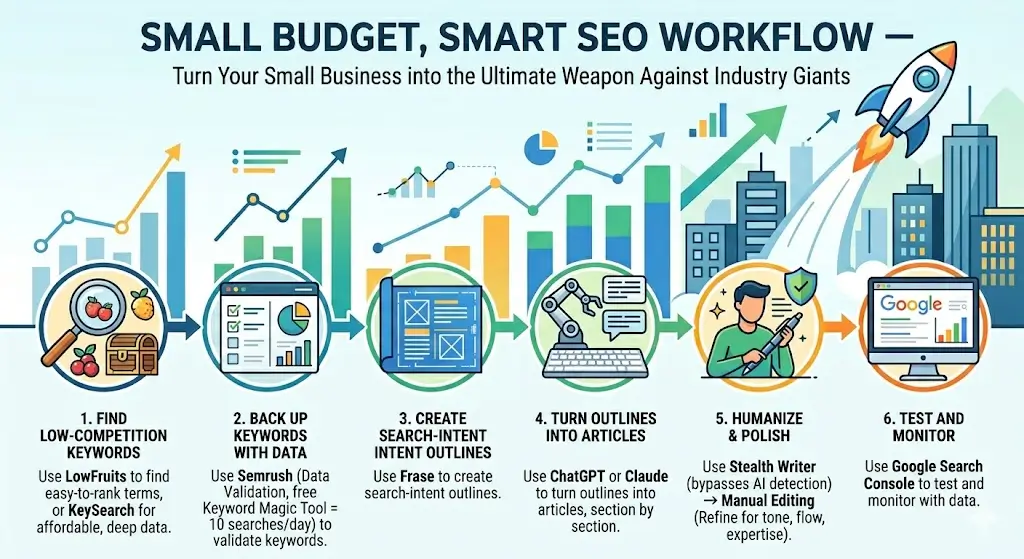
Here’s the low-cost stack they use:
LowFruits → Low-competition keywords you can realistically rank for. Try LowFruits For Free
KeySearch → Cheap, in-depth keyword data. Try Keysearch Today
Semrush → Back up keywords with data (free Keyword Magic Tool = 10 searches/day)
Frase → Use keywords to create search-intent outlines. Try Free Trial
ChatGPT / Claude → Turn outlines into articles, section by section. Signup now, its Free
Humanize → Stealth Writer. Sign Up today for free Use
Rank Math → Optimize before publishing. Try Rank Math Free
Google Search Console → Test and monitor with data
No overwhelm. No tool-hopping. Just a process that improves with each iteration.
SEO is a marathon, not a sprint. Each new page gives you more authority, more trust, and more of the rankings that count. You’re closer to big players than you think – with the right tools, you can close the gap without the money they’d spend to do it.
Pick one keyword today. Build your outline tonight. Publish this week.
That’s not a plan. That’s momentum.
FAQ of AI SEO Tools for Small Business
What’s the best AI SEO tool?
It’s not a tool, it’s a focused stack. LowFruits or Semrush for keywords, Frase for content, Screaming Frog for technical. They work better as a group than individually.
Which AI-powered SEO tools are best for small businesses?
Don’t go for the tool that matches your goal – get the tool that matches your level. Consider your budget, expertise, and key problem. If you’re struggling to find keywords, start with LowFruits or KeySearch. If it’s content, then Frase or Scalenut. If you have technical problems with Rank Math or Screaming Frog. Beginners should prioritize tools that guide rather than overwhelm. And don’t go tool crazy at first – one or two tools well used is far better than five tools used badly.
What’s the 80/20 rule in SEO?
80% of the results come from 20% of the effort. Prioritise a few high-intent, easy-to-rank keywords and pages. Less is more.
Are AI SEO tools worth it?
Yes – particularly if you’re short on time or money. They save time, unearth opportunities more quickly, and provide hard data.
Does ChatGPT do SEO?
It helps with SEO, but doesn’t replace tools. Good for first drafts and outlines – but use with Frase or Surfer for optimization scores.
Best tools on a tight budget?
Free Google Search Console and Rank Math, and the cheap LowFruits. This gives you keyword tracking, on-page optimisation, and low-competition keywords – the trifecta.
Best for beginners?
Rank Math, Frase, and LowFruits. Easy to use, no technical SEO skills needed.
Best tools for local businesses?
Google Business Profile, Rank Math, and LowFruits. Local SEO, on-page optimisation, and local keyword research – all done.
Use 3-5 tools, follow Smart SEO Workflow, measure, and improve. The right tools get you ranking quickly, build trust and revenue – all on a budget.