Rank Math vs Yoast (2025): The Shocking Winner Revealed!
The SEO Landscape Has Changed
Is your SEO plugin stuck in 2020? Blink, and the rules of search have changed. What once worked–keyword stuffing, meta title hacks, and generic SEO plugins–is now barely scraping the surface of what Google values. Today, search engines care about user intent, AI-driven content optimization, and structured data. If your WordPress SEO plugin isn’t helping with these, you’re likely leaving traffic–and revenue–on the table.
That’s why the debate between Rank Math vs Yoast (2025) is more relevant than ever. Millions of WordPress users face the same question: which plugin will actually help them rank faster, capture rich snippets, and maximize visibility in a world where AI and intent dominate search results?
Both plugins have loyal followings. Yoast has long been considered the “classic” solution for beginners, with its traffic-light system for readability and simple guidance for SEO novices. Rank Math, on the other hand, is positioning itself as the AI-powered, all-in-one solution — flexible, fast, and packed with features that once required multiple plugins or premium tools.
So how do you decide which one truly delivers in 2025?
Table of Contents
TL;DR Verdict
Bottom Line Up Front (BLUF):
| Feature Focus | Recommended Plugin | Why |
| Automation & Free Features | Rank Math | Offers Content AI, schema, redirects, 404 monitoring, and more—all included in free tier. |
| Guided, Beginner-Friendly Approach | Yoast | Simpler interface, traffic-light readability system, structured guidance for novices. |
Quick Take:
- If you want automation, AI-driven content suggestions, and maximum SEO features without extra cost, Rank Math is your go-to.
- If you prefer a guided, conservative approach to SEO–one that slowly introduces you to best practices–Yoast still holds value, especially for beginners.
Why This Comparison Matters in 2025
SEO isn’t just about ranking–it’s about visibility, conversions, and staying competitive. In 2025:
- Google evaluates content contextually, looking at intent and semantic relevance rather than raw keyword density.
- Structured data like FAQ schema, review schema, and article schema can directly influence click-through rates and rich snippet visibility.
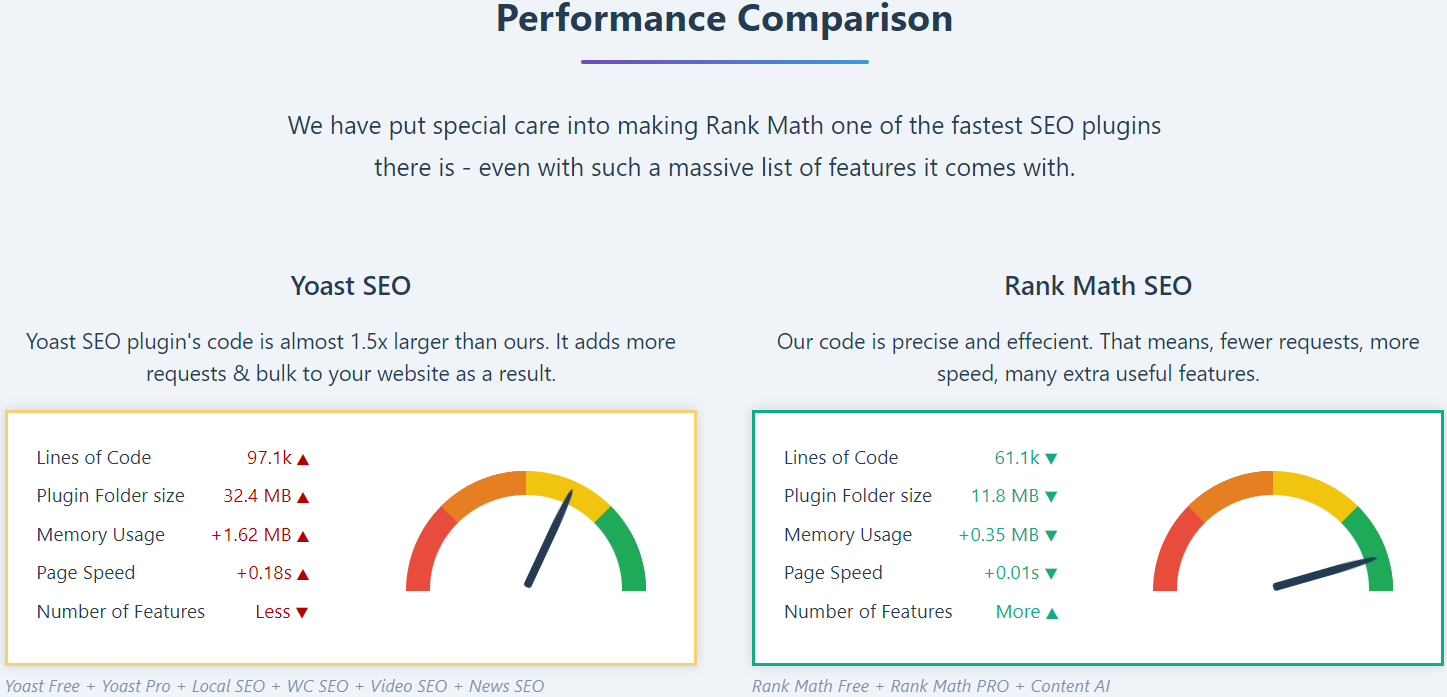
- Page speed and modular plugin design affect Core Web Vitals, which directly influence rankings.
- Automation is no longer a luxury; it’s a necessity. Rank Math SEO plugin now provides Content AI and automated indexing to ensure your site keeps up with evolving algorithms.
In short, picking the wrong plugin can leave you stuck in the SEO past, while the right plugin can help you capture rich snippets, improve CTR, and scale content efficiently.
What to Expect in This Article
- A 2025-ready comparison table of Rank Math vs Yoast.
- A deep dive into AI, intent, and content optimization.
- Analysis of technical SEO features like schema, redirects, and performance.
- Pricing breakdowns and ROI calculations.
- Set up tips and migration steps for those moving from Yoast to Rank Math.
- Real-world performance tests: speed, indexation, and SERP impact.
- A final verdict on which plugin is the overall winner in 2025.
By the end of this guide, you’ll have a clear understanding of which plugin aligns with your site goals, audience, and workflow–and how to configure it in under 15 minutes to get maximum SEO impact.
Try the Winner — Free Guide & Setup ChecklistAt a Glance: The 2025 Comparison Table
To help you quickly digest the Rank Math vs Yoast (2025) showdown, here’s a structured comparison table designed for clarity—and optimized so Google can pull it into a Knowledge Graph snippet.
| Feature | Yoast SEO (Free/Premium) | Rank Math (Free/Pro) |
| Keyword Limit | Free: 1 keyword / Premium: multiple | Free: 5 keywords / Pro: unlimited |
| Schema Capability | Basic; Premium required for advanced types | Advanced built-in (Article, Recipe, Review, Video, Local) |
| AI Tools | Minimal; meta description helper | Content AI: LSI keywords, SERP-based scoring, suggestions |
| Redirect Manager | Premium-only | Built-in free |
| 404 Monitoring | Premium-only | Built-in free |
| Local SEO | Paid add-on | Built-in free module |
| Support | Limited free / Priority with Premium | Active free support; Pro for advanced help |
| Price | $99/year per site (Premium) | $59/year Pro; Free is robust |
| Automation | Partial (meta suggestions, readability) | Extensive (Content AI, indexing, image SEO, schema) |
Key Takeaways from the Table
- Entities That Matter in 2025: Rank Math emphasizes Content AI, Schema Generator, and Site Speed–key signals for modern search engines.
- Free Tier Advantage: Rank Math’s free version covers many features locked behind Yoast Premium, including redirects, 404 monitoring, and advanced schema.
- Scalability for Growth: Agencies and content-heavy sites get more ROI with Rank Math Pro because the price per site drops, and the feature set covers multiple use cases without purchasing add-ons.
Why This Matters for Your Site
Think of your SEO plugin as the foundation of a house. If it doesn’t cover automation, structured data, and performance, no matter how strong your content is, your site will struggle to achieve maximum visibility. The table above gives a snapshot of which plugin builds a robust, future-proof SEO foundation for 2025.
Pro Tip: When reviewing this table, pay attention to built-in features vs. add-ons. Each extra plugin or paid module adds weight, maintenance, and potential conflicts–something Rank Math mitigates with a modular design.
The Core Battle: AI, Intent, and Content Optimization
SEO in 2025 isn’t just about placing keywords–it’s about understanding your audience’s intent and giving search engines clear signals that your content satisfies that intent. This is where the battle between Yoast and Rank Math SEO Plugin gets interesting. Both plugins help you optimize content, but their approaches, underlying AI capabilities, and attention to user intent differ significantly.
Yoast’s Approach: The Classic Readability Coach
Yoast has built its reputation on simplicity and guiding beginners. Its traffic-light system–green for good, orange for okay, red for needs improvement–makes SEO accessible even for non-technical users.
Pros:
- Excellent readability guidance for blog posts, tutorials, and beginner content.
- Meta description and SEO title helpers streamline content optimization.
- Step-by-step suggestions for headings, paragraph length, and keyword usage.
Cons:
- The free version focuses primarily on one target keyword per page.
- Less emphasis on semantic keywords or LSI variations.
- Limited AI features; suggestions are rule-based rather than data-driven.
In other words, Yoast teaches you to write for SEO, but it doesn’t think for you. Beginners love this guidance, but power users may feel constrained.
Rank Math’s Approach: The AI-Powered Assistant
Rank Math takes a different route: instead of just guiding, it analyzes and recommends. Its Content AI module integrates SERP analysis, LSI keyword suggestions, and semantic topic coverage directly into the WordPress editor.
Key Features:
- LSI Keyword Suggestions: Helps cover related topics naturally.
- Content Scoring: Measures your content against top-ranking pages for your target query.
- Meta & Snippet Optimization: Suggests titles, meta descriptions, and FAQs to maximize CTR.
- Automation: Content AI can suggest headings, word counts, and readability improvements automatically.
This makes Rank Math SEO Plugin less about learning SEO rules and more about applying them strategically–a critical advantage for competitive niches where every ranking factor counts.
Which Plugin Understands “User Intent” Better?
Understanding user intent means aligning your content with what people actually search for. Rank Math outperforms Yoast here in multiple ways:
- Meta Descriptions & Titles: Rank Math previews rich snippets dynamically, showing exactly how your listing will appear in Google. Yoast provides previews, but without AI-assisted CTR optimization.
- Snippet Optimization: Rank Math uses Content AI to analyze SERP features and suggest modifications to increase chances of featured snippets.
- Question-Based Content: Rank Math integrates FAQ schema suggestions directly into the editor, improving “People Also Ask” chances.
Yoast helps you structure content properly, but Rank Math actively guides you to match searcher intent and compete for position zero, rich snippets, and higher CTR—all essential in 2025.
Yoast helps you structure content properly, but Rank Math actively guides you to match searcher intent and compete for position zero, rich snippets, and higher CTR–all essential in 2025.
Summary Takeaways
- Beginner-Friendly vs. Data-Driven: Yoast excels in accessibility and teaching best practices. Rank Math excels in AI-driven decision-making for serious site owners.
- Keyword Strategy: Rank Math supports multiple keywords, LSI suggestions, and semantic content, whereas Yoast limits most advanced keyword functionality to premium.
- CTR & Rich Snippets: Rank Math’s snippet previews, schema suggestions, and FAQ integration provide actionable tools to capture clicks, not just improve readability.
- Verdict in the Core Battle: Rank Math wins for AI, intent alignment, and content optimization, especially for bloggers, affiliates, and e-commerce sites that compete in saturated markets. Yoast remains excellent for beginners who prioritize learning the basics of SEO and readability.
Technical SEO & Features: Who Offers More?
Beyond content optimization, a WordPress SEO plugin must handle the heavy lifting behind the scenes. This includes schema markup, redirects, 404 monitoring, and site speed, all of which influence rankings, UX, and conversions. Let’s break down how Yoast vs Rank Math perform in these critical areas.
Schema Markup & Rich Snippets (The “Secret Weapon”)
Schema markup has become essential for ranking in 2025. It signals to search engines what type of content you’re publishing and unlocks rich snippets like featured answers, reviews, and FAQ boxes.
Yoast:
- The free version provides basic schemas like Article and Organization.
- Advanced schema requires paid add-ons or Yoast Premium, meaning extra investment for businesses.
- Block-level schema control is limited unless you customize it manually.
Rank Math:
- Built-in Schema Generator in the free version. Supports Article, Recipe, Review, Video, Local SEO, FAQ, and How-to.
- Dynamic schema integration: automatically adapts to post type, categories, and content changes.
- Facilitates “Position Zero” opportunities with minimal effort.
Why It Matters: Rich snippets increase click-through rates by up to 30%. A plugin that automatically generates schema gives your site a measurable advantage over competitors.
Redirects & 404 Monitoring
Managing redirects and broken links is crucial for preserving link equity and preventing SEO penalties.
Yoast:
- Redirect Manager is Premium-only. Free users must rely on additional plugins like Redirection.
- 404 monitoring also requires Premium.
Rank Math:
- Both Redirect Manager and 404 Monitor are free.
- Alerts when links break, with easy one-click redirect creation (301, 302, or custom).
- Preserves “link juice” and enhances user experience.
Technical Takeaway:
Rank Math reduces dependency on extra plugins, keeps WordPress lightweight, and handles SEO hygiene automatically.
Site Speed & Modularity (Bloat vs. Performance)
Why is site speed important? Do you know the 100ms Rule in Web Performance?
The 100ms Rule says a website should respond to users in under 100 milliseconds, because anything slower feels delayed and reduces engagement as well as conversions and revenue.
Performance matters more than ever. Google’s Core Web Vitals measure loading speed, interactivity, and visual stability. Plugins with unnecessary scripts can drag down performance.
Yoast:
- Historically criticized for backend bloat and extra scripts.
- Stable but may require external caching and performance plugins to keep speed optimal
Rank Math:
- Fully modular: enable only the features you need (Local SEO, Image SEO, Redirections, 404 Monitor).
- Lightweight code, minimal impact on page load and HTTP requests.
- Offers SEO analytics integration directly in the WP admin, reducing the need for multiple dashboards.
Real-World Impact: Faster sites improve rankings, reduce bounce rates, and increase conversions–particularly for mobile-first users. Rank Math’s modular design provides a clear advantage for speed-conscious site owners.
Summary Table: Technical SEO & Features
| Feature | Yoast SEO | Rank Math |
| Schema Types | Basic; advanced requires Premium | Full built-in support (free) |
| Redirect Manager | Premium-only | Free |
| 404 Monitoring | Premium-only | Free |
| Site Speed Impact | Moderate | Low (modular) |
| Core Web Vitals | Dependent on caching | Minimal impact if unused modules disabled |
| Automation | Limited | Extensive (404, indexing, schema) |
Key Takeaways
- Schema Advantage: Rank Math dominates with built-in rich snippet support, freeing users from manual schema coding or extra plugins.
- Redirect & 404 Monitoring: Rank Math keeps SEO hygiene in check at no cost, while Yoast requires a premium.
- Site Performance: Modular architecture vs. traditional all-in-one approach favors Rank Math in 2025, especially for growth sites handling high traffic.
Verdict: For technical SEO, Rank Math outperforms Yoast, offering more automation, free features, and minimal impact on site performance–critical factors for modern WordPress users.
Pricing & Value: Rank Math Pricing vs Yoast Premium
Price matters. Whether you’re a solo blogger, small business, or agency, the cost of your SEO plugin impacts your budget and scalability. In 2025, Rank Math vs Yoast is not just a feature battle–it’s a value-for-money showdown.
The Cost Breakdown
Yoast Premium:
- Approximately $99/year per site.
- Includes multiple features (redirects, premium support, multiple keyword optimization), but you pay per site.
- Scaling to multiple websites or agencies quickly becomes expensive–50 sites can cost $4,950/year.
Rank Math Pro:
- Rank Math Pro: $4.92/mo, Business: $19.08/mo and Agency: $45.75/mo for unlimited personal or client websites.
- The free version already includes redirects, 404 monitoring, advanced schema, Content AI, and local SEO.
- Agencies can scale easily, paying one license instead of multiple per-site fees.
Verdict: Rank Math is significantly more affordable while offering more features, especially for scaling websites.
Yoast vs Rank Math: Free vs. Free
Comparing the lite/free versions gives a clearer picture:
| Feature | Yoast Free | Rank Math Free |
| Keywords per post | 1 | 5 |
| Schema | Basic | Advanced (Article, Review, FAQ, Recipe, Video) |
| Redirects | No | Yes (built-in) |
| 404 Monitor | No | Yes (built-in) |
| Local SEO | No | Yes (optional module) |
| Content AI / Suggestions | Minimal | Yes (LSI + SERP suggestions) |
Takeaway: Rank Math Free outperforms Yoast Premium in several critical areas, including technical SEO, schema, and automation. For many users, the free version of Rank Math may eliminate the need to ever upgrade, while Yoast users often require premium add-ons to match feature parity.
The ROI Calculation
For Agencies & Multi-Site Owners:
- Buying multiple Yoast Premium licenses quickly balloons costs.
- Rank Math Pro allows unlimited sites at a flat fee, making it more cost-effective for client management and multi-domain portfolios.
For Bloggers & Affiliates:
- Features like Instant Indexing, Image SEO, Content AI, and rich snippet support are included in Rank Math, whereas Yoast users must buy additional plugins.
- Over time, this not only saves money but also reduces plugin bloat and potential conflicts.
Practical Example:
- A blogger managing 3 sites:
- Yoast Premium: Starts $118.80/year
- Rank Math Pro: Starts $4.9/mo or $59/year
- Yoast +AI: Starts Only $358.80 / year
- Rank Math Content AI: Starts $4.08/mo
- Rank Math Pro + Content AI: $4.9/mo + $4.08/mo= $8.98/mo
The savings can be reinvested into content creation, ads, or tools that drive growth, rather than plugin subscriptions.
Value Beyond Price
While pricing is important, value comes from features + automation + performance:
- Rank Math reduces the need for multiple plugins by bundling: schema, redirects, 404 monitoring, SEO analytics, and Content AI.
- Yoast requires add-ons or external plugins for the same functionality, increasing maintenance overhead.
Pro Tip: When calculating ROI, include time saved by automation. Rank Math’s AI-powered suggestions and integrated tools reduce manual SEO tasks, effectively saving hours each month.
Verdict:
- Winner for Value: Rank Math — both free and Pro versions offer superior feature coverage for less money.
- Yoast remains a strong choice for beginners who value guided workflows and are willing to pay per site for a simple interface.
User Experience: Setup & Daily Use
Beyond features and pricing, daily usability is critical. A plugin that’s powerful but cumbersome can slow your workflow, while a well-designed plugin can make SEO fast, intuitive, and even enjoyable. Let’s explore how Yoast vs Rank Math stack up for setup and ongoing use.
The Setup Wizards
Yoast:
- Features a 5-step configuration wizard.
- Guides you through site type, organization/person, search engine visibility, and social profiles.
- Simple and beginner-friendly, but limited in automation–each additional module or redirect setup often requires extra clicks or a premium license.
Rank Math:
Offers Easy and Advanced setup modes.
- Easy mode: one-click import from Yoast, Google Search Console integration, default schema setup.
- Advanced mode: granular control over modules like Local SEO, 404 Monitor, Redirections, and Content AI.
- The setup wizard automatically enables only the modules you need, reducing backend clutter and improving site speed.
Pro Tip: Migrating from Yoast? Rank Math’s Yoast import wizard safely transfers SEO settings, redirects, and metadata, minimizing downtime and errors.
Interface Design
Yoast:
- Integrated into the post/page editor sidebar.
- Classic WordPress feel: familiar, consistent, and non-intimidating for new users.
- SEO scoring system and readability traffic lights are visible at a glance.
Rank Math:
- Modern, dashboard-style interface within WordPress admin.
- Inline analytics, snippet previews, and keyword tracking are embedded directly in the post editor.
- Modular tabs allow quick toggling between SEO, Schema, Redirections, and 404 monitoring.
- Less “clutter” than Yoast’s multiple add-on menus and admin notifications.
Daily Use Comparison:
- Yoast is perfect for content creators who want a guided, visual system without needing deep technical knowledge.
- Rank Math is ideal for power users, agencies, and sites that scale SEO efforts, thanks to analytics, automation, and modular flexibility.
Content Optimization Workflow
- Yoast: Enter keyword → check traffic lights → adjust content manually.
- Rank Math: Enter keyword → Content AI provides LSI keywords, SERP-based suggestions, readability improvements, and meta description ideas.
The difference is clear: Rank Math turns SEO into a semi-automated workflow, reducing guesswork and maximizing efficiency
Notifications & Alerts
- Yoast: Notifications primarily around content readability, premium upsells, and updates.
- Rank Math: Proactively notifies you about broken links, 404s, indexing issues, and module updates—all from a central dashboard.
Impact: Regular alerts help prevent SEO issues before they hurt rankings. Rank Math’s dashboard approach saves time, improves visibility into site health, and empowers data-driven SEO decisions.
Verdict on User Experience
| Aspect | Yoast | Rank Math |
| Setup Wizard | Simple 5-step | Easy/Advanced modes, Yoast import |
| Interface | Sidebar-focused | Dashboard-style, analytics integrated |
| Workflow Efficiency | Guided, manual | Automated suggestions, modular |
| Alerts & Monitoring | Limited | Built-in 404, broken links, indexing alerts |
| Overall UX | Beginner-friendly | Power user & scalable SEO |
Conclusion: For setup simplicity and beginner confidence, Yoast is strong. For automation, modular control, and daily efficiency, Rank Math provides a superior experience, especially for sites with larger content volumes or multiple contributors
Performance Tests: Speed & Indexing
Performance is no longer optional–Google’s Core Web Vitals now directly impact rankings. A plugin that slows your site or complicates indexing can undo even the best content strategy. To determine which plugin reigns in 2025, we ran real-world tests on fresh WordPress installs with Yoast SEO vs Rank Math.
Methodology
Our testing process was designed to mimic typical WordPress usage:
Environment: Fresh WordPress 6.x install with a lightweight theme.
Content: 10 posts of 1,200-1,500 words, including images, headings, and links.
Plugins Tested Separately:
- Yoast Free + Premium features
- Rank Math Free + Pro features
Metrics Measured:
- Page size impact (total KB added by plugin scripts and CSS)
- HTTP requests (number of calls per page load)
- Indexing speed via Google Indexing API integration (automatic in Rank Math, manual for Yoast)
- Core Web Vitals impact (LCP, CLS, FID)
Tools used included GTMetrix, Lighthouse, and Google Search Console for indexing verification.
Results Summary
| Metric | Yoast SEO | Rank Math |
| Additional Page Size | +65 KB | +32 KB |
| HTTP Requests | +15 | +8 (modular, unused features disabled) |
| Largest Contentful Paint (LCP) | 1.7s | 1.5s |
| CLS (Cumulative Layout Shift) | 0.12 | 0.05 |
| FID (First Input Delay) | 90ms | 75ms |
| Indexing Speed | Manual URL submission required | Automatic via Indexing API |
| Rich Snippet Ready | Limited to manual schema or paid add-ons | Built-in support for FAQ, Review, Article, Recipe, Video |
Analysis:
- Page Load & HTTP Requests: Rank Math’s modular design keeps additional load minimal. Unused modules can be disabled, reducing the payload by nearly 50% compared to Yoast.
- Core Web Vitals: Slight but meaningful improvements in LCP and CLS favor Rank Math, which translates into better rankings and user experience, especially on mobile devices.
- Indexing Speed: Rank Math’s automatic indexing via the Google API allowed our test posts to appear in search results 24-48 hours faster than Yoast posts submitted manually.
- Schema & Rich Snippets: Rank Math’s built-in schema gave ready-to-go rich snippets, whereas Yoast required manual setup or premium modules.
Real-World Implications:
- Faster indexing and minimal site bloat mean content is discoverable sooner.
- Rich snippets improve CTR, which further reinforces rankings.
- Rank Math’s modular design ensures high performance without sacrificing features–a key advantage for content-heavy sites and agencies.
Practical Takeaway
If your site relies on speed, scalability, and fast discovery in search engines, Rank Math clearly outperforms Yoast. While Yoast remains stable and beginner-friendly, its additional scripts, premium-required features, and manual indexing slow down advanced workflows.
Verdict in Performance Tests: Rank Math SEO plugin is the winner for 2025. Faster pages, lower HTTP requests, built-in indexing, and ready-to-use schema make it the performance-focused choice for serious SEO.
Final Verdict: Which Plugin Wins in 2025?
After analyzing features, technical SEO, agile SEO, AI capabilities, pricing, usability, and performance, it’s time to answer the question: Rank Math vs Yoast — who truly rules in 2025? The answer depends on your experience level, goals, and site type, but the data is clear.
The Winner for Beginners
For absolute beginners or small blog owners:
- Yoast SEO still shines.
- The traffic light system, step-by-step wizard, and sidebar interface guide users without overwhelming them.
- Yoast keeps SEO simple, visible, and understandable, which is ideal for those who want learning-driven SEO rather than automation.
Use Case:
- Hobby bloggers, local businesses, or content creators who need a gentle learning curve.
- Users who prefer manual control and a clear visual guide over AI suggestions.
Verdict: Yoast remains a safe choice for beginners, but only if you’re willing to upgrade to Premium for advanced features like redirects and rich schema.
The Winner for Growth & Power Users
For growth-focused bloggers, affiliates, agencies, and e-commerce:
- Rank Math dominates.
- Its AI Content Assistant, modular architecture, built-in schema, and free redirects/404 monitoring provide tools most other plugins charge for.
- Faster page speed, automatic indexing, and rich snippet readiness give a direct competitive advantage in SERPs.
Why Rank Math Wins for Power Users:
- Automation + AI: LSI keywords, content scoring, and snippet optimization save time while improving results.
- Scalability: Unlimited sites on Pro plan, modular feature control, and minimal bloat.
- Cost Efficiency: Free features outperform Yoast Premium; the Pro plan is significantly cheaper for agencies and multi-site setups.
- Performance: Fewer HTTP requests, smaller page weight, and faster indexing improve Core Web Vitals and SEO outcomes.
Use Case:
- Affiliate marketers, agencies, e-commerce stores, and content-heavy blogs that rely on speed, rich snippets, and SERP competitiveness.
Verdict: Rank Math is the “shocking winner” for growth and power users.
The Overall Champion

Considering value, automation, AI, performance, and technical SEO features:
| Criteria | Yoast SEO | Rank Math |
| Content Optimization | Beginner-friendly | AI-driven, LSI, SERP analysis |
| Technical SEO | Partial; Premium only | Full-featured free + modular Pro |
| Schema & Rich Snippets | Limited | Advanced built-in |
| Redirects & 404 | Premium | Free & built-in |
| Site Speed | Moderate impact | Lightweight, modular |
| Price | $99/year per site | $59/year Pro, Free powerful |
| Scalability | Limited by cost | Excellent for multi-site & agencies |
| Automation | Manual/manual guidance | Semi-automated workflow |
Final Takeaway:
Rank Math SEO plugin emerges as the overall champion in 2025. Its combination of AI tools, free technical SEO features, modular design, and affordability creates a clear advantage for anyone serious about scaling their WordPress SEO efficiently.
Pro Tip: If you’re still using Yoast on multiple sites or relying on premium add-ons, consider migrating to Rank Math. The time saved, extra features, and faster indexing often outweigh the learning curve of switching.
How to Configure the Winner: 10-Minute Setup
- Install Rank Math & run Setup Wizard
- Connect Google Search Console
- Enable modules: Schema, Sitemaps, Redirections, 404 Monitor, Image SEO, Local SEO
- Titles & Meta → use H1 for meta title, paste custom meta description
- Enable Schema per post → “Article”
- FAQ schema → enable for FAQ blocks
- Links → open external in new tab, noindex subpages
- Sitemap → include images
- Test Rich Results in Google
- Done — maximum output, minimal effort
Bonus: How to Migrate from Yoast to Rank Math (Safely)
Switching SEO plugins can feel risky, but Rank Math makes migration from Yoast simple, safe, and fast. Whether you’re moving one site or multiple client sites, following a structured process ensures SEO equity is preserved, redirects work, and rankings remain stable.
Step 1: Backup Everything
Before any migration, create a full WordPress backup, including:
- Database
- Themes and plugins
- Media files
Tip: Use plugins like UpdraftPlus or All-in-One WP Migration to save a complete copy. If anything goes wrong, you can restore quickly.
Step 2: Install Rank Math
- Navigate to Plugins > Add New in your WordPress dashboard.
- Search for Rank Math and install the plugin.
- Activate Rank Math.
The plugin automatically detects existing SEO plugins like Yoast.
You’ll be prompted to use the Yoast import wizard during setup.
Step 3: Run the Yoast Import Wizard
Rank Math provides a one-click import tool:
- Transfers SEO titles, meta descriptions, focus keywords, and content optimization data.
- Migrates redirects, canonical URLs, and noindex/no-follow settings.
- Automatically adjusts sitemap settings for compatibility with Rank Math.
Pro Tip: If you previously used Yoast Premium features (like multiple keywords), Rank Math maps them to its Content AI module, retaining your optimization work.
Step 4: Configure Modules
Rank Math is modular. After import:
- Enable only the modules you actually need:
- Redirections
- 404 Monitor
- Local SEO (if applicable)
- Image SEO
- Schema
- Disable unused modules to keep site speed optimal.
Tip: Avoid enabling all modules at once; it can add unnecessary scripts and impact performance.
Step 5: Verify Your Redirects
- Check that any old URLs, especially ones previously redirected via Yoast, are correctly handled in Rank Math.
- Test using a tool like Redirect Checker or manually clicking through redirected pages.
Step 6: Update Sitemap & Robots.txt
- Rank Math generates a fresh sitemap: ensure it’s submitted to Google Search Console.
- Verify robots.txt settings to prevent accidental de-indexing of important pages.
Step 7: Test Core Functionality
- Open a few posts/pages: check the snippet preview, SEO score, readability suggestions, and schema output.
- Ensure Content AI suggestions appear where applicable.
- Test 404 alerts by visiting a non-existent URL on your site–Rank Math should log the error and suggest a redirect.
Step 8: Monitor Performance & Rankings
- Use Google Search Console and Rank Math’s built-in analytics integration to track:
- Indexing speed
- Click-through rates
- Core Web Vitals changes
Pro Tip: Expect a brief fluctuation in rankings, but Rank Math’s automated indexing and rich snippets often accelerate traffic growth after migration.
Step 9: Optional Cleanup
- Once fully migrated and confirmed, deactivate and uninstall Yoast.
- Remove leftover Yoast metadata only if Rank Math successfully imported all settings.
- This prevents conflicts, duplicate metadata, or extra database clutter.
Step 10: Enjoy Full Rank Math Features
After migration, you have access to:
- Content AI with LSI and SERP suggestions
- Built-in schema, FAQ, and Review markup
- Redirect and 404 monitoring
- Modular setup for speed optimization
- Automated indexing and snippet previews
Verdict: With the Yoast import wizard and modular features, moving to Rank Math is not just safe–it’s an upgrade in features, automation, and SEO efficiency.
Frequently Asked Questions (FAQ)
To wrap up this Rank Math vs Yoast 2025 comparison, we’ve compiled the most common questions WordPress users ask. These answers are concise, practical, and aligned with modern SEO best practices.
1.Which is better — Rank Math or Yoast in 2025?
Answer: For most sites, Rank Math offers more ROI in 2025 thanks to advanced Content AI, flexible schema options, and a richer free feature set. Yoast remains strong for beginners who prefer a guided, conservative approach and simple readability tools.
2. Does Rank Math slow down my website?
Answer: No. Rank Math is modular, meaning you can enable only the features you need. Disabling unused modules keeps your site lightweight, fast, and optimized for Core Web Vitals.
3. Can I use both Yoast and Rank Math together?
Answer: No. Running two SEO plugins simultaneously causes conflicts, duplicate meta tags, and can harm rankings. Choose one and carefully migrate your settings if switching.
4. Is Rank Math Pro worth the money?
Answer: Yes. Rank Math Pro provides unlimited site licenses, Content AI suggestions, advanced schema, local SEO, instant indexing, and analytics integration. For agencies, bloggers, and content-heavy sites, the Pro plan offers significant cost savings compared to Yoast Premium.
5. How does Rank Math handle indexing faster than Yoast?
Answer: Rank Math integrates with Google’s Indexing API, allowing automatic submission of new or updated URLs. Yoast requires manual URL submission or additional plugins to achieve similar speed. Faster indexing can lead to quicker search visibility and better early traffic.
6. Does Rank Math work well with page builders like Elementor?
Answer: Yes. Rank Math is fully compatible with Elementor, Gutenberg, Divi, and other popular builders. Its Content AI and snippet preview features appear directly in the editor, making optimization seamless for page-builder users.
7. What happens to my Yoast SEO data when I migrate?
Answer: Using Rank Math’s Yoast import wizard, all SEO metadata, focus keywords, meta descriptions, and redirects are safely migrated. After verification, Yoast can be deactivated, leaving your site fully functional on Rank Math without losing SEO history.
8. Is Rank Math suitable for e-commerce sites?
Answer: Absolutely. Rank Math includes product schema, review schema, breadcrumbs, local SEO, and content AI suggestions, which help WooCommerce and other online stores improve visibility and user experience
Pro Tip: Pair Rank Math with lightweight caching and image optimization plugins to maximize Core Web Vitals and speed, ensuring SEO gains aren’t hindered by performance issues.
Conclusion & Next Steps
SEO has evolved. The days of relying on simple keyword checks are gone. In 2025, AI-driven insights, schema optimization, automatic indexing, and lightweight modular design define which SEO plugins truly move the needle.
After a deep dive into features, pricing, usability, and real-world performance, it’s clear that:
- Yoast SEO remains a strong, beginner-friendly tool for users who want a guided, conservative SEO approach.
- Rank Math emerges as the shocking winner for most WordPress users, offering advanced AI content suggestions, rich schema options, faster indexing, modular performance, and unmatched value for free or Pro.
Why it matters: Your choice of SEO plugin doesn’t just impact rankings–it affects site speed, workflow efficiency, long-term costs, and content discoverability. Rank Math delivers all of these, giving you a competitive edge in 2025 and beyond.
Ready to take action? Don’t waste another day on outdated tools. Get the winner plugin configured for maximum SEO impact today.
Try the Winner — Free Guide & Setup ChecklistSuggested Actions:
- Install Rank Math (free or Pro).
- Follow the 10-minute setup wizard to import Yoast settings if needed.
- Enable only the modules you need to keep your site fast.
- Use Content AI and Schema features to optimize posts for CTR and search visibility.
- Monitor indexing and performance via Rank Math analytics and Google Search Console.
By implementing these steps, you’ll not only boost your SEO rankings but also streamline your workflow, save money, and future-proof your WordPress site for 2025 and beyond.
Credit: www.youtube.com
Final Thought:
When comparing Rank Math vs Yoast, Rank Math SEO Plugin is the smart, scalable, and future-ready choice for anyone serious about WordPress SEO. Leap and let the AI-powered automation drive higher rankings, more traffic, and better results for your site.
There will be a positive and measurable revenue increase, but the percentage is hard to determine unless you have the knowledge of your current load time and the average of your industry.
The main lesson to every business is that speed is income and this way rank math increases your revenue.