High Ticket Affiliate Marketing: How It Works, Best Programs & How to Start in 2026

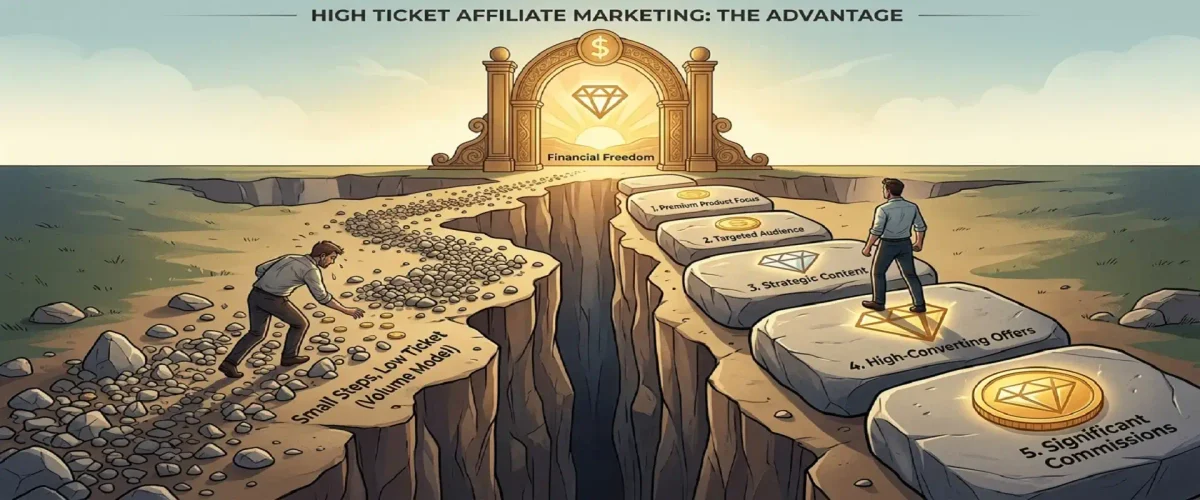
Chasing the biggest commission sounds smart. It isn’t — not by itself.
Here’s what actually works in high ticket affiliate marketing: a valuable offer, the right buyer, an economics model that holds up, and a recommendation you’d stand behind even if you earned nothing from it. Commission percentage is the last thing on that list, not the first.
This guide walks you through what high-ticket affiliate marketing actually is, how it works, which programs and product categories are worth your time in 2026, and how to start — even if you’re running a one-person operation with zero ad budget.
Quick Answer: What Is High Ticket Affiliate Marketing?
High-ticket affiliate marketing means promoting products or services where each sale carries real value for the buyer and a meaningful payout for you — often $100 or more per conversion, sometimes thousands. Instead of chasing hundreds of small sales, you focus on fewer, higher-value ones.
Quick facts:
- Who it’s for: bloggers, small business owners, content creators, and agencies who’d rather build trust with a smaller audience than chase mass traffic
- How it pays: one-time bounties, recurring commissions, or both — the two aren’t mutually exclusive
- The catch: longer sales cycles, more research from buyers, and no guaranteed income — anyone promising fixed numbers is skipping the fine print
What Is High Ticket Affiliate Marketing, Really?
Here’s something most guides won’t tell you: there’s no universal price threshold that defines a “high ticket” offer. You’ll see $500 in one guide and $100 in another. Both aren’t wrong — they’re just using different lines in the sand.
For this guide, we’re defining high-ticket affiliate marketing as offers with high customer value and/or a meaningful affiliate payout, typically starting around $100 per conversion. What matters more than the exact number is the shift in mindset it represents.
Think about the math for a second.
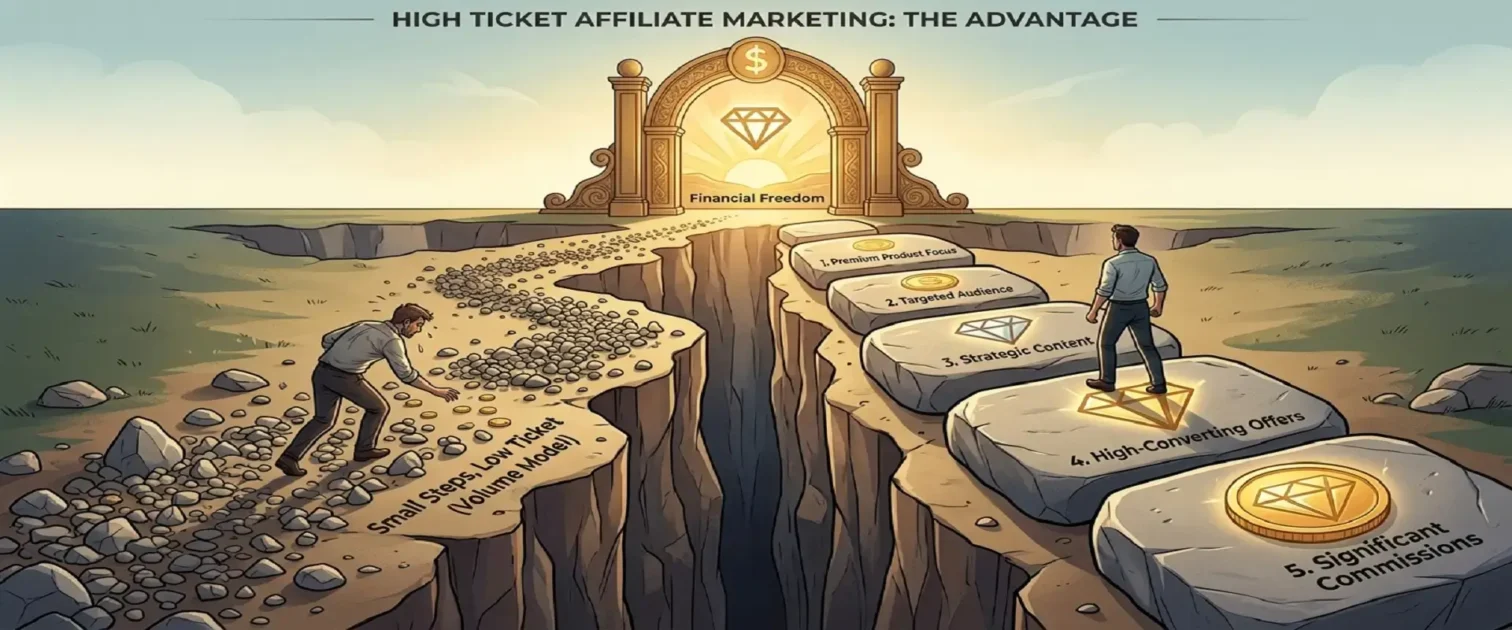
Promote a $20 product at a 10% commission, and you earn $2 per sale. You’d need 500 sales to hit $1,000.
Promote a $1,000 course at a 20% commission, and one sale pays you $200. Five sales get you to that same $1,000.
Same destination. Very different roads.
That’s the real definition of high-ticket affiliate marketing — fewer transactions doing more of the work, because the offer itself carries more weight.
High-Ticket vs. Recurring-Commission vs. Low-Ticket: What’s the Difference?
Here’s where a lot of beginners get tangled up. High-ticket and recurring commission sound like they should be opposites. They’re not.
A SaaS tool can be both high-value and recurring. Think of an enterprise software subscription that pays you 30% every single month a customer stays subscribed — that’s a high-ticket offer that also happens to be recurring. The two labels describe different things: one is about the size of the payout, the other is about how often you get paid.
Here’s how the three models actually compare:
| Model | Typical Value | Commission Style | Main Advantage | Main Challenge |
| Low-ticket | Lower price point | Smaller, one-time | Easier to convert, less trust needed | Needs high sales volume |
| High-ticket | Higher price point | Larger, often one-time | Fewer sales can meaningfully move the needle | Longer sales cycle, more buyer hesitation |
| Recurring | Usually subscription-based | Smaller but repeated | Compounds over time — one sale keeps paying | Depends on customer retention |
Notice something? You can stack these. A high-ticket and recurring offer — like a premium SEO platform with a lifetime revenue share — combines the best of both. That’s exactly what we broke down in our recurring commissions guide, which is worth reading right after this one if compounding income interests you.
Is High Ticket Affiliate Marketing Legit?
Short answer: yes.
Longer answer: it’s legit in the same way any performance-based marketing is legit — you get paid when you generate a real result for a real business. No inventory, no recruiting downlines, no upfront fees to “join.” If a program pays you for signing up other affiliates rather than for sales you generate, that’s not affiliate marketing. That’s a red flag for a pyramid structure, and it’s worth walking away from.
Here’s a simple gut-check you can run on any offer before you promote it:
Would you recommend this product to someone you respect, even if you weren’t earning a commission on it?
If the answer is yes, you’re in legitimate territory. If you’re hesitating, that hesitation is your answer.
A few things that make high-ticket programs feel less “instant” than low-ticket ones — and this is normal, not a warning sign:
- Buyers take longer to decide (weeks or months is common for a $2,000+ purchase)
- Some programs require an application before you’re approved
- Refund windows can claw back a commission if the customer cancels early
None of that makes the model illegitimate. It just means the sales cycle looks different from selling a $15 gadget on social media.
How Does High Ticket Affiliate Marketing Work?
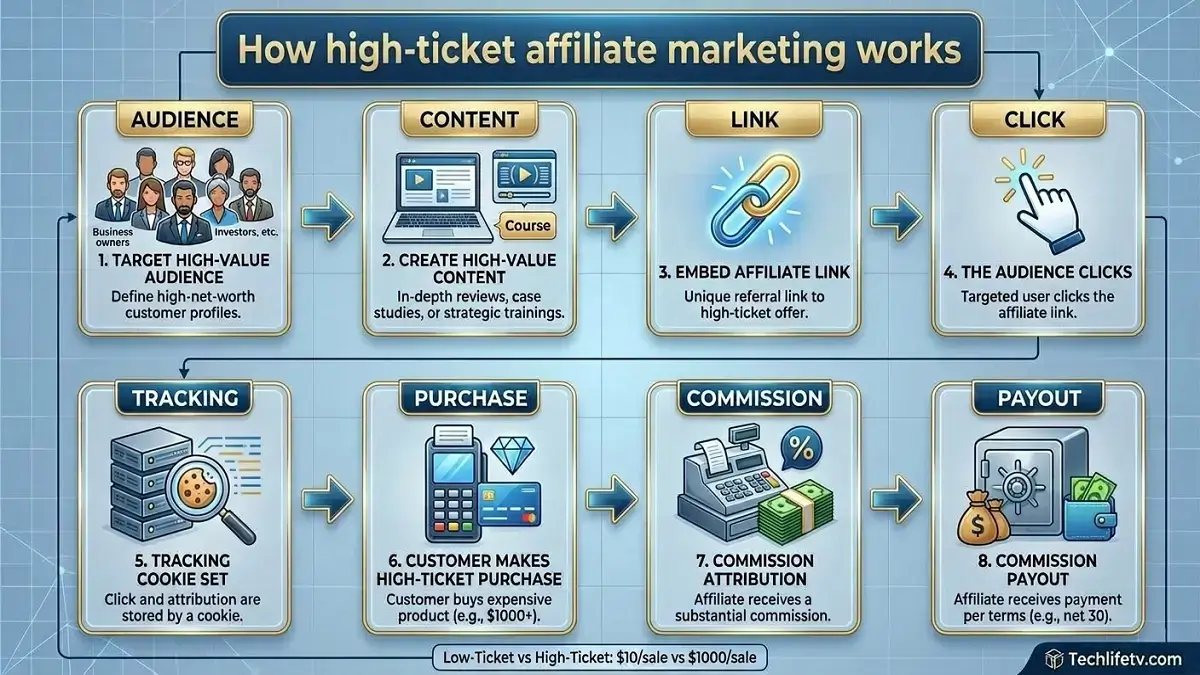
At a basic level, here’s the flow:
Audience → Content → Affiliate Link → Click → Tracking → Purchase → Commission → Payout
You publish something helpful — a review, a comparison, a tutorial. A reader clicks your affiliate link. A tracking mechanism remembers that click. If they buy within a set window, you get credited. The program pays you on its schedule.
That’s the common process. But here’s the part most guides skip: not every program tracks sales the same way. Before you build content around any offer, it’s worth knowing which of these applies:
- Cookie-duration tracking — the most familiar model. A cookie remembers your referral for a set number of days (30, 60, 90 — even 180 for some high-ticket SaaS programs)
- Last-click attribution — whoever sent the most recent click before purchase gets the credit, even if you sent the first one
- Recurring attribution — you get credited for renewals too, not just the initial sale (this is what makes recurring commissions valuable long-term)
- Coupon or promo-code attribution — instead of a cookie, a unique code tied to you gets the sale attributed, which works even if the buyer clears their cookies
The takeaway: don’t assume every program works identically. Check the attribution model before you invest hours of content into promoting it.
Best High Ticket Affiliate Marketing Programs in 2026
Here’s the part where most “best programs” lists just copy each other’s lists. We’re not doing that. Every program below earns its place by real commission economics, not by how well-known the brand is.
How We Evaluated These Programs
We scored each program on:
- Commission size and structure — one-time vs. recurring, and how much it’s actually worth
- Cookie duration/attribution window — a longer window protects your commission during a slow decision
- Audience fit — does this make sense for a blogger, small business, or agency?
- Program reliability — track record, payment consistency, affiliate support
A quick but important note: commission rates change. What’s accurate the week this is published may shift by the time you read it. Always confirm current terms directly on the program’s affiliate page before you build a content strategy around a specific number.
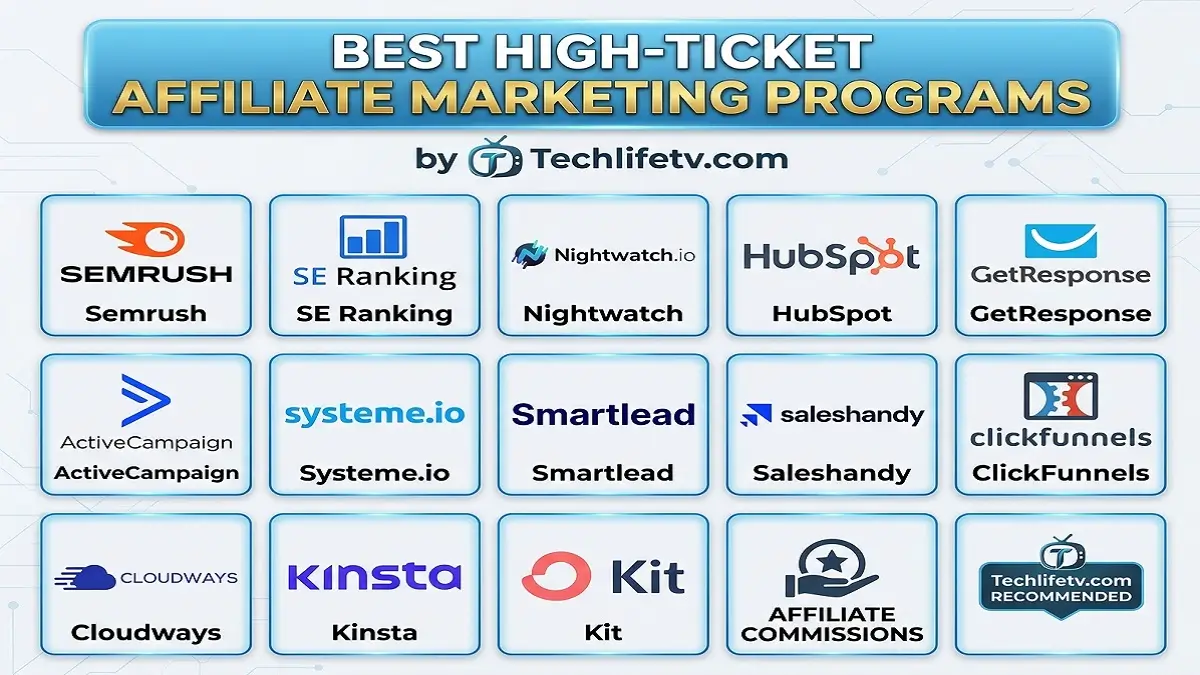
| Program | Category | Commission | Recurring? | Best For |
| Semrush | SEO / Marketing Software | Up to 200% of first month + recurring options | Yes | SEO bloggers, agencies |
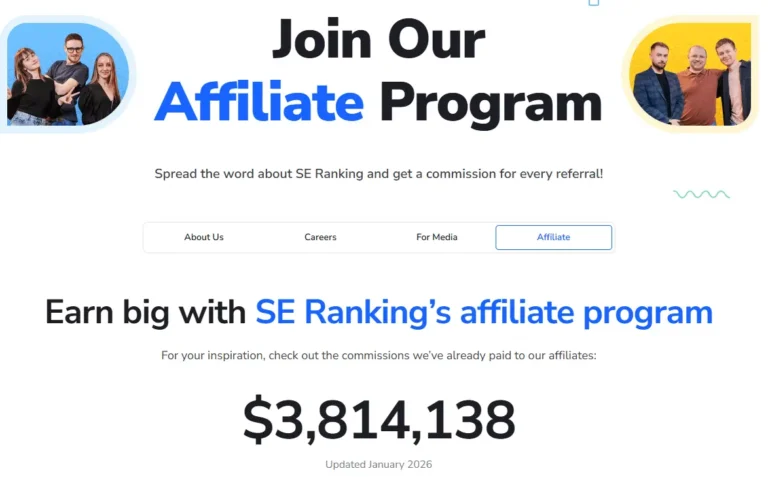
| SE Ranking | SEO Software | ~30% recurring | Yes | SEO content creators |
| Nightwatch | AI Search Visibility / Rank Tracking | 30% recurring, for the life of the account | Yes | AI SEO bloggers, agencies |
| Writesonic | AI Content + GEO/AEO Visibility Platform | 20% recurring, capped at 12 months | Yes (capped) | Content teams, agencies |
| HubSpot | CRM / Marketing Software | Up to $1,000 per sale | No (bounty-based) | B2B marketers, agencies |
| GetResponse | Email Marketing | Recurring or one-time (affiliate’s choice) | Optional | Freelancers, agencies |
| ActiveCampaign | Email Automation | Recurring % of subscription | Yes | SMB marketers |
| Systeme.io | All-in-One Funnel + Email | Recurring 60 % of subscription | Yes | Beginners, solopreneurs |
| Smartlead | Cold Email / Outreach Automation | Tiered 15%→35% + bonus, lifetime | Yes | Agencies, B2B marketers |
| Saleshandy | Cold Email / Outreach Automation | Tiered 15%→25%, lifetime | Yes | Agencies, B2B marketers |
| ClickFunnels | Funnel Building | ~30% recurring | Yes | Digital marketers, coaches |
| Cloudways | Managed Hosting | Flat bounty + hybrid options | Optional | Web-focused bloggers |
| Kinsta | Managed WordPress Hosting | Up to $500 per referral | No (one-time) | Developers, agencies |
| Kit (ConvertKit) | Email for Creators | 50% for 12 months, then recurring | Yes | Content creators |
Quick clarification: Salesforce’s affiliate-style program operates as a Partner Program, not a traditional pay-per-sale affiliate program. Eligibility, relationship structure, and payout model differ from a standard affiliate link setup—so if you see Salesforce listed alongside affiliate programs elsewhere, you’re looking at a referral/partner relationship, not a plug-and-play affiliate link.
Best High Ticket Affiliate Marketing Products & Categories
Programs answer “where can I sign up?” This section answers a different question: what kinds of products are actually worth building content around?
SEO & AI SEO Tools
This is one of the strongest categories for high-ticket affiliate marketing right now, and it’s not close.
Traditional SEO platforms — Semrush, SE Ranking(SE Ranking affiliate review), Surfer — carry monthly price tags high enough that even modest commission percentages translate into real payouts. Before calling any of these “high-ticket” in your content, verify the current commission on their affiliate page; rates shift, and staying consistent with your own past coverage (if you’ve reviewed a program before) matters for your credibility.
A fast-growing sub-category worth watching: AI Search Visibility & Tracking Tools.
Platforms like SE Visible, Profound, Otterly.AI, Rankscale, and Peec AI exist to help brands understand how they show up in ChatGPT, Perplexity, and AI Overviews — a genuinely new and growing need as search behavior shifts. For a deeper breakdown of this category, see our full AI Search Visibility Management Tools guide or browse our wider Best AI Mode SEO Tool roundup for the full AI-SEO toolkit.“
Here’s the honest caveat: not every tool in this category clears the high-ticket bar. Before positioning any of them that way, check:
| Factor | What to Verify |
| Pricing | Monthly/annual cost — some sit in the “budget” range, others “mid-range” or higher |
| Affiliate program | Does one exist at all? |
| Commission | Flat, percentage, or tiered? |
| Payout type | One-time or recurring? |
| Target customer | Solo blogger, agency, or enterprise? |
Only label the ones that genuinely meet the threshold as high-ticket. Blanket-labeling an entire category erodes trust faster than it builds authority.
One tool in this sub-category that does clear the bar with verified terms: Nightwatch, an AI-era rank and visibility tracker. Its affiliate program pays 30% recurring commission for the life of the account on every paid plan a referred user purchases — commission that grows as the customer’s plan grows, not a one-time bounty. It also runs a 365-day tracking cookie, well above the 30-90 day window most SaaS programs offer, which matters because buyers researching a tracking tool rarely decide on the first visit.
Writesonic is a second worth naming specifically, though with a caveat. It’s repositioned itself beyond “AI writing tool” into a full GEO/AEO visibility platform — covering AI search volume research, AI brand visibility monitoring, AI agent/crawler analytics, and AI-assisted content production, all under one product. Its affiliate program pays 20% recurring commission, capped at 12 months (not lifetime, unlike Nightwatch), on plans starting at $79/mo for individuals and $200/mo for agencies. Over that 12-month window, that’s roughly $190-$480 in cumulative commission per referred customer — enough to clear the high-ticket bar, just on a shorter runway than a lifetime-recurring program. Its tracking cookie runs 60 days, shorter than Nightwatch’s 365-day window, so buyers have less time to return through the same link before attribution expires. Worth being precise about both details in your content rather than implying it pays out indefinitely or holds attribution as long as Nightwatch does.
Between the lifetime-recurring structure and the year-long cookie, Nightwatch is one of the clearest examples of a genuinely high-ticket offer in the AI search visibility space — worth naming specifically rather than folding into the generic “check before you label it” list above.
Email Marketing & Marketing Automation
Email tools are a dependable high-ticket category because businesses rarely switch platforms once their list and automations are built — which means recurring commissions here tend to stick around.
Rather than ranking these purely by commission size, it helps to sort by who they actually fit:
- Best for beginners: simpler platforms with lower learning curves
- Best for creators: tools built around newsletters and audience monetization, like Kit
- Best for SMBs: platforms combining email, CRM, and automation, like ActiveCampaign
- Best for all-in-one funnels + email: Systeme.io, which bundles email automation with funnel and course-building tools under one subscription — a natural fit for beginners who don’t want to stitch together separate tools.
- Best for email-centric full-funnel marketing: GetResponse — combines email, automation, webinars, and landing pages under one affordable, subscriber-based plan (starting around $19/mo, with a free tier), and consistently rates higher on ease of use and overall satisfaction
- Best for pure sales-funnel building: ClickFunnels — a more expensive, no-free-tier platform (plans start around $97-127/mo), but purpose-built for high-conversion sales funnels if that’s the one thing you need
Worth being upfront about here: GetResponse and ClickFunnels aren’t interchangeable “advanced marketer” picks — they solve different problems. If your content is going to recommend one over the other, the honest split is email-first marketing (GetResponse) versus funnel-first sales (ClickFunnels), not “pick whichever.” Presenting them as equal alternatives without that distinction is the kind of vague comparison that erodes trust with readers who’ve actually used both.
Cold Email & Outreach Automation
It is worth calling out as its own sub-entry here, distinct from newsletter-style email marketing. Tools like Smartlead and Saleshandy are built for B2B outreach and prospecting rather than audience nurturing — and both run genuinely high-ticket affiliate terms:
| Smartlead | Saleshandy | |
| Commission | Tiered: 15% base, rising to 20% (20+ referrals/mo), 30% (50+), 35% (75+), plus a top-referrer bonus | Tiered: 15% base, rising to 25% at 50+ plans/mo |
| Commission length | Lifetime — as long as the referral stays subscribed | Lifetime — as long as the referral stays subscribed |
| Cookie window | 90 days | 90 days |
| Payout terms | Net-45 after conversion, once earnings reach $50 | Not fixed; instant approval to join |
Both qualify as genuinely high-ticket the same way Nightwatch does — lifetime recurring commission rather than a one-time bounty — which makes them worth naming specifically instead of leaving cold-email outreach out of the category entirely.
Web Hosting & Managed Hosting
Hosting has been a high-ticket affiliate staple for over a decade, and it’s not going anywhere. Every website needs it, buyer intent on hosting comparison content runs high, and the commission structures — flat bounties from providers like Kinsta, hybrid models from Cloudways, tiered payouts from Hostinger and WP Engine — are well-established and reliable.
The tradeoff: it’s a competitive space. Winning here usually comes down to content depth and genuine hands-on testing rather than just listing features.
But which host is actually the strongest recommendation depends on the question you’re answering. “Cheapest to start” and “best for the long haul” have different answers — and conflating them is one of the most common mistakes in hosting comparison content.
| Host | Intro Price | Renewal Price | Long-Term Verdict |
| Hostinger | ~$2.99/mo | ~$11.99/mo (renewal jumps ~4x) | Strong for getting started; weak for long-term cost predictability |
| Cloudways | ~$11-14/mo | Same as intro (no renewal jump) | Best long-term value — pay-as-you-grow across DigitalOcean, Vultr, AWS, or GCP |
| Kinsta | ~$35/mo | Same as intro | Best for performance-critical production sites; priced for it from day one |
| WP Engine | ~$30/mo | Same as intro | Best for agency/enterprise workloads; stable but not budget-friendly |
The practical takeaway for your content: Hostinger earns the “best for beginners” recommendation, Cloudways earns “best for scaling long-term,” and Kinsta or WP Engine earn “best for performance-critical or enterprise sites.” Presenting all four as interchangeable “top picks” without this distinction is exactly the kind of thin comparison content that AI Overviews and skeptical readers both see through quickly.
CRM & Business Software
This category covers tools businesses rely on to manage customer relationships and operations — HubSpot being the clearest example with a verified, traditional affiliate structure paying up to $1,000 per qualifying sale. One important distinction: not every “program” in this space is an affiliate program. Some, like Salesforce’s, operate as partner or referral programs with different eligibility requirements and payout structures. Always check which model you’re actually signing up for before building your content strategy around it.
How to Start High Ticket Affiliate Marketing (Beginner’s Roadmap)
If you’re new to this, here’s the sequence that actually works — without needing a big ad budget.
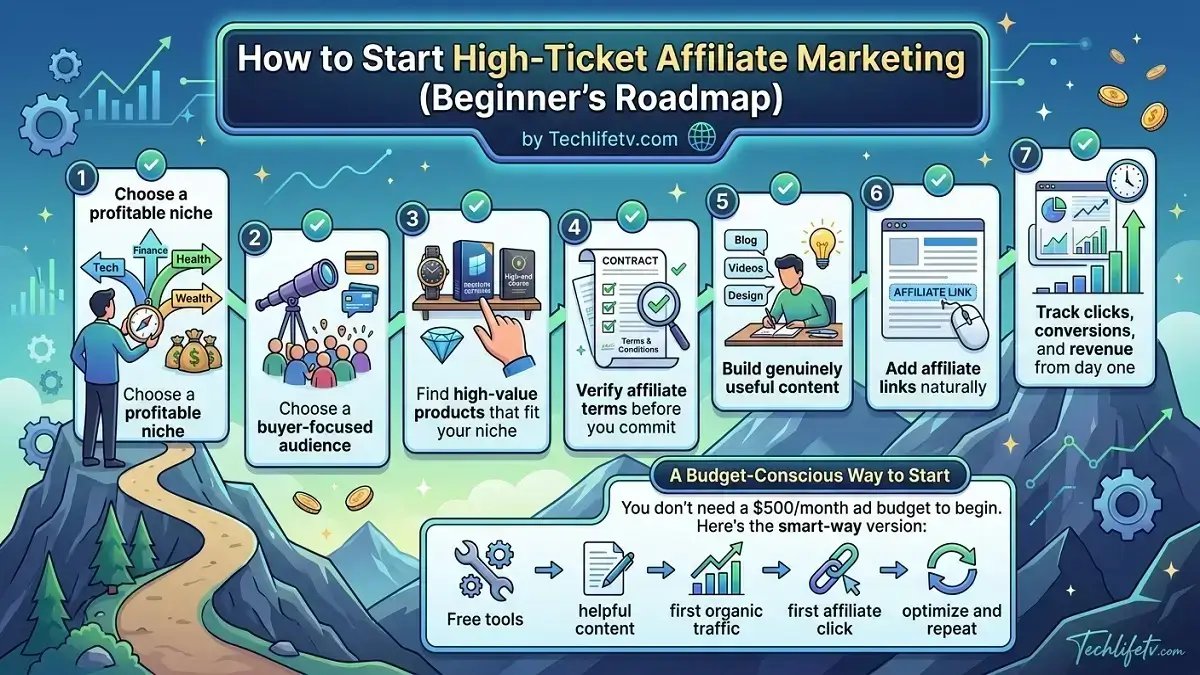
Step 1: Choose a profitable niche. Pick something with real buyer intent and products worth $100+ in commission potential. Don’t chase a niche just because it’s trendy.
Step 2: Choose a buyer-focused audience. Are you writing for total beginners, or for people already comparing options? Your content — and your product picks — should match where your reader actually is.
Step 3: Find high-value products that fit your niche. Look for offers your audience would genuinely want, not just ones with the highest commission attached.
Step 4: Verify affiliate terms before you commit. Confirm the commission structure, cookie duration, and attribution model (see the section above). This single step saves you from months of wasted content.
Step 5: Build genuinely useful content. Comparison posts, honest reviews, and how-to guides consistently outperform thin “top 10” listicles — especially for high-ticket buyers doing real research.
Step 6: Add affiliate links naturally. Don’t force a link into every paragraph. Place it where a reader would actually want to click next.
Step 7: Track clicks, conversions, and revenue from day one. Use whatever your program’s dashboard gives you, or a simple spreadsheet. You can’t improve what you’re not measuring.
A Budget-Conscious Way to Start
You don’t need a $500/month ad budget to begin. Here’s the smart-way version:
Free tools → helpful content → first organic traffic → first affiliate click → optimize and repeat
Start with free keyword research tools, write the most useful piece of content you can on a topic your audience is actually searching for, let organic search send you your first visitors, and only then start reinvesting earnings into paid growth if it makes sense. This is exactly how sustainable affiliate sites are built — without wasting money before you’ve proven what works.
Common Mistakes Beginners Make
Watch out for these — they’re the ones that quietly kill momentum:
- Chasing commission size before product quality. A high payout on a bad product converts once, then damages your credibility.
- Promoting products you don’t understand. Buyers can tell when you haven’t actually used the tool.
- Judging offers only by commission percentage. A 50% cut of a $20 product still pays less than 20% of a $500 one.
- Ignoring recurring revenue potential. A slightly smaller monthly commission can outperform a bigger one-time payout within a year.
- Not checking cookie or attribution rules. You could be doing the work and losing the credit to someone else’s last click.
- Publishing generic, AI-written reviews with no real testing. Readers — and increasingly, AI systems pulling from your content — can tell the difference.
- Skipping affiliate disclosures. This isn’t optional; it’s required, and it builds trust rather than costing you readers.
- Targeting high-ticket products without buyer intent. Traffic that isn’t ready to buy won’t convert, no matter how good the offer is.
- Expecting fast income. High-ticket sales cycles are long. Most affiliates earn little to nothing in their first few months — that’s normal, not failure.
- Spreading across too many unrelated niches at once. Depth in one area beats shallow coverage of five.
The last two matter most if you’re a solo blogger or small business owner — patience and focus will get you further than chasing every trending niche you see.
How Much Can You Realistically Earn?
Here’s an honest answer instead of a made-up income chart: it depends entirely on your traffic, your audience’s buying intent, and the offers you choose. Anyone giving you a fixed number without knowing those three things is guessing.
Instead, here’s a formula that actually helps you estimate your own potential:
Estimated Revenue = Traffic × Click-Through Rate × Conversion Rate × Commission
A simple illustration:
- 10,000 relevant monthly visitors
- × 5% click your affiliate link (500 clicks)
- × 2% of those convert (10 sales)
- × $100 average commission
- = $1,000 in that month
Change any variable — more traffic, a higher-converting page, a bigger commission — and the number moves. This is meant to show you how the math works, not to promise you’ll hit any specific figure. Your real numbers will depend on your niche, your content quality, and how well your offer matches your audience.
FAQ
Frequently Asked Questions
What is high-ticket affiliate marketing?
Is high-ticket affiliate marketing legit?
How does high-ticket affiliate marketing work?
How do I start high-ticket affiliate marketing?
What is considered a high-ticket affiliate product?
Can beginners do high-ticket affiliate marketing?
Is high-ticket affiliate marketing better than low-ticket?
The Bottom Line
High-ticket affiliate marketing isn’t a shortcut, and it’s not about hunting for the fattest commission on the page. It’s about finding offers with real value, understanding who actually needs them, and building the kind of trust that makes a recommendation worth clicking.
Start with one niche. Pick products you’d stand behind with or without the commission. Build content that actually helps. The revenue follows — just not on day one.