Best AI SEO Tools for Small Business: Automate SEO & Grow Faster
Unleashing Growth and Efficiency with AI in Small Business SEO
For small businesses, getting noticed online is more competitive than ever. Limited budgets, tiny teams, and constantly changing search engine algorithms make achieving visibility and trust hard. That’s where AI SEO tools for small business become a game-changer—they help you work smarter, not harder.
AI-powered SEO software handles keyword research, content creation, technical audits, and performance tracking, leading to faster rankings, better traffic, and higher conversions—even if your marketing team is small. Many AI SEO tools now automate keyword research, content optimization, and technical audits.
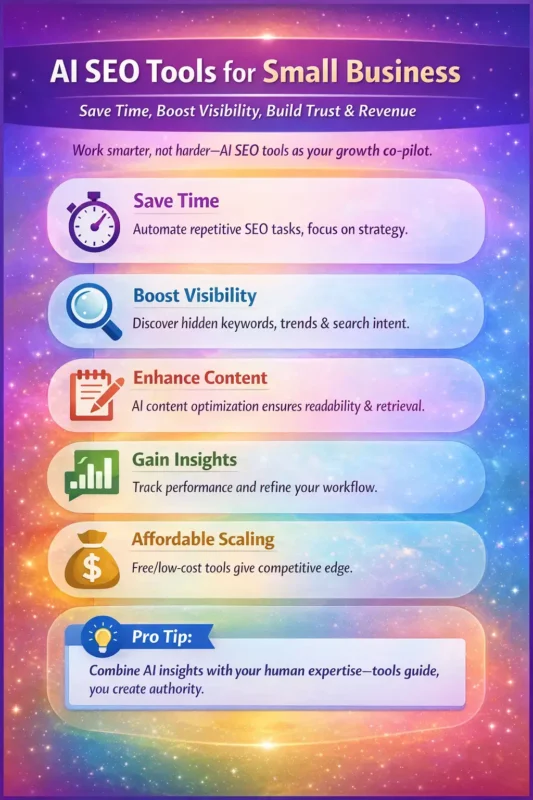
Quick Takeaways – AI SEO Tools for Small Businesses
- Save Time: Automate repetitive SEO tasks so you can focus on strategy.
- Boost Visibility: Uncover hidden keywords, trends, and search intent you might miss manually.
- Enhance Content: AI content optimization ensures your articles are readable, structured, and AI-retrievable.
- Gain Insights: Analytics-driven AI tracks performance and refines your SEO workflow.
- Affordable Scaling: Free and low-cost AI SEO tools give SMBs a competitive edge without overspending.
Table of Contents
The Shifting Search Landscape and the Small Business Challenge
Search isn’t just about keywords anymore. Google and other engines now prioritize user experience, relevance, and authority. Small businesses face unique hurdles:
- Limited time for research and content creation
- Smaller budgets compared to enterprise competitors.
- Difficulty keeping up with generative search optimization and AI-driven results
AI-powered SEO software helps level the playing field by automating complex tasks and providing insights that previously required a full SEO team.
How AI SEO Tools Level the Playing Field for SMBs
AI for SEO speeds up and amplifies your impact.
- AI-driven keyword research finds hidden low-competition opportunities.
- AI content generation creates structured, high-quality drafts tailored to search intent.
- Technical SEO tools like Rank Math or Screaming Frog detect and fix issues faster than manual audits.
Think of AI as a co-pilot for your SEO journey—guiding you to smarter results while you focus on strategy, branding, and conversions.
What This Guide Will Cover: Your Roadmap to AI-Powered SEO
By following this guide, you’ll learn to:
- Understand why AI SEO is critical for small businesses.
- Discover the best AI SEO tools for keyword research, content optimization, and technical SEO
- Build a lean, effective AI SEO workflow.
- Track results and measure ROI
- Prepare for future generative search and AI overviews.
By the end, you’ll have a practical roadmap to harness AI-powered SEO for growth, trust, and revenue—without overcomplicating your workflow.
What Are AI SEO Tools for Small Business?
AI SEO tools for small business are smart software platforms that use artificial intelligence to simplify SEO tasks. They can handle everything from keyword research and content optimization to technical audits and performance tracking. By automating these processes, small teams can save time, work more efficiently, and discover opportunities that would be difficult to spot manually—allowing them to compete with much larger companies.
Why AI SEO is a Game-Changer for Small Businesses
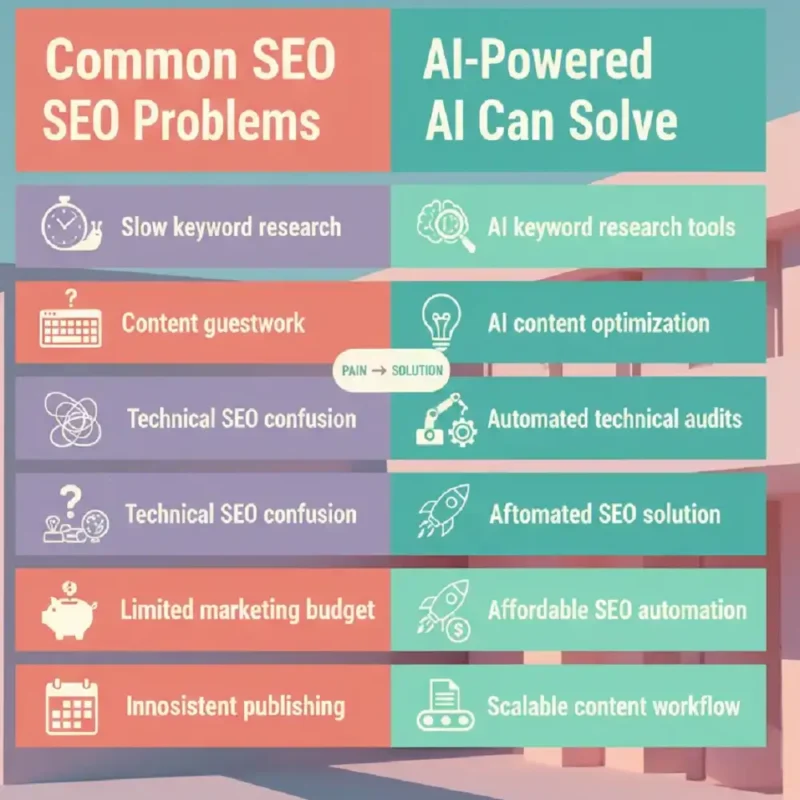
Traditional SEO is slow and resource-intensive. Small businesses struggle to keep up with bigger competitors. AI SEO tools change the game by giving you efficiency, insight, and scalability to compete effectively.
Overcoming Resource Limitations: Time, Budget, and Expertise
Small teams can’t spend hours on manual keyword research or technical audits. AI SEO tools:
- Automate repetitive tasks like content scoring, internal linking suggestions, and meta-tag optimization
- Provide actionable insights from large datasets in seconds.
- Offer affordable solutions—from free options like Rank Math and Google Search Console to low-cost AI software.
Solo entrepreneurs can now use these tools to execute strategies once limited to full SEO teams.
Boosting Efficiency: Automating Repetitive SEO Tasks
Efficiency is key. AI SEO software helps you:
- Generate optimized content outlines with Frase or Surfer SEO.
- Audit site health and fix crawl errors, broken links, and page speed issues
- Track keyword performance automatically with AI dashboards
By automating repetitive tasks, small businesses free up time for strategy, creativity, and growth initiatives.
Driving Growth: Faster Rankings, More Traffic, and Higher Conversions
AI tools don’t just save time—they accelerate growth:
- AI keyword research targets high-ROI terms.
- AI content optimization improves readability, structure, and search retrieval.
- Enhanced visibility brings more qualified traffic and higher conversion rates.
AI acts as your growth engine, helping your small business progress faster without additional staff.
Gaining a Competitive Edge Against Larger Players
Big brands have more resources, but AI SEO levels the playing field:
- AI-powered insights reveal untapped keyword opportunities.
- AI-driven technical SEO audits detect problems faster than manual checks.
- AI content optimization ensures content is retrievable, authoritative, and user-friendly.
An AI SEO workflow helps small teams match larger competitors in visibility, trust, and conversions.
Understanding the AI-Powered Search Ecosystem
The search ecosystem is evolving rapidly. Today, it’s not just about keywords—it’s about how AI interprets content, user intent, and experience. AI SEO tools analyze, understand, and optimize content for modern search engines.
By leveraging machine learning for SEO, AI content optimization, and generative search strategies, small businesses can compete with larger players without overspending.
What are AI SEO Tools? Demystifying the Technology
AI SEO tools are software that uses machine learning, natural language processing, and predictive analytics to optimize search:
- Automate keyword research, content creation, technical audits, and performance tracking
- Identify high-value opportunities, including low-competition keywords and content gaps.
- Act as a full-service co-pilot for small business teams
Think of them as intelligent assistants analyzing massive datasets and suggesting actions faster than any human could.
The Role of Machine Learning (ML) and Large Language Models (LLMs)
Modern AI SEO tools rely on ML algorithms and LLMs to understand context and intent:
- ML detects patterns in user behavior and SERP results.
- LLMs like GPT generate contextually relevant, readable, and AI-retrievable content.
- Together, they enable small businesses to produce authoritative content that search engines and AI answer engines love.
The Rise of AI Overviews, AI Answer Engines, and Generative Search
Search is shifting to AI-driven summaries and answer boxes:
- AI overviews provide concise answers from multiple sources.
- Answer engines and generative search deliver instant responses, reducing the need to click through
- Structuring content with clear headings, bullet points, and concise answers improves AI retrieval.
Analogy: Think of search engines as smart assistants. The better they understand your content, the more likely they are to “choose” it.
How Google’s AI Mode and Future Search Engine Innovations Impact Your Strategy
Google’s AI Mode and similar innovations change how content is discovered and ranked:
- Optimize for AI retrieval with structured data, schema markup, and semantic content.
- Adapt your AI SEO workflow to focus on user intent, content clarity, and retrievability.
- Combine keyword research, content optimization, and technical SEO into a coherent AI-powered strategy.
AI is no longer optional—it’s core to any growth-focused SEO approach.
Key Areas Where AI SEO Tools Shine for Small Businesses
AI SEO tools transform every stage of your workflow. From research to content creation to technical audits, here’s where they make the biggest impact:
AI for Keyword Research & Strategy
AI helps small businesses identify:
- Low-competition, high-intent keywords
- Related search terms using search intent analysis
- Competitor gaps
Tools: LowFruits, Semrush—prioritize high-ROI keywords quickly.
AI for Content Creation & Optimization
Content is king, but high-quality creation takes time. AI content optimization tools:
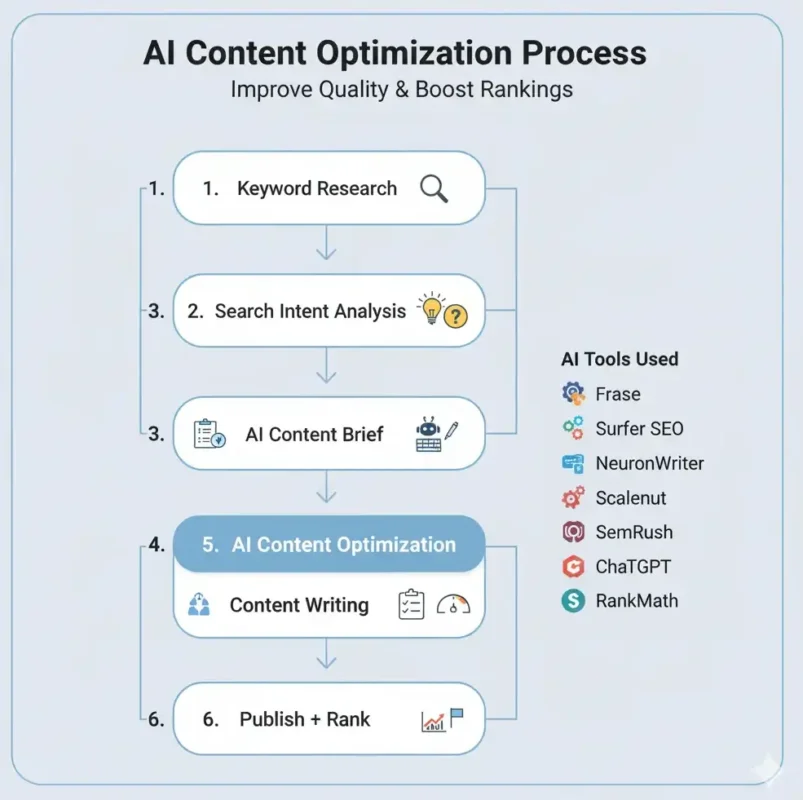
- Generate drafts, outlines, and meta descriptions.
- Suggest readability and engagement improvements.
- Align content with generative search optimization and answer engine requirements.
Example: Frase or NeuronWriter can turn a simple topic into a fully optimized, AI-retrievable article.
AI for Technical SEO Audits and Site Health
Technical SEO ensures your site is crawlable:
- Detect broken links, duplicate content, crawl errors, and slow pages.
- Automated suggestions for fixes
- Meets Google AI overview optimization standards
Tools: Screaming Frog, Sitebulb, Rank Math
AI for Local SEO Dominance
Local businesses benefit from AI by:
- Identifying geo-specific low-competition keywords
- Optimizing Google Business Profiles and local metadata
- Monitoring rankings and reviews automatically
Even solo entrepreneurs can dominate local search results with AI insights.
AI for Competitor Analysis & Backlink Strategy
Understanding competitors is crucial:
- Analyze competitor content and keywords.
- Suggest backlink opportunities
- Track competitor performance for iterative improvement
AI-driven analysis lets small businesses compete efficiently with larger players.
What Are the Best AI SEO Tools for Small Businesses?
The best AI SEO tools for small businesses are software platforms that help automate keyword research, content optimization, and technical SEO tasks. Popular tools like Frase, Scalenut, NeuronWriter, LowFruits, Rank Math, and Copy.ai make it easier for small teams to create optimized content, track performance, and discover opportunities that would be hard to spot manually—all without needing a large marketing team.
Best AI SEO Tools are:
- Frase – AI content briefs ,outline and SEO optimization.
- Scalenut – Content creation and research workflow.
- NeuronWriter – Semantic SEO and keyword optimization.
- LowFruits – Low-competition keyword discovery.
- Rank Math – WordPress SEO automation.
- Copy.ai – AI-powered content and copywriting.
Top AI SEO Tools for Small Businesses
Small businesses often ask: “Which tools actually help me rank, get noticed, and grow revenue without overspending?”
In the AI era, more content alone won’t drive visibility. You need tools that help you research smartly, write efficiently, optimize technically, and track performance. Having the right AI SEO stack is essential.
Here’s a breakdown of the top AI SEO tools for small businesses with actionable tips.
Best AI Keyword Research Tools for Small Businesses
Keywords are the foundation of visibility. You want terms people search for—and can realistically rank for.
Top Tools:
- Semrush – Discover long-tail keywords, analyze competitors, and spot content gaps
- Ahrefs – Excellent for backlink analysis and competitor research
- LowFruits – Ideal for small budgets; finds low-competition, high-potential keywords
Pro Tip: Focus on search intent over search volume. A keyword with 200 searches that converts is better than one with 5,000 searches and no buyer intent.
Best AI Content Optimization Tools
Once you know your keywords, AI content tools help craft content that ranks and engages:
- Frase – Generates content briefs and outlines from top-ranking pages.
- Surfer SEO – Optimizes headings, keywords, and structure for search intent
- Scalenut – AI-assisted content creation while keeping your voice
- NeuronWriter – Semantic analysis for richer, comprehensive content
Pro Tip: Combine AI suggestions with human judgment. Tools structure content; your insight builds trust and engagement.
Best AI Technical SEO Tools
Even amazing content won’t rank if your site has technical issues.
Top Tools:
- Screaming Frog SEO Spider – Detects broken links, duplicate content, and crawl errors.
- Sitebulb – Visual, actionable site audits
- Rank Math – WordPress users can manage schema, sitemaps, and indexing easily
Pro Tip: Schedule audits regularly. Technical issues quietly kill traffic every day.
Best All-in-One AI SEO Platforms
Some platforms combine research, content optimization, technical SEO, and analytics. Ideal for small teams.
Top Platforms: Semrush, Ahrefs
Pro Tip: If new, start with one all-in-one platform and add specialized tools like LowFruits or NeuronWriter as needed.
Best Free SEO AI Tools for Small Businesses
Budget-friendly tools still offer strong foundations.
For small businesses working with tight budgets, the Best Free SEO AI Tools can still deliver powerful results. Tools like Rank Math and Google Search Console help automate essential SEO tasks such as on-page optimization, keyword tracking, and indexing insights.
For example, many small WordPress sites use Rank Math’s free version to optimize titles, meta descriptions, and schema markup while monitoring performance in Google Search Console—all without spending a dollar.
Pro Tip: Start free to learn data-driven SEO before investing in premium tools.
If you want a deeper breakdown, see our full list of best AI SEO tools.
Quick Comparison Table of Top AI SEO Tools
| Semrush | Keyword research, all-in-one SEO | Paid |
| Ahrefs | Competitor analysis, backlinks | Paid |
| LowFruits | Low-competition keywords | Paid |
| Frase | Content outlines & briefs | Paid |
| Surfer SEO | On-page optimization | Paid |
| Scalenut | AI-assisted content generation | Paid |
| NeuronWriter | Semantic keyword optimization | Paid |
| Screaming Frog | Technical site audits | Paid |
| Sitebulb | Visual technical audits | Paid |
| Rank Math | WordPress SEO automation | Free/Paid |
| Google Search Console | Performance tracking & indexing | Free |
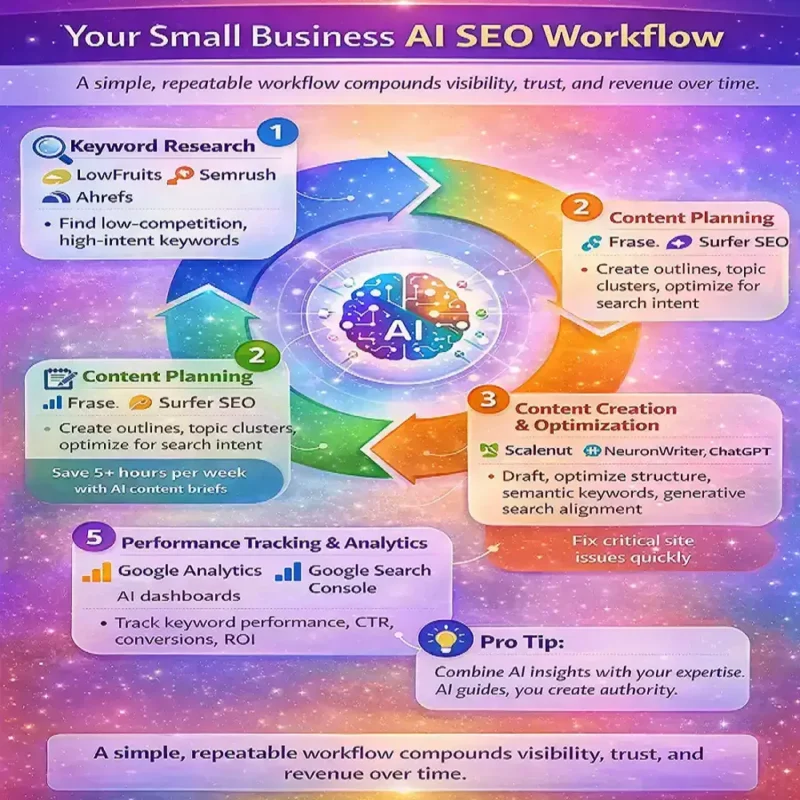
Pro Tip: Think of your AI SEO tools as a workflow stack:
1️⃣ Keyword research → 2️⃣ Content planning → 3️⃣ Content creation → 4️⃣ Technical optimization → 5️⃣ Performance tracking
When your tools work together, visibility, trust, and revenue scale naturally.
The tools below help automate keyword research, content optimization, and technical SEO. Here’s a quick comparison to help you choose the right AI SEO tool for your workflow.
Quick Comparison of the Best AI SEO Tools for Small Businesses
| Tool | Best For | Key Feature | Pricing | Try It |
|---|---|---|---|---|
| Frase | Content optimization | AI content briefs and SERP analysis | Paid | Try Frase |
| Scalenut | AI content creation | Research, writing, and optimization in one platform | Paid | Try Scalenut |
| NeuronWriter | Semantic SEO optimization | NLP-driven keyword suggestions | Paid | Try NeuronWriter |
| LowFruits | Keyword research | Finds low-competition keywords | Affordable | Try LowFruits |
| Rank Math | WordPress SEO | Schema, on-page optimization, and SEO automation | Free / Paid | Try Rank Math Free |
| ChatGPT/Gemini/DeepSeek/Grok | AI writing/Image | Blog content/Image | Free / Paid | Try ChatGPT/Gemini/Deepseek/Grok |
Building Your AI SEO Stack: Essential Tools for Small Businesses
Overwhelm is common with too many AI SEO tools. The secret is creating a smart, streamlined workflow.
Think of your AI SEO stack like a recipe. Each ingredient (tool) has a purpose. Mix them correctly, and you get visibility, trust, and conversions without wasting resources.
Start with AI-Driven Keyword Research and Search Intent Analysis
Everything begins with knowing what people are searching for. AI-powered keyword research helps you:
- Find opportunities
- Analyze search intent
- Avoid highly competitive terms.
Tools & Tips:
- LowFruits – discover low-competition, high-potential keywords
- Semrush / Ahrefs – competitor research and content gaps
- Focus on long-tail keywords aligned with buyer intent.
Example: Targeting “best AI SEO tools for small business” instead of “SEO tools” attracts highly motivated readers.
Use AI Tools for Content Planning, Creation, and On-Page Optimization
Once keywords are ready, AI content tools help you plan, structure, and optimize your content.
Tools:
- Frase – generates briefs and outlines.
- Surfer SEO – optimizes headings, keyword placement, and structure.
- Scalenut / NeuronWriter/ChatGPT – semantic suggestions while preserving your voice
Pro Tip: AI is your research assistant, not a ghostwriter. Your storytelling and insights make content trustworthy.
Strengthen Your Website with AI-Driven Technical SEO Audits
Technical SEO ensures your site can be properly indexed and crawled.
Tools: Screaming Frog, Sitebulb, Rank Math,SemRush
Pro Tip: Prioritize high-impact fixes first. Focus on visibility and user experience.
Track Rankings and Traffic with Analytics and Search Data
Monitoring results is critical for growth.
Tools & Approach:
- Google Analytics & Search Console – traffic, CTR, keyword rankings
- AI dashboards – combine insights from multiple tools
Example: If a blog drives traffic but not conversions, AI insights can suggest on-page tweaks to increase ROI.
Combine Your Tools into a Simple AI SEO Workflow
A tool is only as good as your workflow:
- Keyword research → identify opportunities. Use LowFruits for low budget , Semrush/ahref for high budget /GKP for free.
- Content planning → generate outlines. Frase is the best or Scalenut.
- Content creation & Optimization → optimize with AI. Frase/ChatGPT/Gemini/Grok/DeepSeek for writing and Surfer SEO/NeuronWriter/frase for optimization.
- Technical SEO check → audit with tools like RankMath/Semrush/.
- Monitor & adjust → track performance. GSC/ Google Analytics.
Pro Tip: Treat it like a content assembly line: each step builds on the last, saving time and maximizing results.
Implementing AI SEO Responsibly: Best Practices for Small Businesses
AI is powerful, but human judgment is essential. Relying solely on AI risks content that ranks but fails to build trust or drive conversions.
The Human Element: Why Your Expertise Still Matters
AI can generate outlines and draft content—but your experience matters:
- Example: AI may suggest a high-volume keyword, but your insight identifies that the intent is informational, not purchase-driven.
- Treat AI as a co-pilot, not a driver.
Prioritizing E-E-A-T and User Experience (UX)
Google values Experience, Expertise, Authority, and Trustworthiness (E-E-A-T):
- Use AI for structure and SEO, but showcase expertise through examples, case studies, and insights.
- Improve page speed, mobile responsiveness, and navigation.
Analogy: AI arranges the shelves; you provide the helpful staff.
Ethical Considerations and Google Guidelines
- Avoid keyword stuffing and unnatural phrasing.
- Ensure originality and fact-checking.
- Disclose AI-assisted content when appropriate.
Pro Tip: Ethical SEO builds credibility and loyalty, crucial for SMBs.
Measuring Growth & Efficiency: Tracking Your AI SEO ROI
Implementing AI SEO tools only matters if you measure impact.
Key Metrics for Small Businesses to Track
- Organic traffic growth
- Keyword rankings
- Click-through rate (CTR)
- Time on page & bounce rate
- Conversion rate
Pro Tip: Track weekly or monthly, not daily.
Leveraging Google Analytics, Google Search Console, and Other Data Sources
- Google Analytics – traffic, conversions, behavior
- Search Console – indexing, keyword performance
- AI dashboards – combine insights from multiple tools
Optimizing Your Marketing Budgets with AI Insights
- Identify high-performing content
- Reduce spending on low-converting campaigns.
- Automate repetitive tasks to free time.
Think of your AI stack as an investment, not an expense.
The Future is Now: Optimizing for AI Overviews & Generative Search
Search is shifting to AI-generated summaries and answer boxes. Small businesses can appear directly in AI-driven results—but only if their content is structured, authoritative, and AI-friendly.
Understanding Google’s AI Overviews and Answer Engine Optimization
- Content may appear in snippets or AI answers, boosting visibility.
- Tools like Frase and NeuronWriter help structure content for retrieval
Pro Tip: Use clear headings, bullet points, and concise answers.
Preparing Your Website for AI-Driven Search Results
- Structured data and schema highlight expertise.
- Use featured snippets, lists, and tables.
- Optimize page speed and mobile experience.
Analogy: Your content is a package; AI must see clearly what’s inside.
Evolution of SEO into Generative Engine Optimization (GEO)
GEO is the next frontier:
- Combine AI-driven research, planning, and technical SEO
- Focus on high E-E-A-T content with rich experience signals.
- Monitor AI answer performance via Search Console and analytics.
GEO amplifies traditional SEO, compounding visibility, trust, and revenue.
FAQ for AI SEO Tools for Small Business
Q: What AI tool is best for SEO?
No single tool is the best; combine tools for keyword research, content, and technical SEO (Semrush, Frase, Screaming Frog).
Q: What is the 80/20 rule for SEO?
20% of efforts drive 80% of results. Focus on high-impact keywords and pages.
Q: Are AI SEO tools worth it?
Yes. They save time, improve accuracy, and reveal hidden opportunities.
Q: Can ChatGPT do SEO?
Yes, for content outlines, drafts, and keyword suggestions—but pair it with SEO tools for optimization.
Q: Best SEO tools for a very small budget?
Google Search Console, Rank Math (Free), LowFruits and Frase.
Q: Any easy-to-use SEO tools for small businesses?
Rank Math, Frase, and LowFruits are intuitive for beginners.
Q: Helping local businesses – Best SEO tools?
Google Business Profile, Rank Math, and LowFruits—boost local visibility.
Q: Which AI tools are actually worth using for SMBs?
Keyword research: LowFruits, Semrush, Ahrefs; Content: Frase, Surfer SEO, NeuronWriter; Technical: Screaming Frog, Rank Math
Keyword Research → Content Optimization → Content Creation → Technical SEO
Recommended AI SEO Tool Stack for Small Businesses
If you’re starting with AI-powered SEO, you don’t need dozens of tools. A simple stack covering keyword research, content optimization, and technical SEO is enough to compete effectively.
- Keyword Research: LowFruits keyword research tool helps you find low-competition keywords that small websites can rank for.
- Content Optimization: Use Frase AI content optimization platform or NeuronWriter semantic SEO tool to create optimized articles based on search intent.
- AI Content Creation: Scalenut AI SEO platform and AI writing tools (ChatGPT/Gemini/Grok/DeepSeek help generate blog drafts and outlines faster.
- Technical SEO & On-Page Optimization: WordPress users can automate schema, sitemaps, and SEO settings using Rank Math SEO plugin for WordPress.
Pro Tip: Start with 3–5 tools that cover research, content, and technical SEO. A streamlined AI SEO stack saves time, reduces costs, and helps small businesses grow faster.
Keyword Research → Content Optimization → Content Creation → Technical SEO
Conclusion: Empowering Your Small Business with AI SEO
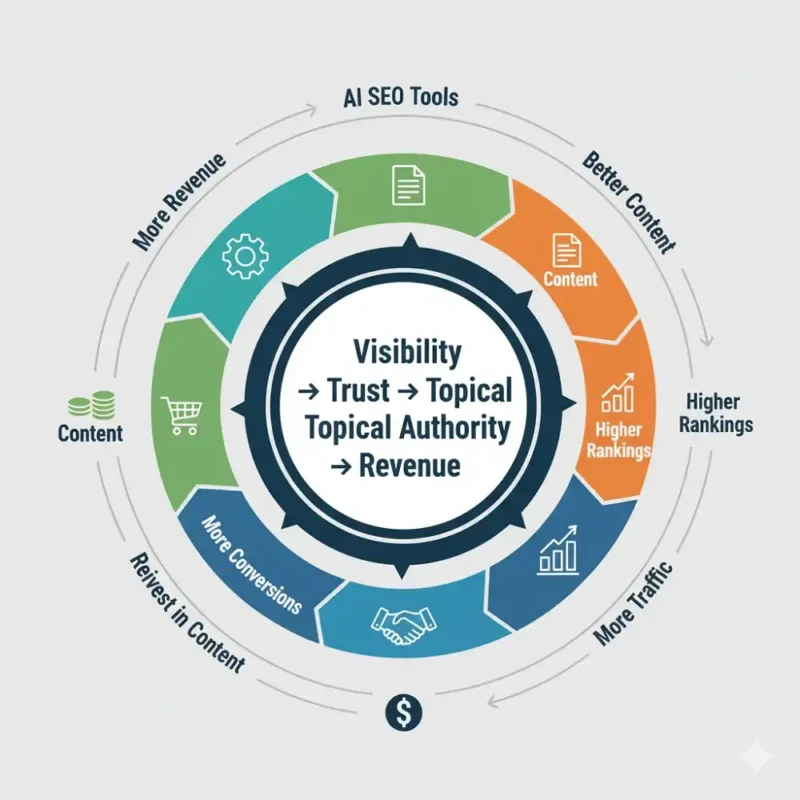
AI SEO tools aren’t just time-savers—they’re growth accelerators:
- Increase visibility with AI-powered research.
- Build trust through structured, experience-rich content.
- Boost conversions and revenue with intent-aligned content.
- Scale efficiently with AI workflows and tool stacks.
Choosing the right AI SEO tools can dramatically improve your rankings and efficiency.
Recap of Key Benefits: Growth, Efficiency, and Competitive Advantage
- Growth: Faster audience reach with AI insights
- Efficiency: Automate audits, briefs, and optimization
- Competitive Advantage: Compete with larger players using AI retrieval and structured content
A Call to Action: Start Your AI SEO Journey Today
Start small:
- Identify 3–5 essential AI SEO tools (Frase, Surfer SEO, Rank Math)
- Build a simple, scalable workflow.
- Analyze results and iterate.
Every step compounds. Start responsibly, and your content will become retrievable, trustworthy, and profitable.
The Future of Small Business SEO is Intelligent and Accessible
AI rewards experience-rich, retrievable content, not just volume. By integrating AI tools thoughtfully, small businesses and affiliates can level the playing field, rank higher, be retrieved by AI, and earn user trust—while maximizing efficiency and revenue.
- ❌ More content, ≠ more visibility
- ✅ Better, retrievable, experience-rich content = compounding success
✅ Take Action
Start with 3–5 essential AI SEO tools, build a simple workflow, track performance, and iterate.
The right AI SEO stack helps small businesses rank faster, get retrieved by AI, and earn user trust, setting the stage for long-term growth and revenue